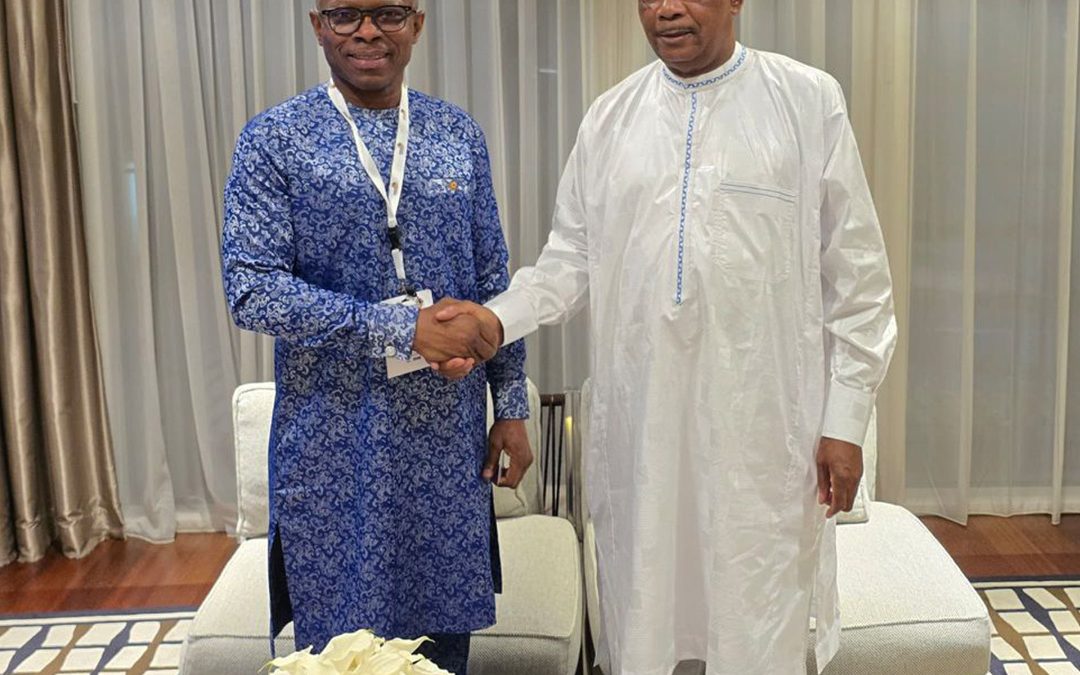
On the sidelines of the Biashara Afrika 2024 Forum, Mr. Anselme Vodounhessi, Coordinator of the Common African Agro-Parks #CAAPs Programme, held a high-level discussion with His Excellency Mahamadou Issoufou, Champion of the AfCFTA, on the development of #CAAPs zones in Africa within the AfCFTA framework.
During the meeting, His Excellency Issoufou underscored the significance of the #CAAPs programme in addressing Africa’s agricultural challenges, specifically pointing out that the continent spends over 70 billion euros annually on food imports. He reaffirmed his support for the #CAAPs agenda and committed to advancing it under the AfCFTA, recognizing it as crucial for Africa’s economic independence in the agro-industrial sector.
A key topic of discussion was the development of a #CAAPs Zone for Livestock in the Tri-Border Region of Burkina Faso, Niger, and Mali. His Excellency stressed the urgency of this initiative, given its potential to strengthen local economies, improve food security, and mitigate regional tensions.
His Excellency emphasized the need for ongoing collaboration to ensure the success of the #CAAPs initiative in unlocking Africa’s agricultural potential through the AfCFTA framework.
Accra, Oct. 3, GNA- The implementers of the Common African Agro-Parks (CAAPs) programme, aimed at reducing food imports and fostering innovation in Africa, have called for increased partnerships and investments to enhance agricultural transformation on the continent.
The CAAPs initiative, part of the African Union’s Agenda 2063, aims to help Africa reclaim the approximately $50 billion in annual food imports that are currently sourced from outside the continent.
During a presentation at the Development-Smart Innovation through Research in Agriculture (DeSIRA) CONNECT programme held in Accra, Mr. Anselme Vodounhessi, Coordinator for CAAPs, said that agro-parks would function as hubs for transformative technologies.
He explained that those technologies would support essential processes, ranging from precision farming to climate-smart agriculture, and enable Africa to increase productivity, minimize post-harvest losses, and enhance sustainability.
Mr Vodounhessi, who is also the Head of Monitoring and Evaluation at the Forum for Agricultural Research in Africa (FARA), said the initiative would also foster public-private partnerships that bring together governments, private investors, and international organisations to mobilise capital and expertise to scale-up innovations.
Projections from the United Nations Economic Commission for Africa (ECA) suggest that Africa’s annual food imports are set to rise dramatically, increasing from $15 billion in 2018 to $110 billion by 2025—seven times higher. Additionally, the current figure of $43 billion is expected to triple in that timeframe.
Mr Vodounhessi said it was time for Africa to “lead the future of agriculture.”
“By creating this fertile investment environment, the CAAPs are poised to attract billions of dollars in financing, driving agricultural growth and creating millions of jobs.
“With strong political support from the African Union and key stakeholders, the CAAPs initiative is not just about transforming agriculture—it’s about positioning Africa as a global leader in sustainable, innovation-driven agri-business,” he said.
The DeSIRA, which featured Western Africa, Central Africa, and Madagascar was organised by the European Commission through the DeSIRALIFT initiative and the FARA.
Participants shared lessons and outcomes from DeSIRA projects and discussed measures to scale up innovations in the agricultural sector.
The DeSIRA Initiative aims to promote innovation in agricultural and food systems to support sustainable transitions and improve resilience to climate change in Africa, Asia, and Latin America.
Through participatory research and multi-stakeholder engagement, DeSIRA projects drive innovation to enhance food security, nutrition, and livelihoods.
Abidjan, Côte d’Ivoire Côte d’Ivoire secures USD 28.7M investment to boost cashew processing industry from three foreign companies, marking a significant step toward boosting local processing capabilities.
The investment deals were finalized during the Cashew Sector Investment Forum, held by the CCA on September 23 in Abidjan.
TORQ Commodities, a UK-based commodity trader, committed USD 10 million to the project. In addition, a consortium formed by India’s Zantye Agro Industries and Austria’s Münzer agreed to invest USD 11.2 million, while Agricas Global, an agricultural commodities trader from the UAE, pledged USD 7.5 million.
These investments aim to support Côte d’Ivoire’s efforts to process more of its cashew nuts locally. “The added value we could achieve through local processing remains under-exploited,” said Kobenan Kouassi Adjoumani, the Minister of Agriculture.
He emphasized that only 21% of cashews produced in the country are currently processed locally, falling short of the government’s ambitious goal of processing 50% by 2030.
Côte d’Ivoire’s government has placed considerable emphasis on increasing the local processing of cashew nuts, a move seen as critical for job creation and economic growth.
According to the General Directorate of Customs, Ivorian exports of cashew nuts and almonds generated USD 1.3 billion in revenue in 2023. However, only USD 217 million of this amount came from processed cashew kernels.
Minister Adjoumani acknowledged the gap between production and processing, stressing the need for further investment to meet national targets. “Our processing rate in 2023 is still far from our goal. With more investment, we believe this will change over time.”
The global cashew market is dominated by processing giants like Vietnam and India. These countries benefit from advanced technology and lower production costs, making it harder for African producers to compete.
Despite these challenges, Côte d’Ivoire is positioning itself as a leader in African cashew processing, ranking third globally.
According to projections from the CCA, the country is expected to harvest 1 million tons of cashew nuts in 2024.
As Côte d’Ivoire continues to increase production, its government is working to enhance the local industry through both public and private partnerships.
This includes the promotion of policies aimed at attracting more foreign investment, improving local processing facilities, and ensuring the sector remains competitive.
The Food and Agriculture Organization of the United Nations (FAO) on Thursday reaffirmed its commitment to supporting Africa beyond 2025.
The Director-General was invited to participate in a G7 panel session with agriculture ministers in Syracuse, Italy, on how best to support Africa’s post-Malabo agenda. Agreed by African heads of state and government at the 2014 African Union Summit in Equatorial Guinea, the Malabo Agenda set out an ambitious list of concrete agricultural goals to be achieved by 2025.
“In 2023, more than one in five Africans were affected by hunger, amounting to nearly 300 million people,” said Qu and added that “without accelerated action and increased resource mobilization, it is projected that the number of people facing hunger in Africa will rise by an additional 10 million by 2030.” The continent remains the most food-insecure region in the world, with 58 percent of its population experiencing moderate or severe food insecurity.
“Success is possible,” Qu said, “but we need to all work together, across the continent and with all partners if we are to achieve the transformation of African agrifood systems to be more efficient, more inclusive, more resilient and more sustainable.”
Looking ahead, FAO remains committed to supporting the post-Malabo process, which highlights the necessity for a comprehensive transformation of the continent’s agrifood systems that effectively, efficiently, and coherently addresses food insecurity, poverty, and the impacts of the climate crisis.
FAO’s involvement in Africa
FAO has always supported the Malabo Process and the Comprehensive Africa Agriculture Development Programme. Since 2017, it has been collaborating with the African Union Commission to contribute to the Programme’s biennial reporting mechanism, providing capacity-building for monitoring the Malabo Declaration’s commitment to enhancing the resilience of livelihoods and production systems to the impacts of the climate crisis and other related risks.
This work has been carried out using FAO’s Resilience Index Measurement and Analysis through the provision of technical support to country experts, mapping national household data for all of Africa’s 54 countries, and conducting several training sessions. Recently, FAO has launched a digital toolkit designed to empower countries to generate the required indicators.
“I wish to reaffirm FAO’s continued focus and commitment to supporting Africa in achieving the post-Malabo agenda,” said the Director-General.
After January 2025, FAO’s existing data, tools, and approaches will support the design, implementation, and tracking of the post-Malabo agenda.
For example, FAO’s policy monitoring and public expenditure analysis will help governments track their commitments and optimize their policies. Furthermore, the FAO Global Roadmap to achieving SDG2 without breaching the 1.5°C threshold will ensure that the continent’s actions align with and benefit from the global agenda.
FAO’s support extends beyond providing knowledge and evidence to countries. It is also driving changes on the ground. For example, the FAO Flagship Hand-In-Hand Initiative supports 40 countries across the continent.
The Director-General said this year’s Hand-in-Hand Investment Forum, which is due to take place in mid-October at FAO’s headquarters in Rome under the umbrella of the World Food Forum 2024, will witness 13 African countries engage with investors to accelerate transformation through concrete projects.
The Board of Directors of the African Development Bank Group on 20 September 2024 approved a $129.71 million loan to Tanzania for the implementation of a youth-focused agribusiness program.
The loan will fund the first phase of the “Building a Better Tomorrow: Youth Initiatives for Agribusiness” program, which aims to create business opportunities and jobs for young people in key agricultural sectors.
The total cost of the project is estimated at $241.27 million. In addition to the Bank’s loan, which covers 53,76 percent of the cost, the funding package includes grants of $1.15 million from the Korea-Africa Economic Cooperation (KOAFEC) Trust Fund and $210,000 from tropical vegetable seed firm East-West Seed. The Tanzanian government will provide $110.41 million, representing 45.76 percent of the total.
Patricia Laverley, the Bank’s Country Manager for Tanzania, said: “This project is expected to incubate and empower approximately 11,000 ‘agripreneurs,’ including at least 6,000 young agribusiness owners.” She added that the program will facilitate access to finance for an additional 2,500 young people already involved in agribusiness but lacking access to commercial loans. We expect each agribusiness run by a young person will employ an average of five workers.”
The project will implement strategies to raise awareness and manage knowledge using youth-oriented information and communication technologies. It will also provide training and support for agrifood business incubation and acceleration, with a particular focus on the recruitment of female applicants.
Digital technologies, including satellite technology and artificial intelligence, will be utilized to improve agricultural productivity and decision-making processes for young farmer cooperatives.
As of 30 June 2024, the African Development Bank approved 25 projects in Tanzania, with a total commitment of $3.48 billion.
Sierra Leone is ramping up investments to position itself as a key player in the global food export market. Located near major cocoa-producing countries like Côte d’Ivoire and Ghana, and sharing a similar climate, Sierra Leone has strong potential to become a significant exporter of commodities such as cocoa, cashew, rice, and cassava.
However, the country faces several challenges. According to the World Food Programme, a staggering 82.3% of the population is food insecure. Additionally, due to inadequate processing infrastructure, Sierra Leone imports a large amount of rice to meet domestic demand.
To address these issues, the country recently secured $100 million in funding from the African Development Bank (AfDB), building on an existing $480 million in investments from OPEC and the Arab Bank for Economic Development in Africa (BADEA). This new investment is part of Sierra Leone’s ambitious strategy to overhaul its food system, reduce food insecurity, and ultimately become a major food exporter.
How Will the Funding Be Used?
The recent AfDB funding will contribute to Sierra Leone’s broader ‘Feed Salone’ initiative, which is a collaborative effort involving contributions from the government, NGOs, and private sector investors. The initiative is designed to transform the country’s food production system, focusing on both addressing food insecurity and enhancing its export potential.
According to Dr. Henry Musa Kpaka, Sierra Leone’s Minister for Agriculture and Food Security, the project is conservatively estimated at $1.8 billion in total. This comprehensive approach seeks to build essential infrastructure that can support the country’s agricultural ambitions and help alleviate its reliance on food imports.
How Will the Funding Reduce Food Insecurity?
Sierra Leone’s rice consumption per capita is one of the highest in the world, with an average of 131 kg per person per year. Although the country is currently 65-70% rice self-sufficient, the lack of adequate processing facilities forces it to rely heavily on imports to close the gap. In fact, about one-third of Sierra Leone’s food import bill is spent on rice alone.
Another challenge is that some of the country’s domestically produced rice is exported to neighboring countries like Guinea, Liberia, and Senegal. Some farmers even agree to sell their rice before it is harvested, making it harder for Sierra Leone to meet its own demand.
To become fully self-sufficient in rice production, Sierra Leone needs to develop agro-processing zones, build better roads for transportation, and establish access to energy and irrigation systems. Investments in these critical areas could significantly boost production. For instance, according to Dr. Kpaka, improved irrigation could double rice yields from two tons per hectare to four.
This funding and infrastructure development are pivotal steps toward Sierra Leone’s goal of addressing food insecurity, reducing its dependence on imports, and positioning itself as a key agricultural exporter in the region.
Source: Food Navigator | Photo Credit: Getty Images/WS Studio
__________
The Common African Agro-Parks Programme (CAAPs) is aimed at boosting regional trade for agricultural commodities by increasing locally processing of key agricultural products. The CAAPs will help Africa take over the African Food Import Market of about USD50 billion per annum that is currently outsourced to the rest of the world. Read more at https://faraafrica.org/caaps/