The President of the African Development Bank made a clarion call for the strengthening of research for development institutions on the continent. He affirmed with empirical data that the ‘Technology Delivery Platforms are working and that it is time to revamp FARA and to support the development of the agriculture value chains. These sentiments were passionately expressed in his keynote presentation to the 8th FARA General Assembly that was held on the 25th of November 2020.
According to the African Development Bank President, hunger is the greatest risk confronting Africa and in order to mitigate this risk, it is imperative to urgently combine our efforts on food security and recovery from the Covid pandemic. According to Dr. Akinwumi Adesina, the days of pilot work are over in Africa and it is time to work at scale and faster, to reach tens of millions of farmers with agricultural technologies and accelerated market access and financing to stimulate wealth generation.
The President of the African Development Bank Group (AfDB), Dr. Akinwumi Adesina delivered the keynote address on the theme, Institutions, Innovation, Impact. He commended FARA for braving the odds of the global pandemic to hold its General Assembly and highlighted the impact of COVID-19 on food and nutrition security on the continent and the efforts required to mitigate its effects.
“Africa today has some 250 million people who are malnourished…while collectively we must tackle the impact of COVID-19, hunger is the greatest risk facing Africa. Without good nutrition, medicines and vaccines just don’t work. Therefore, we must now urgently combine food security and recovery from the COVID-19 pandemic”
Dr. Adesina recapped the impressive results from the deployment of technologies to show that science, technology delivery platforms, and institutional partnerships for delivery can be leveraged to push Africa’s agriculture forward and called on all stakeholders to do more to significantly strengthen the institutions for research and development on the continent.
Re-emphasizing the AfDB’s commitment to supporting the agricultural research ecosystem on the continent, the AfDB President stated…
“It is time to revamp FARA and the ecosystems of research and development at the regional levels…African agricultural systems must become modern, integrated and well supported to achieve production and processing of food and agricultural products and farming inputs at scale…The African Development Bank will strongly support FARA, farmers’ organizations and the private sector to expand and sustain the success stories of Africa’s agriculture”.
Dr. Adesina concluded his keynote address by indicating that success at scale will depend on a stream of appropriate agricultural technologies, supported by institutional ecosystems that are innovative, as well as financing, that will drive greater competitiveness of Africa’s agricultural value chains.
“The mountain may be steep, the journey may be long, yet we will not be discouraged, for the distance we have covered, gives us hope. Let this hope drive enthusiasm and let the enthusiasm power us into the achievement of our vision. For only when Africa is fed, and we fully unlock the wealth of Africa’s agriculture; is our mission complete”, he said.
In her submission, The African Union Commission’s Commissioner for Rural Economy and Agriculture, Her Excellency Ambassador Josefa Sacko, said “Africa cannot put agricultural research development aside and still aim to transform agriculture and report good performance. It is a paradox!”.
Emphasizing the need to prioritize investment into agriculture science research for development in Africa, Ambassador Sacko cited examples from other continents which are reaping the benefits of investing in agricultural science research, to provide the latest cost-effective technologies to their farming populations.
“We can no longer wait for bailouts that are not forthcoming, to run African Agricultural Science, Technology and Innovation”.
Her Excellency Ambassador Josefa Sacko affirmed the commitment of the AU Commission to work with FARA, within its continental mandate, to strengthen the deployment of Research, Science and Technology towards the achievement of the 2025 CAADP Malabo targets of doubling productivity, halving post-harvest losses and strengthening resilience to climate and associated risks, such as locusts and COVID-19. She also reiterated the call to mobilize emergency domestic funding to support agricultural science research on the continent.
The 8th General Assembly of the Forum for Agricultural Research in Africa is a statutory triennial event that ended on Thursday, November 25, 2020, with a renewed call by the Forum and its collaborators to the leadership of the continent to urgently refocus investment in the area of agricultural research, technology and innovation to ensure food and nutrition security on the continent.
About FARA
The Forum for Agricultural Research in Africa (FARA) is the continental apex organisation for agricultural research and innovation in Africa. It is also the body mandated by the African Union Commission (AUC) and the African Union Development Agency (AUDA)-NEPAD to serve as their technical arm on agricultural research and innovation. FARA also facilitates the deployment of science, technology and innovation to accelerate the achievement of the continent’s agriculture and food security targets as set out in the Comprehensive Africa Agriculture Development Programme (CAADP) and the 2014 Malabo declaration on accelerated African agricultural growth and transformation. FARA works in close cooperation with the sub-regional agriculture research organisations (ASARECA, CCARDESA and CORAF) as well as the African Forum for Agricultural Advisory Services (AFAAS). Together, these organisations implement the CAADP XP4 programme which is co-funded by the European Commission and IFAD. This programme sets out to strengthen the collaborative capacities of these organisations in supporting countries to implement a science-led and climate-relevant transformation of their agricultural systems.
The Forum for Agricultural Research in Africa (FARA) calls for more engagement as the long-term EU-AU research and innovation partnership (LEAP) reaches its midpoint.
November 26, 2020, ACCRA, Ghana – Africa’s apex organization for coordinating and advocating for agricultural research and innovation has called on more African and European countries to prioritize investment in science, technology and innovation for agriculture on the continent.The Forum for Agricultural Research in Africa (FARA) updated partners on a joint initiative between the European Union and the African Union to promote sustainable agriculture during its General Assembly this week. FARA also called on the agricultural research for development sector on the continent to unite and implement a roadmap for food and nutrition security.
“The general objective of LEAP4FNSSA is to establish a sustainable platform for the efficient and coherent implementation of the AU-EU Research and Innovation Partnership,” said Yemi Akinbamijo, Executive Director of FARA.
“Agriculture is biology, and our agriculture is as good as our science. FARA drives the AU’s mandate to strengthen the application of science and technology to accelerate agricultural transformation in Africa and ensure equitable access to resources like the International Research Consortium. Meanwhile, it is vital that African partners play their part to help drive the agenda for improved food and nutrition security across the continent.”
The 8th FARA General Assembly included presentations from Dr Philippe Petithuguenin from the French research centre CIRAD, Dr. Shadrack Moephuli the President of South Africa’s Agricultural Research Council and Dr George Essegbey from the Science and Technology Policy Research Institute (CSIR-STEPRI) in Ghana. The Assembly called on African institutions to rally around FARA in its efforts to coordinate agricultural research for development on the continent.
“FARA holds an important mandate on the continent, which the LEAP4FNSSA can leverage for the establishment and operation of the International Research Consortium by Africa and Europe,” said Dr. Bouchaib Boulanouar, Partnerships Coordinator in Agriculture and Agro-industry at the African Development Bank and FARA Board Member. “The roles of FARA and sub-regional organisations in building the IRC partnership platform are crucial. Among others, they involve inviting partners and disseminating information among stakeholders. FARA will ensure the IRC composition is equitable to advocate for mutual interests of Africans and Europeans.”
Speaking at the high level plenary panel of the 16th Comprehensive Africa Agriculture Development Programme (CAADP) Partnership Platform, which preceded discussions on the LEAP4FNSSA, FARA’s Executive Director also updated the African Union Commission and other stakeholders on the organisation’s perspectives in mobilizing support to African countries to enable them achieve CAADP targets, with the EU-funded CAADP XP4 programme as case study.
Several international development partners such as the International Fund for Agricultural Development (IFAD), the Organisation of African, Caribbean and Pacific States (OACPS), the European Commission and the African Union Commission reiterated their support around the interventions that FARA is leading on the continent.
FARA has also recently acquired web-based survey instruments and training materials on Capacity Strengthening on Knowledge Management as legacy products of another joint institution, the Technical Centre for Agricultural and Rural Cooperation (CTA), which is winding down in December 2020. These will be used by African institutions to assess the state of institutional knowledge management and design appropriate responses to their needs.CTA was established under the Cotonou Agreement between the EU and Africa, Caribbean and Pacific (ACP) states to support smallholder agriculture.
“FARA appreciates the support received from CTA in sharing these intellectual assets so that we can continue the important work of fostering EU and African collaboration by ensuring they remain shared resources for a common vision,” added Dr. Akinbamijo.
“As neighbours and, increasingly, as trading partners, Europe and Africa have many shared interests and much to learn from one another as our food systems face the challenges of the future.”
As part of FARA’s ongoing support for sustainable food systems across Africa, the organisation will also host the virtual Biennial Africa Climate Smart Agriculture Stakeholders Conference on December 1-2, which will provide updates on the state of CSA initiatives and contributions of science to a food systems approach in Africa.
Ends
For more information or interview requests, contact:
The Forum for Agricultural Research in Africa (FARA) is the continental apex organisation for agricultural research and innovation in Africa. It is also the body mandated by the African Union Commission (AUC) and the African Union Development Agency (AUDA)-NEPAD to serve as their technical arm on agricultural research and innovation. FARA also facilitates the deployment of science, technology and innovation to accelerate the achievement of the continent’s agriculture and food security targets as set out in the Comprehensive Africa Agriculture Development Programme (CAADP) and the 2014 Malabo declaration on accelerated African agricultural growth and transformation. FARA works in close cooperation with the sub regional agriculture research organisations (ASARECA, CCARDESA and CORAF) as well as the Africa Forum for Agricultural Advisory Services (AFAAS). Together, these organisations implement the CAADP XP4 programme which is co-funded by the European Commission and IFAD. This programme sets out to strengthen the collaborative capacities of these organisations in supporting countries to implement a science-led and climate relevant transformation of their agricultural systems.
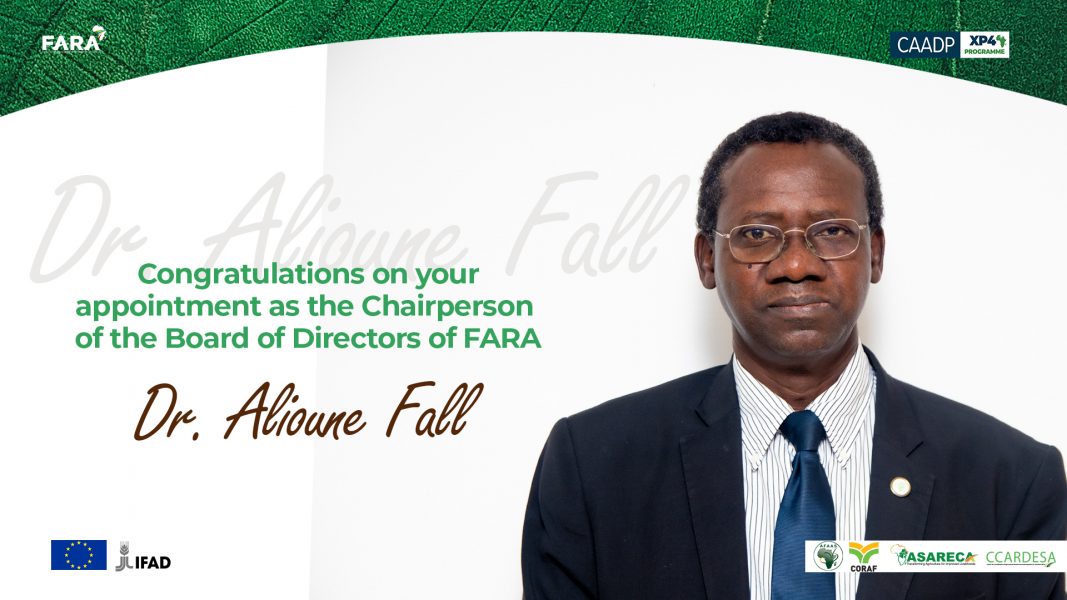
24/11/2020. ACCRA – The 8th General Assembly (GA) of the Forum for Agricultural Research in Africa (FARA), has confirmed Dr. Alioune Fall as the substantive Chairperson of the Forum for the next three years.
Dr. Alioune Fall who has been the Acting Chairperson of FARA since July 2019 brings over three decades of astute experience and knowledge in agricultural research for development on the African continent and other parts of the world. He is currently the Director-General of Senegal’s National Institute for Agricultural Research (ISRA). He holds a Master of Science (MSc) degree in Applied Physics from the Cheikh Anta Diop University in Senegal, another MSc degree in Agriculture from the Sam Houston State University, Texas, United States, and a Doctorate degree (PhD) in Agricultural Engineering from Michigan State University, United States.
With many national, continental and global recognitions in agriculture science, technology and innovation space, the new FARA Chairperson brings to this role a wealth of experience, knowledge and networks.
The GA also confirmed the appointment of the Board of Directors of FARA. Its membership includes, among others, the Executive Directors of the sub-regional agriculture research organizations, namely ASARECA, CCARDESA, CORAF and NAASRO who are ex-officio members.
About FARA
The Forum for Agricultural Research in Africa (FARA) is the apex continental organization responsible for coordinating and advocating for the increased and more impactful application of agricultural research-for-development (AR4D) in Africa. FARA is the designated technical arm of the African Union Commission and the African Union Development Agency on matters concerning agriculture science, technology and innovation.
FARA currently leads the EU-funded CAADP XP4 programme which is managed by the International Fund for Agriculture Development (IFAD), aimed at strengthening the capacities of the regional and sub-regional agriculture research and extension organizations (SROs) as well as National-Agriculture-Research-Systems (NARS), and by promoting collaboration and knowledge sharing among the organizations and relevant European institutions.
25/11/2020. ACCRA – La 8e Assemblée générale (AG) du Forum pour la recherche agricole en Afrique (FARA) a confirmé la nomination du Dr Alioune Fall au poste de Président du Forum pour un mandat de trois ans.
Dr Alioune Fall, qui était Président par intérim du FARA depuis juillet 2019, dispose de plus de trente ans d’expérience en recherche agricole pour le développement en Afrique et hors du continent. Il est actuellement Directeur général de l’Institut sénégalais de recherches agricoles (ISRA). Dr Fall est titulaire d’une maîtrise en physique appliquée de l’université Cheikh Anta Diop de Dakar-Sénégal, d’une seconde maîtrise ès science en agriculture de l’université d’État Sam Houston (Texas, États-Unis) et d’un Doctorat (PhD) en génie agricole de l’université d’État du Michigan (États-Unis).
Le nouveau Président du FARA, qui a reçu de nombreuses distinctions nationales, continentales et mondiales pour son travail dans le domaine de l’agronomie, de la technologie et de l’innovation, possède une vaste expérience et de solides connaissances. Il dispose également d’un large réseau de contacts.
L’Assemblée générale a également confirmé la nomination des administrateurs composant le Conseil d’administration du FARA. Le Conseil est composé notamment des Directeurs exécutifs des organisations sous-régionales de recherche agricole à savoir l’ASARECA, le CCARDESA, le CORAF et la NAASRO qui en sont des membres de droit.
À propos du FARA
Le Forum pour la recherche agricole en Afrique (FARA) est l’organisation faîtière chargée de coordonner et de promouvoir la recherche agricole pour le développement en Afrique. Le FARA est l’organe technique de la Commission de l’Union africaine et de l’Agence de développement de l’Union africaine pour les questions relatives à la recherche agricole, à la technologie et à l’innovation.
Le FARA dirige actuellement le programme PDDAA-XP4, géré par le Fonds international pour le développement agricole (FIDA), qui vise à renforcer les capacités des organisations sous-régionales de recherche et de vulgarisation agricoles (OSR) et des systèmes nationaux de recherche agricole (SNRA), ainsi qu’à favoriser la collaboration et l’échange de connaissances entre ces organisations et avec les institutions européennes concernées.
Pour en savoir plus, veuillez visiter : www.faraafrica.orgou entrez en contact avec :
Le programme de Bourse de recherche et d’innovation en agriculture pour l’Afrique (ARIFA), un projet phare du FARA, a été cité comme exemple de bonne pratique par le Bureau des Nations Unies pour la coopération Sud-Sud (UNOSSC). Dans une publication intitulée « Good Practices in South-South and Triangular Cooperation in the Context of Food Security (Bonnes pratiques en matière de coopération Sud-Sud et triangulaire pour la sécurité alimentaire) », le programme ARIFA figure parmi les plus de 40 bonnes pratiques agricoles relatives à la sécurité alimentaire considérées par l’UNOSSC comme illustrant les principes fondamentaux de la coopération Sud-Sud et triangulaire (CSST) qui permet de relever les défis de développement en apportant des résultats concrets.
Le lancement de la publication a eu lieu dans le cadre de l’édition 2020 du Forum Brésil-Afrique, accueillie par l’Institut Brésil Afrique (IBRAF), qui a attiré des participants venus du monde entier.
Le Directeur exécutif du FARA, Dr Yemi Akinbamijo, a remercié l’UNOSSC et l’IBRAF d’avoir reconnu les efforts déployés par le FARA dans le cadre du CSST. Dr Abdulrazak Ibrahim, Coordinateur de l’ARIFA au FARA, parlant au nom du Directeur exécutif a indiqué que le programme établissait de nouvelles règles de jeu pour le paysage de l’AR4D parce qu’il tirait parti du pouvoir de la science, de la technologie et de l’innovation dans les pays du Sud pour renforcer la capacité de l’Afrique à innover en utilisant l’approche multipartite adoptée pour les systèmes d’innovation. L’approche adoptée pour l’ARIFA aide les bénéficiaires à mettre en place des plateformes d’innovation dans leurs pays d’origine à la fin de leur formation. Le programme ARIFA qui est conçu pour permettre de remodeler la pédagogie et améliorer les moyens d’existence grâce à une formation fournie par des pays tels que le Brésil, la Chine, Cuba, l’Inde etc., vise à former au moins 5 000 praticiens de l’AR4D qui constitueront l’ADN du Programme détaillé pour le développement de l’agriculture africaine (PDDAA) en vue de relever les défis de l’alimentation et de la nutrition sur le continent au cours des dix prochaines années.
Cette reconnaissance permet au programme ARIFA de joindre la liste des bonnes pratiques en matière de CSST sur la Galaxie Sud-Sud de l’UNOSSC, un outil de gestion des connaissances accessible à l’échelle mondiale.
Le programme était à ses débuts en 2019 lorsque le FARA avait demandé de l’inclure dans la publication. Il a depuis lors évolué et a été couronné de succès notamment pour ce qui est du partenariat entre l’Université fédérale de Viçosa (UFV) et le Fonds d’affectation spéciale pour l’enseignement supérieur (TETFund) du Nigeria. Le partenariat FARA-UFV-TETFund apporte actuellement son appui à la formation d’au moins 120 Nigérians.
Selon l’UNOSSC, les bonnes pratiques recensées dans l’édition de cette année sont également pertinentes dans la crise sanitaire globale sans précédent déclenchée par la pandémie de COVID-19. En ce qui concerne le programme ARIFA, la création de centres virtuels de formation et d’innovation (VTrain Hub en anglais), où les candidats reçoivent une formation virtuelle, représente une excellente solution qui peut être appliquée à grande échelle sur tout le continent.
Pour plus d’informations sur le programme ARIFA, veuillez contacter : Dr Abdulrazak Ibrahim [email protected]