Cette année, la Journée internationale des femmes se tient dans un contexte sans précédent. Le continent, plus précisément le secteur agricole, commence à se remettre lentement de la pandémie de COVID-19. Cette situation offre une occasion de « reconstruire en mieux ». Toutefois, cela exige également des mesures pratiques immédiates qui permettent de relever les problèmes systémiques qui empêchent une pleine participation des femmes à la recherche agricole pour le développement (RAD).
Les femmes dans la recherche agricole pour le développement en Afrique font face à de nombreux obstacles dont une discrimination systémique dans l’accès à la terre, la charge des travaux non rénumérés et des salaires inférieurs à ceux de leurs homologues masculins[1]. Les femmes sont souvent exclues des postes à responsabilité à tous les niveaux. Le FARA demande instamment que soient reconnues toutes les femmes leaders de la RAD africaine ainsi que les femmes qui jouent un rôle important dans la transformation du système alimentaire africain.
Les femmes sont responsables de 60 à 80 pour cent[2] de la production alimentaire mondiale. Par conséquent, donner aux femmes la possibilité d’accroître la durabilité des systèmes alimentaires augmentent les chances de réussite d’une telle transformation. Le FARA reconnaît le rôle joué par les femmes et continue d’exhorter les partenaires régionaux, sous-régionaux, nationaux et mondiaux à accroître les investissements dans des approches intelligentes en matière de genre en vue de faire avancer la science, la technologie et l’innovation dans la RAD africaine. Le FARA plaide également en faveur d’une plus grande égalité des sexes au niveau des politiques et des stratégies à travers la position commune africaine pour le Sommet des Nations Unies sur les systèmes alimentaires (2021) et le Projet d’appui aux organisations régionales et sous-régionales africaines pour la recherche et l’innovation agricoles anciennement en charge du pilier IV du Programme détaillé de développement de l’agriculture africaine (CAADP-XP4).
Le FARA fait également la promotion de l’égalité entre les sexes dans le cadre du Compact catalyseur pour le Renforcement des capacités et la diffusion des technologies (CDTO) du programme Technologies pour la transformation de l’agriculture en Afrique (TAAT) de l’initiative « Nourrir l’Afrique » de la Banque africaine de développement (BAD). Il faut notamment adopter une approche holistique en vue de surmonter les défis et favoriser l’émancipation économique des femmes. Bien que les interventions mettent en général l’accent sur l’impact ou les résultats, le FARA plaide en faveur de pratiques qui permettent d’examiner les liens entre l’intervention et le résultat. Ces approches ont été appliquées dans le cadre du CDTO du TAAT.
Le Rapport sur le développement humain en Afrique 2016 indique que les disparités entre les genres coûtent quelque 95 milliards de dollars US par an en moyenne à l’Afrique subsaharienne[3]. Investir dans des approches intelligentes en matière de genre pourrait donc déboucher sur des avantages économiques. En outre, selon l’Institut mondial McKinsey 12 à 28 trillions USD[4] pourraient être injectés dans l’économie mondiale si la parité hommes femmes en matière de résultats économiques est atteinte. Par conséquent, les femmes leaders sont un catalyseur essentiel du changement étant donné qu’elles contribuent à autonomiser d’autres femmes, à sensibiliser et à servir de modèles.
Au moment où le FARA célèbre la Journée internationale des femmes, nous reconnaissons la contribution vitale des femmes à l’économie agricole de l’Afrique. Nous nous réjouissons également à la perspective de réaliser des plans d’action conjoints en vue d’accroître la participation des femmes à la recherche agricole pour le développement. La Journée internationale des femmes de cette année est l’occasion d’exhorter les partenaires à s’élever contre les obstacles systémiques et institutionnels qui empêchent les femmes de participer pleinement à la science et à l’innovation technologique en vue de l’amélioration du système alimentaire du continent.
[1] “Encadré 1 : Progress towards Gender Equality in Wages, Where Do We Stand?,” Global Gender Gap Report 2020 (blog), accessed March 8, 2021, https://wef.ch/2rPU0C7. (Encadré 1 : Progrès accomplis en matière de rémunération hommes-femmes, où en sommes-nous ? Rapport 2020 du Forum économique mondial sur l’inégalité hommes-femmes, (blog), consulté le 8 mars 2021,)
[2] “What’s the Truth about the Role of Women in Agriculture Today?,” Water, Land and Ecosystems, February 28, 2018, https://wle.cgiar.org/thrive/big-questions/what-truth-about-role-women-agriculture-today.(Quelle est la vérité sur le rôle des femmes dans l’agriculture aujourd’hui ?, Eau, terres et écosystèmes, 28 février 2018)
[3] C. Leigh Anderson et al., “Economic Benefits of Empowering Women in Agriculture: Assumptions and Evidence,” The Journal of Development Studies 57, no. 2 (February 1, 2021): 193–208, https://doi.org/10.1080/00220388.2020.1769071. (Les avantages économiques de l’autonomisation des femmes dans l’agriculture : hypothèses et preuves, la revue des études du développement)
This year’s International Women’s Day is celebrated in such unprecedented times. As the continent and, more specifically, the agricultural community start to recover from the COVID-19 pandemic slowly, it presents an opportunity to build back better. However, to do that requires immediate, practical actions that choose to challenge the systemic issues that have prevented the full participation of women in Agricultural Research for Development (AR4D).
Women in Africa’s AR4D face multiple challenges, including systemic discrimination in accessing land, the burden of unpaid work, and lower wages compared to their male counterparts[1]. Women are also often excluded from leadership and decision-making positions at all levels. As such, on this year’s international women’s day, FARA urges the recognition of all women leaders in Africa’s AR4D and the women who play a significant role in the transformation of Africa’s food system.
Women produce 60-80 percent[2] of the world’s food; therefore, ensuring that women have opportunities to make food systems more sustainable increases the chances that such a transformation will succeed. Acknowledging women’s role, FARA continues to lobby regional, sub-regional, national, and global partners to increase investment in gender-smart approaches for advancing Science Technology and Innovations within Africa’s AR4D. FARA also advocates for increased gender equity at the policy and strategic level through the 2021 United Nations Food Systems Summit (UNFSS) “One Africa Voice dialogue” and CAADP Ex Pillar 4 program.
FARA is also advancing gender equity through AfDB’s Feed Africa’s strategy under the program: Technologies for African Agricultural Transformation (TAAT) Capacity Development and Outreach (CDTO) enabler compact. Notably, a holistic approach must be adopted to overcome challenges and improve women’s economic empowerment. While interventions would typically focus on impacts or outcomes, FARA advocates for practices that review the pathways between intervention and outcome. As such, these approaches have been applied in the TAAT CDTO framework.
Given that the 2016 Africa Human Development Report suggests that gender inequality costs Sub-Saharan Africa approximately 95 USD billion per year[3], investing in gender-smart approaches to agribusiness might lead to economic benefits. This is also observed by McKinsey Global Institute that 12-28 USD trillion[4] could be added to the global economy if women achieved parity with men in economic outcomes. Therefore, women leaders are an essential catalyst for change, as they serve to empower other women, raise awareness, and act as role models.
As FARA celebrates this year’s International Women’s Day, we recognize the vital contribution of women in Africa’s agricultural economy and look forward to carrying out joint action plans in increasing the participation of women in AR4D. This year’s International Women’s Day presents an opportunity to lobby partners towards challenging the systemic and institutional barriers that have prevented women from fully participating in Science, Technology and Innovations to enhance the continent’s food system.
[1] “Box 1: Progress towards Gender Equality in Wages, Where Do We Stand?,” Global Gender Gap Report 2020 (blog), accessed March 8, 2021, https://wef.ch/2rPU0C7.
[2] “What’s the Truth about the Role of Women in Agriculture Today?,” Water, Land and Ecosystems, February 28, 2018, https://wle.cgiar.org/thrive/big-questions/what-truth-about-role-women-agriculture-today.
[3] C. Leigh Anderson et al., “Economic Benefits of Empowering Women in Agriculture: Assumptions and Evidence,” The Journal of Development Studies 57, no. 2 (February 1, 2021): 193–208, https://doi.org/10.1080/00220388.2020.1769071.
Le premier forum « Une planète, la santé des sols et des racines »
Un nouvel événement annuel examine l’importance de la santé des racines et des sols pour la sécurité alimentaire, les moyens de subsistance et la résilience face aux changements climatiques et marque le lancement d’une communauté d’action pour la santé des racines et des sols
Le premier forum « Une planète, la santé des sols et des racines » a eu lieu le 1er mars. Plus de 800 personnes y ont participé pour discuter de la manière de libérer le potentiel d’une meilleure santé des sols et des racines en vue de contribuer à la transformation des systèmes alimentaires. Le forum a rassemblé des experts du secteur de l’agriculture, des organisations internationales, des ONG, des universités et les secteurs public et privé. Ils ont conjointement appelé à mettre en œuvre une action collective dans le domaine de la science et de la technologie ciblant les premiers stades de croissance des plantes. Cette année, l’accent a été mis sur le continent africain qui possède environ 60% des terres arables non cultivées du monde.
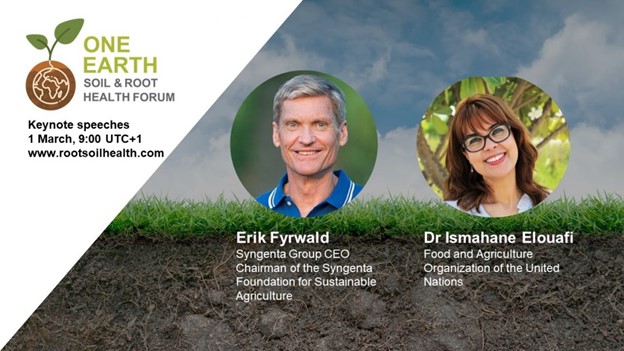
Les sessions parallèles qui étaient axées sur la Turquie, le Moyen-Orient, l’Afrique subsaharienne et l’Afrique du Sud ont permis de mener des discussions dans les langues régionales. Les orateurs principaux de la plénière étaient M. Erik Fyrwald (PDG du groupe Syngenta et président de la Fondation Syngenta pour l’agriculture durable) et Dr Ismahane Elouafi (Scientifique en chef de l’Organisation des Nations Unies pour l’alimentation et l’agriculture).
Erik Fyrwald a souligné que « tout commence avec le sol ». Il s’agit de la base des pratiques agricoles productives. Avec un sol sain, l’on peut avoir des plantes saines, des personnes saines et une planète saine. En agissant sur la santé des sols grâce à des pratiques agricoles régénératrices, nous agissons sur le changement climatique, la perte de la biodiversité et la sécurité alimentaire, et nous améliorons également les moyens de subsistance des agriculteurs. Le forum « Une planète, la santé des sols et des racines » permet à la communauté internationale de progresser vers la réalisation de ces objectifs ».
Dr Ismahane Elouafi a fait observer que « des sols sains représentaient le fondement de l’agriculture car ils fournissent 95% de notre nourriture. Les sols fournissent également du carburant, des fibres et des produits médicaux, et jouent un rôle clé dans le cycle du carbone, en stockant et en filtrant l’eau, et en améliorant la résilience aux inondations et aux sécheresses. »
S’exprimant au cours de la table ronde d’ouverture, Dr Michael Misiko, Directeur de l’agriculture de la région Afrique de The Nature Conservancy, a fait observer que « le changement climatique était indissociable de la vie et de la santé de nos sols et des racines qui doivent y prospérer ». Dr Abdelfattah Dababat (chercheur principal et représentant de la Turquie au CIMMYT) a souligné l’importance des actions de sensibilisation et a en outre précisé que les cultivateurs ne reconnaissent pas que la santé des sols et des racines peut constituer un problème.
La plupart d’entre eux ne sont pas conscients de la pourriture des racines et des problèmes de santé des sols dans leurs champs qui affectent leur rendement. C’est pourquoi l’expression « ennemi caché » s’applique parfaitement. La gestion de la santé des racines et des sols fait défaut et ces pertes de rendement sont tout simplement acceptées.
Les intervenants ont également mis en évidence le lien entre la santé des sols et des racines et la productivité économique à long terme et le bien-être des sociétés. Parmi les autres points soulevés figuraient les technologies permettant de mesurer la santé des sols et leur rôle dans la prise de décisions éclairées par les agriculteurs et les scientifiques. L’importance de donner de plus grands moyens d’action aux petits exploitants agricoles afin de leur permettre d’avoir accès aux technologies modernes a été soulignée tout comme la nécessité d’une collaboration entre les secteurs public et privé pour y parvenir.
Les orateurs invités à la table ronde d’ouverture étaient Dr Michael Misiko (Directeur de l’agriculture de la région Afrique, TNC), M. Mandla Nkomo (Directeur général pour l’Afrique australe, Solidaridad), Pr Richard Sikora (ancien chef du département de nématologie dans les écosystèmes des sols, Université de Bonn) et Dr Steve Maund (chef du service recherche et développement de Syngenta).
La table ronde était animée par Mme Redi Tlhabi (membre du corps de presse des Nations Unies, auteure et animatrice primée).
Les intervenants à la table ronde de clôture étaient Dr Abdelfattah A. Dababat (chercheur principal, représentant de la Turquie au CIMMYT), Dr Debisi Araba (Directeur général du Forum sur la révolution verte en Afrique), Dr Yemi Akinbamijo (Directeur exécutif du Forum pour la recherche agricole en Afrique), Dr Azariah Soi (Président de l’Association africaine du commerce des semences) et Dr Luc Henry (Responsable AME du programme Seedcare de Syngenta). La table ronde était animée par Mme Neva Sadikoglu-Novaky (Responsable du développement durable des entreprises, Syngenta).
Les séances parallèles portaient sur ce qui suit :
i) des solutions aux maladies transmises par le sol en vue de protéger et d’améliorer la santé des racines, ii)le soutien aux petits agriculteurs afin d’améliorer la santé et la fertilité de leurs sols et les possibilités de mobiliser les secteurs public et privé, iii) les techniques sans labour et le traitement des semences pour la santé des sols et des racines et iv) l’état des pressions exercées par les nématodes et ravageurs du sol. L’impact négatif du labour traditionnel comprend l’érosion du sol et les émissions de carbone. L’importance des techniques sans labour a donc été analysée.
La santé sous les pieds : pourquoi les racines et le sol sont importants
Environ 95% des aliments que nous consommons poussent de la terre.
Cependant plus d’un tiers des sols du monde sont dégradés. En l’absence de mesures rapides, ce chiffre pourrait atteindre 90% d’ici 2050. L’érosion du sol réduit le volume d’eau, la quantité de nutriments et l’espace racinaire dont disposent les plantes. Des racines saines permettent de de mieux tirer profit des nutriments et de l’eau. Elles permettent également d’obtenir davantage de pousses et de feuilles à partir de chaque graine. Par conséquent les agriculteurs produisent plus de nourriture et les sols stockent davantage de carbone. La santé des sols et des racines contribue à atténuer les effets du changement climatique. Les sols contiennent plus de carbone que l’atmosphère et la végétation réunies. Selon des études, les sols contiennent 2 500 milliards de tonnes de carbone contre 800 milliards de tonnes dans l’atmosphère et 560 milliards de tonnes dans la faune et la flore. Des sols sains ont une plus grande capacité de stockage du carbone. Des plantes saines ayant de bonnes racines stockent davantage de carbone.
Le Forum était organisé par Agventure, l’Association pour le renforcement de la recherche agricole en Afrique de l’Est et du Centre (ASARECA), l’Association africaine du commerce des semences (AFSTA), le Forum pour la recherche agricole en Afrique (FARA), le Centre international d’amélioration du maïs et du blé (CIMMYT), Rizobacter, Seed Co Limited, Syngenta Seedcare, la Fondation Syngenta pour une agriculture durable et The Nature Conservancy (TNC).
A new annual event examines root and soil health’s importance for food security, livelihoods and climate resilience and marks the launch of a community for root and soil health action.
The first One Earth Root and Soil Health Forum took place on March 1. Over 800 people attended to discuss how to
unlock the potential of better soil and root health to help transform food systems. The Forum brought together
experts from farming, international organizations, NGOs, academia and the public and private sectors. Together they
called for collective action in science and technology targeting the early stages of plant growth.
The main emphasis this year was on Africa, which has around 60% of the world’s uncultivated arable land.
However, parallel workshops focusing on Turkey, the Middle East, Sub-Saharan Africa and South Africa enabled tailored
discussions in regional languages. Plenary keynote speakers were Erik Fyrwald (Syngenta Group CEO and Chairman
of the Syngenta Foundation for Sustainable Agriculture) and Dr. Ismahane Elouafi (Chief Scientist at the UN Food and
Agriculture Organization).
Erik Fyrwald underlined that “everything starts with soil. It is the foundation of productive farming practices – with
healthy soil, you can have healthy plants, healthy people and a healthy planet. By acting on soil health through
regenerative agriculture practices, we are acting on climate change, biodiversity loss and food security, as well as
improving farmer livelihoods. The One Earth Soil and Root Health Forum helps an international community shift
towards achieving this – together.”
Dr Ismahane Elouafi noted that “healthy soils are the foundation for agriculture, as they provide 95% of our food.
Soils also provide fuel, fiberand medical products, and play a key role in the carbon cycle, storing and filtering water,
and improving resilience to floods and droughts.”
Speaking on the opening panel, Michael Misiko, Africa Agriculture Director of The Nature Conservancy, noted that
“climate change is inseparable from the life and health of our soils and the roots that must thrive within them.”
Underlining the importance of awareness raising action, Dr. Abdelfattah Dababat (Senior Scientist, Country
Representative for Turkey, CIMMYT) underlined that “growers basically do not recognize soil/root health to be a
problem.
Most of them are not aware of the root rot diseases and soil health issues in their fields, affecting their
yield. This is why the term “hidden enemy” applies perfectly. Root and soil health management is therefore, not
practiced and those yield losses are simply accepted.”
Speakers also underlined the link between soil and root health and the long-term economic productivity and the
welfare of societies. Other points raised included technologies measuring soil health and their role in enabling
informed decision-making by farmers and scientists. The importance of empowering smallholders and enabling
access to modern technologies was also underlined as was the importance of public-private sector collaboration in
achieving this.
Speakers in the opening panel were Dr. Michael Misiko (Africa Agriculture Director, TNC), Mandla Nkomo (Managing
Director for Southern Africa, Solidaridad), Prof Richard Sikora (Former Head Soil-Ecosystem Phytopathology,
University of Bonn) and Steve Maund (Head CP R&D Sustainability, Syngenta).
The panel was moderated by Redi Tlhabi (member of the UN Global Journalists Corps, author and award-winning broadcaster).
Speakers in the concluding panel were Dr. Abdelfattah A. Dababat (Senior Scientist, Country Representative for
Turkey, CIMMYT), Debisi Araba (Managing Director, African Green Revolution Forum), Yemi Akinbamijo (Executive
Director, Forum for Agricultural Research in Africa), Azariah Soi, (President, African Seed Trade Association) and Luc
Henry (Seedcare Head AME, Syngenta). The panel was moderated by Neva Sadikoglu-Novaky (Business Sustainability
Lead at Syngenta).
The different parallel sessions covered
i) solutions for soil borne diseases in protecting and enhancing root health, ii)supporting smallholder farmers to improve the health and fertility of their soils and the opportunities for public
and private sectors to engage, iii) no tillage technologies and seed treatment for soil and root health and iv) the state
of nematode soil pest pressures. The negative impact of conventional tillage systems include soil erosion and carbon
emissions. The importance therefore of no tillage technologies was analysed.
Health underfoot: why roots and soil are important Around 95% of the food we eat grows in the earth.
However, more than one-third of the world’s soils are degraded; without rapid action, this figure could rise to 90% by 2050. Soil erosion decreasesthe water, nutrients and root-space available to plants. Healthy roots enable better use of nutrients and water. They help produce more shoots and leaves from each seed, enabling farmers to produce more food and soil to capture more carbon. Healthy roots also help tackle soil erosion. Soil and root health help mitigate climate change. More carbon already resides in soil than in the atmosphere and all plant life combined. Studies show that there are 2,500 billion tons of carbon in soil, compared with 800 billion tons in the atmosphere and 560 billion tons in plant and animal life. Healthier soil can store even more. Healthy plants with good roots capture further carbon from the atmosphere.
The Forum was organized by Agventure, Association for Strengthening Agricultural Research in Eastern and Central Africa
(ASARECA), African Seed Trade Association (AFSTA), Forum for Agricultural Research in Africa (FARA), International Maize and
Wheat Improvement Center (CIMMYT), Rizobacter, Seed Co Limited, Syngenta Seedcare, the Syngenta Foundation for Sustainable
Agriculture, Solidaridad and The Nature Conservancy (TNC).
Africa’s youth need investment, not ’empowerment’, to realise the continent’s potential and support food security, says the head of the African Development Bank
By Megan Rowling
BARCELONA, Jan 29 (Thomson Reuters Foundation) – The African Development Bank plans to deploy billions of dollars to help young people build a new digitally-driven model of agriculture that can feed the continent’s people and boost prosperity even as the planet heats up, its president said.
At a global summit this week, the bank and the Global Center on Adaptation announced an initiative to strengthen African efforts to become more resilient to extreme weather and rising seas, threats worsened by fast-accelerating climate change.
The African Development Bank plans to put half of its climate finance towards the initiative – $12.5 billion between now and 2025 – and raise an equal amount from donor governments, the private sector and international climate funds.
Akinwumi Adesina, a former Nigerian agriculture minister who leads the bank, told the Thomson Reuters Foundation that Africa is struggling on two fronts – with the economic and health fallout from the COVID-19 pandemic, as well as climate shocks.
Drought, floods, creeping deserts and climate-fuelled locust attacks are forcing down crop yields and driving up hunger and migration on the continent, he said.
“It’s a double disaster,” the bow-tie-wearing official said in a video interview. “We’ve got to change this and give Africa what it needs to be able to adapt well to climate change.”
Patrick Verkooijen, CEO of the Netherlands-based Global Center on Adaptation, which has a regional office in Abidjan, said Africa was the continent most vulnerable to climate change, despite producing only 5% of global planet-heating emissions.
The new programme is an opportunity “to put adaptation on steroids”, by focusing on improved food production, climate-resilient infrastructure, youth entrepreneurship and better access to finance, he said in an online interview.
African countries are putting more of their financial resources towards adapting to climate change, he noted, even as their budgets are stretched by the pandemic.
“But there is still a massive gap. That gap needs to be filled, and it needs to be filled urgently,” he added.
David Kayi, a Hello Tractor engineer, explains how the Hello Tractor mobile phone application works to Pascal Kaumbutho of Agrichem Africa, at a hay farm in Umande village in Nanyuki, Kenya February 4, 2020. REUTERS/Njeri Mwangi
INVESTMENT NOT ‘EMPOWERMENT’
Two goals of the new Africa Adaptation Acceleration Program are increasing farmers’ access to digital services to help them cope with erratic weather and providing finance to young entrepreneurs to set up agricultural businesses, Adesina said.
The bank plans to use its capital to leverage $3 billion more to support about 10,000 new youth-led companies in areas such as food logistics, distribution and green technology, and to educate 1 million young people on adaptation, its chief said.
It will reduce the risks for commercial banks to lend to young people and provide youths with training and skills to become so-called “agripreneurs”.
Adesina, a winner of the World Food Prize, said the number of African youth – now about 250 million – would exceed 840 million by 2050, and they needed to be part of the solution to climate change, even though it was a problem they did not cause.
“What we do with them today will determine the future of Africa,” he said.
Creating more green jobs was a must to prevent many leaving the continent to seek a better life elsewhere, he added.
“I don’t buy (youth) ’empowerment’ language… what we need is youth investment,” he said.
The adaptation programme plans to mobilise $2 billion to expand climate-smart technology to improve agriculture and food security, including access to digital services, which are only available to about 13% of African farmers today, Adesina noted.
Climate advisory services will be provided to 300 million farmers by 2030 under the programme.
Expanding insurance coverage for crops and livestock, to protect farmers from climate disasters, will be key, as well as improving weather forecasts and financial services provided on smartphones and other digital devices, he said.
The bank is already getting drought- and heat-tolerant varieties of crops such as maize and wheat to farmers in east and southern Africa, boosting yields, and testing more ecological ways of farming, such as zero-tillage, in places like Ghana.
It has also pledged to raise $6.5 billion to drive forward Africa’s Great Green Wall project to plant and restore trees, grassland and vegetation on the Sahara’s southern edge to keep the desert at bay and help farmers stay on their land.
Adesina said the new programme aims to expand tried-and-tested ways of helping Africans adapt to climate change.
“We know what works – we are just all tired of small-scale stuff. We want to do big things,” he said.
African agriculture needs to become more competitive, efficient and dynamic to feed a growing population and turn farming into a thriving business instead of a “way of life”, he added.
The size of Africa’s food and agriculture market is expected to exceed $1 trillion by 2030, which would represent a tripling in two decades, offering far bigger business opportunities than investing in outdated forms of dirty energy, he noted.
“Anybody going to get rich in Africa is not going to get rich out of oil and gas – they are going to get rich out of agriculture,” he said.
(Reporting by Megan Rowling @meganrowling; editing by Laurie Goering. Please credit the Thomson Reuters Foundation, the charitable arm of Thomson Reuters, that covers the lives of people around the world who struggle to live freely or fairly. Visit http://news.trust.org/climate)