Africa possess a wide range of indigenous vegetables with huge nutrients to meet the need of its inhabitants. Jute mallow is an important shrub with loads of minerals and vitamins. It is eaten as vegetable soup. The centre of origin of this important vegetable is between Africa and Asia., although the largest variation in species is found in Africa.
Jute mallow grows very well across different agroecologies in Africa, it thrives very well under marginal conditions of nutrients and moisture. This vegetable contains high nutrient value as one cup of 87g could provide 32 calories. If you contrast the nutrient in jute mallow with the major exotic leafy vegetable such as cabbage (Brassica spp) and lettuce (Lactuca sativa) you will realize that the nutritional value of jute mallow is richer and higher.
Africa stand to gain higher and better nutritional advantages from our indigenous foods. All efforts should be on deck to improve these commodities and ensure their prominence in our food system.
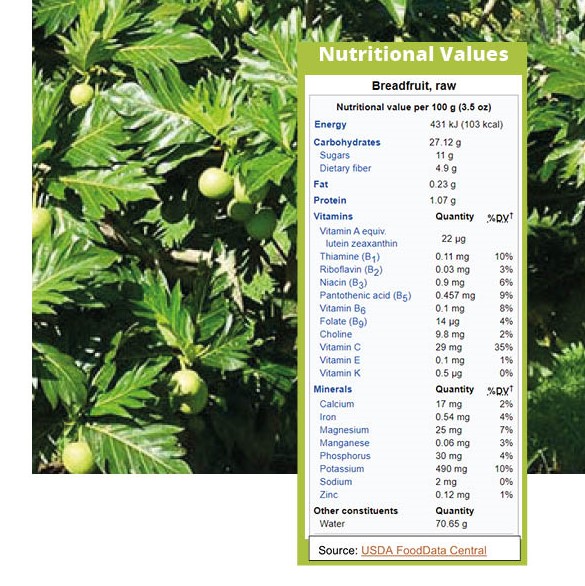
Source: USDA FoodData Central, 2019.
The continental discussion to develop the “Africa Manifesto on Forgotten food is ongoing.
The breadfruit is an amazing food commodity; it should rather be called a “loaf of nutrients”, it contains huge amounts of vitamin, mineral and other essential elements. At last! it now falls within the forgotten food commodities. Bread fruit originates from New guinea and the Philippines; but it grows very well in most tropical areas of the world and thrives in wet ecologies of Africa.
The consumption is now limited, largely within the farming families as occasional snacks, hence its cultivation in little to no-existent and now serves as volunteer trees on farms. Research effort on the breadfruit is also very minimal leaving it in its very rudimentary state of development.
Improving this commodity has the potential to contribute to food and nutritional security in Africa.
The re-awakening of the potentials in forgotten foods as part of the global efforts of fostering sustainable food and nutritional security, gives the opportunity to develop a rich commodity like breadfruit to attains a prominent role in the food system.
The continental discussion to develop the “Africa Manifesto on Forgotten food is ongoing.
Malgré les progrès réalisés de façon continue en matière de développement économique dans de nombreux pays africains, la faim est en augmentation et touche quelque 246 millions de personnes. La pandémie de Covid-19 a mis en lumière les failles des systèmes alimentaires du continent, déjà mis à mal par le changement climatique, les conflits et les parasites. Il est urgent d’accroître les investissements et d’élargir les partenariats pour promouvoir la transformation de l’agriculture africaine par la technologie et l’innovation.
La Banque africaine de développement et le Fonds international de développement agricole (FIDA), en partenariat avec le Forum pour la recherche agricole en Afrique (FARA) et le CGIAR, coorganiseront un dialogue de haut niveau intitulé « Nourrir l’Afrique : leadership pour intensifier les innovations réussies ».
Le forum, organisé en visioconférence, réunira des chefs d’État africains, des hauts fonctionnaires, des dirigeants de banques multilatérales de développement, des partenaires au développement, des instituts de recherche, des chefs d’entreprise, des opérateurs du secteur privé, des agences d’investissement, des universitaires, des organisations de la société civile et des experts internationaux.
Les objectifs spécifiques de l’événement sont les suivants :
Obtenir des engagements politiques au plus haut niveau des dirigeants pour reproduire les réussites en Afrique ;
Présenter des histoires d’impact pour sécuriser les ressources et reproduire des exemples de réussite à travers le continent ;
Démontrer ce qui fonctionne dans la recherche agricole régionale pour le développement et ce qui doit être fait pour soutenir les investissements;
Parvenir à une vision commune pour mobiliser les investissements afin de produire des technologies et des innovations qui transforment les systèmes alimentaires africains.
Ce dialogue de haut niveau “Nourrir l’Afrique” se conclura par un communiqué qui contribuera à la réunion préparatoire du Sommet sur les systèmes alimentaires prévu à Rome en juillet 2021, et au Sommet des Nations unies sur les systèmes alimentaires qui aura lieu plus tard dans l’année.
Participez à la conversation : #FoodSystems #FeedAfrica
Despite positive and ongoing gains in economic development in many African countries, hunger is on the rise, impacting some 246 million people. The Covid-19 pandemic has shone a spotlight on the cracks in the continent’s food systems, already under strain from climate change, conflict and pests. Increased investments and expanded partnerships are urgently needed to promote Africa’s agricultural transformation through technology and innovation.
The online forum will bring together African heads of state, senior government officials, heads of multilateral development banks, development partners, regional organizations, research institutions, business leaders, private sector operators, investment agencies, academia, civil society organizations and experts from across Africa and beyond.
The event will:
Secure political commitments at the highest level of leadership to replicate success across the continent;
Showcase impactful stories to secure resources and replicate in priority commodities across the continent;
Demonstrate what is working in regional agricultural research for development, and what needs to be done to sustain investments;
Arrive at a shared vision for mobilizing investments to produce technology and innovation that transform African food systems.
The Feeding Africa high-level dialogue will conclude with a communiqué that will contribute to the pre-Food Systems Summit in Rome in July 2021, and the United Nations Food Systems Summit later in the year.
Engagement of a Consultant to train Country Stakeholders on Resource Mobilization and management in conjunction with International Experts
Name of project:
CAADP-XP4
Activity Ref No:
CAADP-XP4 Output 2/ Activity 2.2.1 / 2021
Procurement Ref:
FARA/CAADP-XP4/CS/IC/2021/01
Date:
Monday, April 19, 2021
The Science for African Agriculture (S4AC) Consortium comprising AFAAS, ASARECA, CCARDESA, CORAF and FARA, has secured resources from the EU under the Development Smart Innovation through Research in Agriculture (DeSIRA) initiative to implement a 4-year project in Africa. The overall budget available to the S4AC consortium under this project is €30 million. This project, called CAADP Ex-Pillar 4 Africa Regional and Sub-regional Organizations for Agricultural Research and Innovation (CAADP-XP4) project will link research and innovation with development initiatives to boost the transformation of innovation in agriculture and food systems to make them more resilient to climate change and better responsive to development demands. Its objective is to enable agricultural research and innovation, including extension services, to contribute effectively to food and nutrition security, economic development, and climate mitigation in Africa.
The overall objective of the CAADP-XP4 is to increase the contribution of Africa’s regional and country level agriculture and food innovation systems towards achievement of climate relevant and sustainable transformation of the continent’s agriculture and food systems.
The objective of this request for expression of interest is to engage a consultant to build the capacity through the training of multi-stakeholders from CAADP-XP4 organizations in resource mobilization and management. The training will develop real cases of proposals that can be submitted to calls after adjustment or customizing to specific calls.
As part of the responsibility, the Consultant will be assigned mainly to:
Prepare an agenda for the training which will last for 5 working days;
Prepare power point presentation related to proposal development and project management including the fiduciary component to be submitted to FARA prior to start the training;
Carry out the online training of around 30 multi-stakeholder participants (researchers, NGOs, Private sector) for at least five working days.
Support the participants to use the real case studies to develop 10 full proposals and provide post-training support of 5 days to finalize the proposals.
These tasks are detailed in the terms of reference in the link below:
The Executive Director of FARA invites interested consultants to express interest in carrying out this assignment.
Consultants interested in this call must provide an Expression of Interest no longer than 10 pages, outlining proposed methodologies, references related to the execution of similar contracts, experience in similar areas or evidence of knowledge and/or involvement in resource mobilization, and a proposed timeline. Brochures, CV’s, and other supplementary materials submitted shall count not in the 10-page limit.
The anticipated period of performance for this consultancy is 20 man-days expected to fully complete by June 2021.
The individual consultant will be selected based upon procedures defined in the Procurement Guidelines of FARA.
Interested consultants may obtain supplementary information from the Research, Policy and Investment Lead Specialist, Jonas Mugabe [[email protected]] and copy the Procurement Expert, Mr. Callistus Achaab [[email protected]], during the following hours: 9h00 to 15h00 GMT.
Please download the Terms of Reference below for further information on this opportunity.
Expressions of Interest should be submitted electronically to [[email protected]] and addressed to Dr. Yemi Akinbamijo, Executive Director of FARA, No 9 Flower Avenue, New Achimota, Mile 7, Accra, Ghana, no later than Monday, 3rd May, 2021, at 14h00 GMT. Tel: +233 302 772823/744888
FARA Affirmative Action Statement on Recruitment: there is no discrimination based on gender race, religion, ethnic orientation, disability or health status.