Le Forum pour la recherche agricole en Afrique (FARA) et le Fonds d’affectation spéciale pour l’enseignement supérieur (TETFund) du Nigeria organisent, en collaboration avec l’Université fédérale de Viçosa (UFV) au Brésil, le premier Symposium du Programme de bourse de recherche et d’innovation en agriculture pour l’Afrique (ARIFA) en vue de consolider la Plateforme de Partenariat de l’ARIFA (APP). À l’invitation du Pr Demetrius David da Silva, recteur de l’UFV, le symposium de tiendra du 25 au 30 avril 2022 à Viçosa.
La réunion sera déclarée ouverte par Son Excellence Professeur Mohammad Ahmad Makarfi, Ambassadeur du Nigeria au Brésil, qui sera accueilli par l’Architecte Sunday S.T. Echono (FNIA), Secrétaire exécutif du TETFund et Dr Yemi Akinbamijo, Directeur exécutif du FARA.
Le professeur Márcio Venício Barbosa, Président de l’Association brésilienne pour l’éducation internationale (FAUBAI), et Dr George Forpoh, sous-ministre chargé du développement régional, de la recherche et de la vulgarisation au ministère de l’Agriculture du Liberia devraient également participer à cette réunion.
Au nombre des participants attendus au symposium figurent plus de quarante boursiers du programme ARIFA qui étudient actuellement dans six universités brésiliennes, des responsables des institutions participantes au Nigéria et au Brésil et des représentants du Libéria, du Ghana et de la République démocratique du Congo.
Le thème du symposium est : « Stratégie de perfectionnement pédagogique du système de recherche et d’innovation dans le domaine agricole en Afrique : les leçons apprises au Brésil ». Le colloque vise à renforcer la coordination entre les partenaires actuels du programme ARIFA que sont le FARA, l’UFV et le TETFund.
Le symposium, qui se tiendra au même moment que la conférence de l’Association brésilienne pour l’éducation internationale (FAUBI), débouchera sur l’élaboration d’une plateforme plus solide dédiée aux partenariats de l’ARIFA (APP) et la participation d’un plus grand nombre d’universités brésiliennes. Les résultats de la réunion permettront de renforcer les capacités institutionnelles des Centres d’excellence du TETFund (TCoE) et de créer des plateformes d’innovation et une stratégie de mise à l’échelle pour un modèle panafricain de l’ARIFA, en partenariat avec d’autres Fonds d’affectation spéciale pour l’éducation y compris au Ghana, en Afrique du Sud et au Liberia.
À propos de l’ARIFA
Le Programme de Bourse de recherche et d’innovation en agriculture pour l’Afrique(ARIFA) vise à former une nouvelle génération de travailleurs aptes à réformer le secteur de l’agroalimentaire africain en vue de constituer le facteur de changement nécessaire pour une transformation rapide de l’agriculture au cours de la prochaine décennie. Le modèle de bourse nigérian est financé par le Fonds d’affectation spéciale pour l’enseignement supérieur (TETFund) dans le but de renforcer la compétence stratégique pour modifier le discours concernant la diminution des capacités des établissements d’enseignement supérieur du pays. Dans le cadre de ce partenariat, le TETFund aide des universitaires nigérians à suivre une formation à l’UFV dans le cadre de programmes de maîtrise sur mesure dans divers domaines scientifiques liés à l’agriculture.
À propos du FARA
Le Forum pour la recherche agricole en Afrique (FARA) est une organisation continentale chargée par la Commission de l’Union africaine (CUA) et l’Agence de développement de l’Union africaine (ADUA) de faciliter l’application généralisée de la science et de l’innovation en vue de la réalisation des objectifs du PDDAA. Le FARA encourage la création de partenariats novateurs, le renforcement des capacités, la gestion des connaissances et le plaidoyer politique. Le Secrétariat du FARA, qui sert d’organe technique de l’ADUA, est basé à Accra au Ghana.
À propos du TETFUND
Le TETFUND est un programme mis en place par le gouvernement nigérian en 2011 dans le but de gérer, superviser et décaisser les revenus provenant de la taxe scolaire aux établissements d’enseignement supérieur publics au Nigéria. Son principal objectif est de transformer les établissements publics d’enseignement supérieur par le financement et une gestion efficace des projets.
À propos de l’UFV
L’Université fédérale de Viçosa (UFV) est une des plus anciennes universités fédérales brésiliennes. Son campus principal est situé dans la ville de Viçosa, dans l’État de Minas Gerais. Elle a été fondée en 1922 en tant qu’École supérieure d’agriculture et de médecine vétérinaire sur ce qui allait devenir le campus Arthur Bernardes. Elle est ensuite devenue l’Université rurale de Minas Gerais avant sa fédéralisation complète en 1969. L’UFV qui est considérée comme l’une des universités les plus prestigieuses du Brésil propose 47 différents programmes d’enseignement de premier cycle dans de nombreux domaines dont l’ingénierie, l’agronomie, la médecine, la médecine vétérinaire, l’élevage et d’autres domaines scientifiques. Les programmes du deuxième cycle de l’enseignement supérieur de l’UFV sont jugés excellents par le Coordenadoria de Aperfeiçoamento de Pessoal de Nível Superior (Coordination pour le perfectionnement du personnel de l’enseignement supérieur (CAPES)). Selon le classement QS, l’UFV figure parmi les 100 meilleures universités au monde dans les domaines de l’agriculture et de la sylviculture.
Pour de plus amples renseignements, prière de prendre contact avec
Dr Yemi Akinbamijo, Directeur exécutif du Forum pour la recherche agricole en Afrique (FARA), a rendu le 12 avril 2022 une visite de courtoisie au Dr Kwaku Afriyie, ministre de l’Environnement, des Sciences, de la Technologie et de l’Innovation (MESTI)
La réunion avait pour but de fournir au ministre des informations relatives aux préparatifs de la COP27.
La 27e session de la Conférence des Parties (COP 27) à la Conférence des Nations unies sur les changements climatiques 2022 se tiendra du 7 au 18 novembre 2022 à Sharm El-Sheikh en Egypte. Le FARA dirigera la mise en œuvre de Directives relatives à l’agriculture intelligente face au climat en Afrique (ACSAF en anglais) et présentera un plan consolidé pour atténuer la crise climatique et orienter la mise en œuvre de l’ACSAF au cours de la prochaine décennie (le plan décennal africain) dans le but de renforcer la capacité d’adaptation aux changements climatiques de l’Afrique conformément aux exigences de la stratégie africaine sur les changements climatiques 2030.
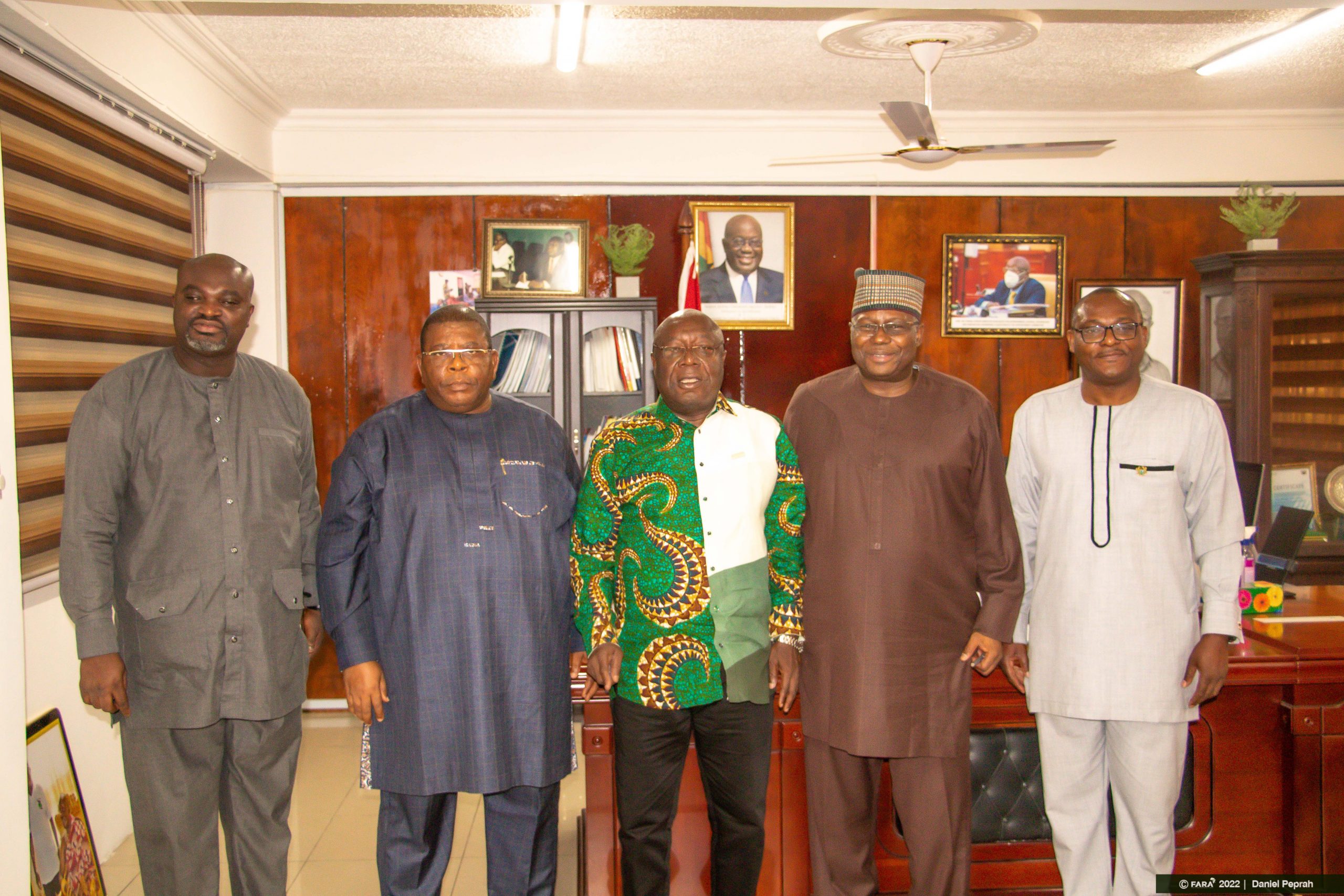
From Left-right, Mr. Peter Dery (Director for Environment, MESTI ) Mr. Johnson Okpong (Finance Director, FARA) Hon. Dr. Kwaku Afriyie (MP), Minister for MESTI, Dr. Yemi Akinbamijo (ED, FARA) Mr. Kwamena Quaison (Director for Science, Technology & Innovation(ST&I))
Dr Akinbamijo et Dr Afriyie ont également mis en exergue la collaboration en matière d’éducation, de recherche agricole et d’innovation.
Dr Yemi Akinbamijo a réaffirmé la nécessité pour le Ghana de tirer parti du programme de Bourses de recherche et d’innovation en agriculture pour l’Afrique (ARIFA) qui a pour objectif de former une nouvelle génération d’au moins 5 000 travailleurs aptes à réformer le secteur de l’agroalimentaire africain. Cela pourrait constituer le facteur de changement pour une transformation rapide de l’agriculture et la réalisation des objectifs du Programme détaillé pour le développement de l’agriculture africaine (PDDAA)-Malabo de l’Union africaine.
Dr Afriyie était heureux de recevoir le FARA. Selon lui, le ministère est bien placé pour tirer parti de la science et de la technologie. Il a insisté sur le fait que son ministère adoptait des solutions basées sur la nature pour faire face aux changements climatiques et les défis qui y sont associés. Il a ajouté qu’une collaboration avec d’autres institutions locales et internationales, notamment le FARA, était essentielle pour promouvoir un environnement durable.
Le ministre a indiqué que les dirigeants africains devaient commencer à utiliser les accords internationaux pour stimuler la croissance nationale.
The European Union (EU), through the Forum for Agricultural Research in Africa (FARA), has awarded a team of five researchers from Jomo Kenyatta University of Agriculture and Technology (JKUAT) research project funding totaling Kenya Shillings 31 million.
The project, entitled “Upgrading of Silver Cyprinid (Rastrineobola argentea) value chain through multi-stakeholder partnerships and novel climate-smart postharvest processing technologies and practices for improved rural livelihoods,” is among the 11 projects competitively selected from 150 submitted proposals by researchers in Kenya, Uganda, and Rwanda.
Ms. Vesta Akosua Nunoo, Grant Compliance Officer at the Forum for Agricultural Research in Africa (FARA), based in Accra, Ghana during a meeting at JKUAT to discuss the implementation of the project
It will be implemented by a multidisciplinary team comprising Prof. Nelson Ojijo (Department of Food Science & Technology), Prof. Christopher Kanali, Dr. Eric Ronoh, Eng. Gareth Kituu, and Eng. Samuel Njuguna (all from the Department of Agricultural and Biosystems Engineering).
The JKUAT pentad, in collaboration with the other consortium members – Kenya Marine & Fisheries Research Institute (KEMFRI), JKUAT Enterprises Ltd (JKUATES), and Kisumu and Busia Beach Management Units – seeks to boost the economic value of silver cyprinid fish, locally known as Omena, through a two-pronged approach – preventing post-harvest loss and promoting its consumption.
Omena is an important source of livelihood because it constitutes the bulk of the fish catch from Lake Victoria, according to Prof. Ojijo, a Food Technologist and the project’s lead researcher. However, due to microbial spoilage arising from poor drying conditions and high ambient temperatures, nearly half of the fish landings at the beaches go to waste, prompting overfishing to compensate for the loss.
To address this issue, the project will produce two machines. The first is a charcoal-powered portable cooling machine, which will enable the immediate preservation of the fish, while the second is a solar-powered drying machine, which will facilitate fast drying of the fish regardless of the weather and therefore prevent microbial growth.
Prof. Nelson Ojijo, a Food technologist at JKUAT and the Principal Investigator of the Project
The project will also focus on value-added processing into various novel products to promote the consumption of this fish variety, particularly among the youth with high nutritional demands.
Notably, the project is committed to collaborating with locals around the Lake Victoria beaches in order to create solutions that will be adopted and thus ensure sustainability.
To that end, roles and responsibilities will be divided between researchers and non-researchers in order to keep the focus on these needs. This will be accomplished through the use of a multi-stakeholder engagement mechanism known as innovation platforms (IP).
The IP is a social space, usually involving ongoing face-to-face and/ or virtual interactions, through which stakeholders engage to diagnose problems, identify opportunities, develop solutions and find ways to achieve shared goals.
The IP is crucial to the project as the basis for organizing the stakeholders along the Omena value chain for knowledge co-creation and innovation.
Sample of the Solar Dryer Machine to be developed by the Agriculture Engineers at JKUAT
The project will be carried out for 30 months, beginning in March 2022, as part of the broader EU-funded regional project, “Strengthening Agricultural Knowledge and Innovation Ecosystem for Inclusive Rural Transformation and Livelihoods in Eastern Africa (AIRTEA),” being coordinated by a consortium of partners comprising FARA, the Association for Strengthening Agricultural Research in Eastern and Central Africa (ASARECA), and the Eastern Africa Farmers Federation (EAFF).
The Forum for Agricultural Research in Africa (FARA) and the Tertiary Education Trust Fund (TETFund) of Nigeria, in partnership with the Federal University of Viçosa (UFV), Brazil, will be holding the First Agricultural Research and Innovation Fellowship for Africa (ARIFA) Symposium to consolidate the ARIFA Partnership Platform (APP). The event will take place in Viçosa between the 25th and 30th of April 2022, hosted by the Rector of UFV, Prof. Demetrius David da Silva.
The event will be declared open by the Ambassador of Nigeria in Brazil, His Excellency Professor Mohammad Ahmad Makarfi, who will be received by Arc. Sunday S.T. Echono (FNIA), the Executive Secretary of TETFund and Dr Yemi Akinbamijo, the Executive Director of FARA.
Also expected are the President of the Brazilian Association for International Education (FAUBAI), Prof. Márcio Venício Barbosa and Dr George Forpoh – Deputy Minister – Regional Development, Research & Extension – Ministry of Agriculture, Republic of Liberia.
Targeted participants expected during the symposium include over forty ARIFA scholars currently studying in six Brazilian universities, leaders from participating institutions in Nigeria and Brazil, and representatives from Liberia, Ghana, and DR Congo.
The symposium’s theme is “Pedagogic Retooling Strategy for Africa’s Agricultural Research and Innovation System: Lessons from Brazil” and aims to strengthen alignment, partnership, and coordination, among current ARIFA partners: FARA, UFV, TETFund.
Coming at a time when the conference of the Brazilian Association for International Education (FAUBI) is taking place, the symposium will lead to the development of a more robust ARIFA Partnership Platform (APP) that will guide the alignment of Graduate Cohort Compacts (GCC) with the participation of a higher number of Brazilian universities. Outcomes from the meeting will lead to institutional strengthening of TETFund Centers of Excellence (TCoE), forming ARIFA Innovation Platforms, and a scaling strategy for an Africa-wide ARIFA model, in partnership with other African Education Trust Funds, including Ghana, South Africa, and Liberia.
About ARIFA
The Agricultural Research and Innovation Fellowship for Africa (ARIFA) aims to produce a new generation of fit-for-purpose workforce to re-engineer the African agri-food sector to provide the change factor for rapid agricultural transformation in the next ten years. The Nigerian model of the fellowship is funded by the Tertiary Education Trust Fund (TETFund) to build strategic competence to change the prevailing narrative of the waning capacity of tertiary institutions in the country. Under this partnership, TETFund supports the training of Nigerian academia to undertake tailor-made MSc programs in various fields of sciences related to agriculture at UFV.
About FARA
FARA is the Forum for Agricultural Research in Africa, a continental organization mandated by the African Union Commission (AUC) and the African Union Development Agency (AUDA) to facilitate the widescale application of science and innovation toward achieving CAADP targets. FARA promotes innovative partnerships, capacity strengthening, knowledge management, and policy advocacy. FARA has its secretariat in Accra, Ghana, as the technical arm of the AUC and AUDA.
About TETFUND
TETFUND is a scheme established by the Federal Government of Nigeria in 2011 to disburse, manage, and monitor education tax to government-owned tertiary institutions in Nigeria. Its focus is to provide focused and transformative intervention in public tertiary institutions in Nigeria through funding and effective project management.
About UFV
Universidade Federal de Viçosa (UFV)-the Federal University of Viçosa is a frontline federal university in Brazil. Its main campus is located in the city of Viçosa, the state of Minas Gerais. Founded as the Higher College of Agriculture and Veterinary Medicine in 1922 on what would become the Arthur Bernardes campus, it transformed into the Rural University of Minas Gerais and became fully federalised in 1969. Rated as one of the most prestigious universities in Brazil, UFV offers 47 different undergrad courses in many areas, including engineering, agronomy, medicine, veterinary medicine, animal husbandry, and other areas related to science. The graduate courses at UFV are highly rated by the Coordenadoria de Aperfeiçoamento de Pessoal de Nível Superior (CAPES). According to the QS ranking, UFV is among the 100 best universities globally in the areas of Agriculture and Forestry.
Dr. Yemi Akinbabamijo, Executive Director of the Forum for Agricultural Research in Africa (FARA), paid a courtesy call on Dr. Kwaku Afriyie, Minister in Charge of the Ministry of Environment, Science, Technology, and Innovation (MESTI), yesterday, April 12, 2022.
The meeting’s purpose was to provide the honorable Minister with an update on FARA’s preparations for COP27.
The 27th session of the Conference of the Parties (COP 27) to the UN Climate Change Conference 2022 will take place from November 7–18, 2022 in Sharm El-Sheikh, Egypt, where FARA is expected to lead the African Climate-Smart Agriculture Framework (ACSAF) implementation of the purpose-driven process that will deliver a consolidated plan to mitigate the climate crisis and the operationalization of the 10-year framework to guide the ACSA for the next decade (the African Decadal Plan) that will position Africa for a meaningful climate-resilient Africa. In principle, it will operationalize the global demands of the AUCCS 2030.
From Left-right, Mr. Peter Dery (Director for Environment, MESTI ) Mr. Johnson Okpong (Finance Director, FARA) Hon. Dr. Kwaku Afriyie (MP), Minister for MESTI, Dr. Yemi Akinbamijo (ED, FARA) Mr. Kwamena Quaison (Director for Science, Technology & Innovation(ST&I))
In addition, the two talked about educational and agricultural research and innovation collaborations.
Dr Yemi Akinbamijo reiterated the need for Ghana to leverage the Agricultural Research for Innovation Fellowship in Africa (ARIFA) initiative, whose target is to produce at least 5,000 new generations of the fit-for-purpose workforce to re-engineer the African agri-food sector. This could provide the change factor for rapid agricultural transformation and achieve the goals of the Comprehensive Africa Agricultural Program (CAADP)-Malabo of the AU.
Dr Afriyie was pleased to host FARA and asserts that his ministry is well-positioned to leverage science and technology. He stressed how his sector is employing nature-based solutions to address climate change and its associated challenges and that strong collaborations with other local and international institutions, particularly with FARA, are critical for promoting a sustainable environment.
He stated that African leaders must begin utilizing international accords to boost their countries’ growth.