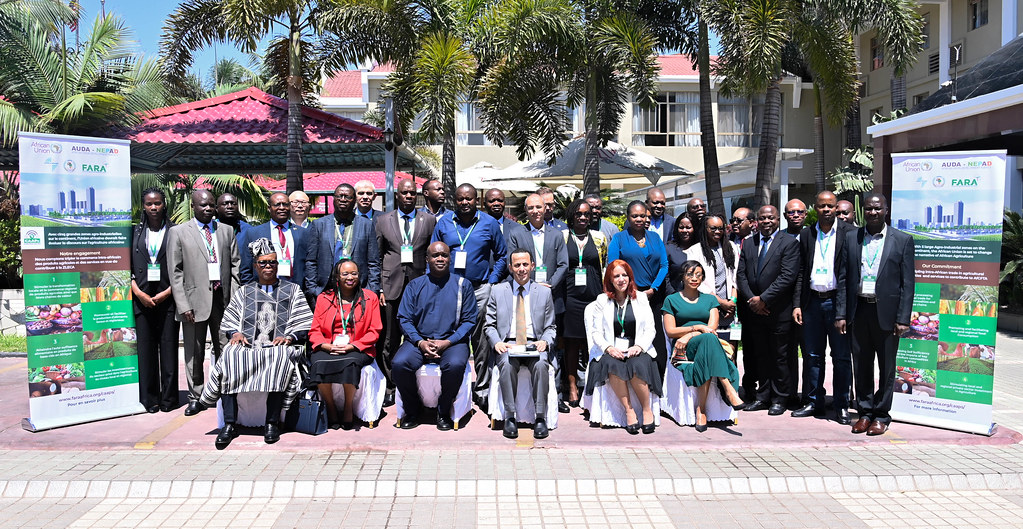
Common African Agro-Parks (CAAPs) are vehicles aimed at driving cross border projects to leverage on initiatives which focus on priority or strategic commodities. It is envisioned this approach will spur economic development and transformation in Africa, as espoused within the framework of the African Union (AU) Agenda 2063.
Principal Advisor, Value chains, Office of the Secretary General Themba Khumalo explains that CAAPs involves agreed actions between two countries to identify trade opportunities.
“Our target is to have excess food for trade and where there are domestic projects that will be supported, CAAPs aims to promote regional integration and trade,” Mr. Khumalo said.
Mr. Themba Khumalo, Principal Advisor, Value chains, Office of the Secretary General, AfCFTA.
To catalyze CAAPs, it’s about countries justifying their projects within their Regional Economic Communities (REC) for the implementation of the Common African Agro-Parks programme. Once countries identify and concretize their projects, they need to sign agreements and trade. For these CAAPs to be viable and translate into tangible results, there is a need to ensure private sector investment.
Mr. Khumalo says when pursuing these investments, there will be a need for private sector players to be able to present their projects and mobilize resources to actualize trade agreements.
He clarifies whatever projects exist in countries aside the identified CAAPs continues although it is better to be enshrined in the regional investment plans for purposes of recognition as a CAAPs regional integration plan.”
“We need to radically change the way we work to actualize and achieve the goals of the CAAPs,” Mr. Khumalo says.
He advised that countries need to look at their own domestic interests, what exists and how best it can be scaled up. This should be coupled with a commitment to create an enabling policy environment for trade and, among others, to avoid any barriers between countries wanting to promote trade in their RECs.
Mr. Khumalo explained that for the CAAPs to be recognized and supported, a certain criterion needs to be met as spelled out in the Abuja declaration.
The Abuja declaration criteria outlines some of the critical elements of setting up a CAAPs within a RECs. Among them is considering the nature of strategic importance in relation to integration, economic growth, and food security. Further, there is a need to ascertain what is on the ground in the context of feasibility of project, as there must be a base to engage some of the partners for pre-feasibility.
This means when looking at most entities, they will be needed for feasibility study, which will entail the community having basic information to decide and demonstrate the ability to promote regional boosting. Overall, there is need to look at whether countries can commit from a policy point of view as a country outside investor zones to enable private sector to make those decisions. It is key for countries to critically look at their comparative advantages and harmonize their investments with financial commitment towards agreed value chains.
A typical case of a CAAPs is the trade agreement between Zimbabwe and Zambia dubbed “Common Agriculture Industrial Park (CAP)” signed between the two countries in 2021. The partnership between the two countries is valued at over US$12 million.
Speaking in Lusaka during the inaugural coordination meeting of Regional Economic Communities (REC) for the implementation of the Common African Agro-Parks programme, Ministry of Industry and Commerce, Chief Director Florence Makombe from Zimbabwe, explains that the trade agreement rides on the already existing bilateral trade.
Chief Director Florence Makombe, Ministry of Industry and Commerce, Zimbabwe
Ms. Makombe disclosed that the agriculture industrial park between the two countries includes the following value chains: Soyabean, dairy, wheat, horticulture, maize, and fisheries.
“There has been progress made on the Zimbabwe and Zambia on the agreement. There is need to adjust from the last meeting held in Harare were looking at the legal framework,” She said.
Ministry of Commerce, Trade and Industry, Director Industry, Musokotwane Sichizuwe says Zambia has the capacity in terms of the agriculture sector also given the favorable weather.
Mr. Musokotwane Sichizuwe (left), Zambian Ministry of Commerce, Trade and Industry with colleague Chipoka Mulenga (right)
Mr. Sichizwe says once a feasibility is conducted in Zambia, it will help unpack most of these criteria requirements.
“Zambia has prioritized farm blocks. Initially, the focus was on special economic zones but now it is extended to farm blocks. It aligns well given that we are trying to do some of these things at a regional level,” he disclosed.
Mr. Brian Ngandu, Ministry of Agriculture, Zambia
Ministry of Agriculture, Brian Ngandu says Zambia and Zimbabwe have enjoyed a long-lasting trade relationship. This is an advantage to both countries as their identified trade agreement is likely to stimulate increased trade.
While, Zambia and Zimbabwe may not have same the land polices, the implication is that both countries may need to reform policies to align with goals of CAAPs and strengthen this agro park initiative to attract and unlock business opportunities in order to enhance trade between the two countries. – National Agricultural Information Services
AFRICA is spending about US$50 billion every year importing food from other parts of the world. This situation poses an opportunity for African countries to reposition themselves in a bid to make the continent food secure.
This led the African Union Commission to conceptualise the Common African Agro-Parks (CAAPs) aimed at attracting private investments to establish transboundary mega agro industrial hub on the continent.
The Common African Agro-Parks is a mega initiative of the African Union to create regional agro-industrial hubs aimed at responding to the continent’s demand for interventions at boosting local processing and regional trade for agricultural commodities and their value chains.
To come up with innovative solutions to drive the CAAPs, Common Market for Eastern and Southern Africa (COMESA) hosted member states who convened in Lusaka recently to share ideas and experiences to better address the intra and regional trade meant to enhance agricultural commodities and value chains.
The CAAPs will help the agro-allied sector of the Africa economy to deliver on the AU Agenda 2063 aspirations within the framework of the Africa Continental Free Trade Agreement (AfCFTA).
Initiated in 2019, CAAPs is one of the initiatives of Comprehensive African Agricultural Programme (CAADP) to be implemented within the framework of the African Union (AU) agenda 2063 to achieve the CAADP Malabo commitments, particularly the commitment to “triple intra-African trade in agricultural commodities and services.”
The programme seeks to promote and facilitate local and regional as well as food production. In this way, achieving self-sufficiency of key agriculture commodities in Africa remains a critical milestone.
CAAPs Programme Coordinator, FARA Anselme Vodounhessi explains that CAAPs aspires to stimulate local and regional private sector investment in agriculture.
Mr. Vodounhessi says Africa has abundant resources but need to actualise economic opportunities by aggressively engaging in value chains in the agriculture sector which are viable and profitable.
He reaffirms Africa has lots of arable and abundant land which needs to be exploited in order to create and build a desired Africa.
Generally, Africa has good strategies but the major bottleneck is the implementation. According to Chief, Regional Division for Africa, UNIDO Victor Djemba explains that coordination of key actors in the implementation process of value chains in the agriculture sector remains problematic.
Mr. Djemba acknowledges that the private sector does a lot work but in isolation, hence the need for them to work in a concerted manner with sector players. This, he argues requires the proposed industrial parks to work effectively, needs inclusivity of private sector participation from project inception within the existing structures.
“It’s not the work of one entity but all entities need to be involved for a successful development of key players in the establishment and development of industrial parks,” he said.
Mr. Djemba said key players need to be involved in the whole process of implementation.
“Involving investors from inception requires embracing the laws and rules of both countries to provide an enabling environment for industrial parks to thrive,” he said.
Rural Development, Agro-Industries Agro-Industrial Parks Unit, UNIDO Project Officer Andrew Goodwin explains that everything which is set-up in agro-processing zones is business focused and has to be a long-term approach. Therefore, there must be commitment to develop agro-processing zones in industrial parks. It is obvious this approach needs an enabling environment to succeed.
Mr. Goodwin further says industrial parks are able to flourish through leases and services offered to the public.
For instance, industrial parks in Ethiopia and Senegal have been successful because they make their revenue from generation developers as they have invested in building sheds, installed power, water and other necessities within the parks.
These processing companies provide services such as commercial services, resource centres, among others which enable them to broaden resource base and maximise on their profits. Its also imperative to take cognizant of the prevailing climate change conditions. This should inform sector players to build climate resilience.
Mr Goodwin said these integrated agro-food parks refers to central processing hubs which strive to reach out to rural areas from world transformation centres. For example, breeding, storing, collection centres at farmer level and cooperatives would also have these centres for processing.
He further said it was impressive that farmers in Ethiopia and Senegal are developed with cooperative unions, which closely work with the Ministry of Agriculture and also have bidding bilateral agreements.
With the success model of Ethiopia and Senegal, it is clear agriculture is the answer to creating prosperity and will always be the most economically viable sector to focus on for generations to come.
CAAPs aspirations is for member states to mobilise domestic resources to invest these into agro-parks and ensure a food secure continent. It is imperative to take into account the success of this programme needs a lot of resource mobilisation. The member states can co-create and unlock opportunities for the transboundary setting to enable Africa flourish. – National Agricultural Information Services.
Joint Press Release by AUC, AUDA, FARA, COMESA, & FAO
Lusaka, Zambia – October 17, 2023: Regional Economic Communities in Africa are set to meet this week to drive forward a proposal for mega agro-industrial hubs across the continent that would boost agricultural development. The Common African Agro-Parks (CAAPs) are aimed at boosting regional trade for agricultural commodities, increasing local processing of key agricultural products and reducing food import. This significant event will occur from October 18 to 21, 2023, at the COMESA headquarters in Lusaka, Zambia, with support from the Food and Agriculture Organization of the United Nations (FAO) through its Technical Cooperation Programme (TCP).
Partners participating in the meeting include the Africa Union Commission, the African Union Development Agency, the Common Market for Eastern and Southern Africa, the Food and Agriculture Organization, United Nations Industrial Development Organization, United Nations Economic Commission for Africa, the Pan-African Agribusiness Chamber, the Pan-African Farmers Organisation, the Africa Business Council, IFPRI, African Continental Free-Trade Area, Afreximbank, African Development Bank and the CAAPs Secretariat hosted by the Forum for Agricultural Research in Africa. The rest are country representatives from Zambia and Zimbabwe, key private sector players such as Bühler Group, Grüner, BRICS as well as the World Food Programme.
The Third Ordinary Session of the Specialized Technical Committee (STC) on Agriculture, Rural Development, Water and Environment, held on 21-25 October 2019 in Addis Ababa, widely discussed the benefits of agro-industrialization to the continent and resolved to adopt the Common African Agro-Parks (CAAPs) as a programme contributing to the implementation of the African Continental Free Trade Area (AfCFTA). The CAAPs Programme was finally ratified as a flagship initiative of the AU Agenda 2063 during its 36th Summit in February 2023.
The CAAPs initiative aims to create transboundary mega agro-industrial hubs across Africa. This ambitious endeavour falls within the Comprehensive African Agricultural Programme (CAADP) framework and the AU Agenda 2063. Its overarching objective is to drive the industrialization strategy of African governments and RECs, transforming economies from traditional raw material exporters to agro-industrial powerhouses.
Despite Africa’s abundant fertile land and a burgeoning young workforce, the continent spends approximately USD 50 billion ($50b) annually importing food commodities.
The CAAPs program seeks to reverse this trend by promoting cross-border agriculture value chains, attracting private sector investments in agro-industrialization, and establishing sustainable cross-border policies within the context of the African Continental Free-Trade Area (AfCFTA).
Over four days of intensive interaction, the Directors of RECs and CAAPs Technical Working Groups (CAAPs-TWG) Experts will strengthen collaboration, build synergies and draw actions to accelerate the implementation of this initiative.
Firstly, they will raise awareness among RECs about CAAPs, facilitating subsequent sensitization of AU Member States and fostering a knowledge exchange regarding regional agro-industry development within the AfCFTA framework.
Also, they will solicit feedback from RECs regarding the CAAPs process, necessary infrastructure, governance, and legal models, and the AfCFTA instruments vital for creating a conducive business environment for transboundary Public-Private Partnerships (PPPs) in CAAPs.
Again, they will deliberate on the mapping exercise for future agro-industrial development in Africa, with a practical case study of the ZimZam CAAPs location. RECs are expected here to propose locations for the 10 CAAPs Demonstration Projects ( 2 per region) and for the 5 larger CAAPs (one per region) envisioned by the African Union.
Finally, they will forge a harmonized process for RECs’ engagement with countries and stakeholders within their respective regions, including the private sector and regional banks, to prepare for CAAP implementation.
At the end of the four days meeting, participants would have (i) compiled feedback from RECs on the CAAPs process, infrastructure models, and the required legal instruments for joint governance and PPPs in transboundary settings within the AfCFTA context; (ii) agreed on a harmonized process for engagements with countries; (iii) compiled and validated feedback of criteria for mapping future transboundary agro-industrial development zones in Africa; (iv) developed a joint roadmap for rolling out CAAPs in AU Member States; and (v) developed action plans for joint resource mobilization and partnership engagement among RECs to develop CAAPs.
This Inaugural Coordination Meeting marks a pivotal moment in Africa’s agricultural and industrial transformation pursuit. By fostering collaboration and knowledge sharing among regional economic communities, this event lays the foundation for a sustainable, prosperous, and food-secure future for the continent.
The African Union Development Agency-NEPAD (AUDA-NEPAD) is the development agency of the African Union, promoting partnerships for the transformation of Africa as an integrated, prosperous, and peaceful continent.
The Common Market for Eastern and Southern Africa (COMESA) is a regional economic community of 21 member states. It brings together over 600 million people into a cooperative framework for sustainable economic growth and prosperity through regional integration.
The Common African Agro-Parks Programme (CAAPs) is an African Union Commission (AUC) initiative to establish transboundary mega agro-industrial hubs across Africa to drive industrialization and food security. It is hosted by the Forum for Agricultural Research in Africa (FARA), an apex continental technical institution of the AUC headquartered in Accra, Ghana.
The Food and Agriculture Organization (FAO) is a specialized agency of the United Nations that leads international efforts to defeat hunger. FAO currently provides institutional support to the CAAPs Secretariat, hosted by FARA, to coordinate stakeholders’ consultations and leadership engagement for greater ownership of the CAAPs; formalize partnerships with the technical partners for the design and establishment of the CAAPs; and to build the capacity of stakeholders to support the decision-making process at the various African Union organs.
International Expert, Consultancy for Resource Mobilization Support Services for the Common African Agro-Parks (CAAPs) Programme
Name of Project:
FARA/CAAPs
Procurement Ref:
FARA/CAAPs/CS/Res.Mob/IC/2023/01
Date:
Tuesday, August 29, 2023
The Common African Agro-Parks Programme (CAAPs) was initiated in 2019 as one of the concrete initiatives of the Comprehensive African Agricultural Programme (CAADP) to be implemented within the framework of the African Union (AU) Agenda 2063 for achieving the CAADP Malabo commitments, especially the one on “tripling Intra-African trade for agricultural commodities and services.
CAAPs emerged from the major recommendations of the Inaugural CAADP-Biennial Review (BR) Report presented to the 2018 AU Assembly of Heads of States, where recommendations were formulated for the AU Commission to initiate continental actions that shall aim at: i)- boosting regional trade for agricultural commodities by increasing locally processing of key agricultural products and their respective value chains; ii)- promoting and facilitating increased consumption of locally and regionally produced agricultural commodities; iii) -achieving self-sufficiency and lowest possible importation of key agriculture commodities in Africa; and iv)-stimulating local and regional private sector investments in agriculture. The implementation of the CAAPs will help Africa to take over the African Food Import Market of about USD50 billion per annum that is currently outsourced to the rest of the world.
The CAAPs is coordinated by the AU Commission, through the Agriculture, Rural Development, Blue Economy and Sustainable Environment (ARBE); the Economic Development, Trade, Industry and Mining (ETIM) in partnership with the Secretariat of the African Continental Free Trade Area (AfCFTA); – African Export-Import Bank (Afrexim Bank); and the Forum for Agriculture Research in Africa (FARA).
These core institutions are steering the coordination of the CAAPs through two major organs: the CAAPs Steering Committee (CAAP-SC) and the Technical Coordination Team (the CAAPs-TCT), with the CAAPs-Secretariat hosted at FARA.
The CAAPs was recently adopted as a Flagship Program of the AU Commission by the Extra-Ordinary Session of the Specialized Technical Committee on Agriculture, Rural Development, Water and Environment (ARDWE) in March 2023. This development will result in AU establishing a robust Secretariat to support the implementation of the program. Additionally, the CAAPs is being piloted in Zambia and Zimbabwe. Scaling out the CAAPs at the continental level based on the lessons learnt in these two countries and supporting the operations of the envisioned CAAPs Secretariat will necessitate resources.
Therefore, the CAAPs-Secretariat requires the support of a Resource Mobilization consultant to support the development of a Resource Mobilization Strategy and Implementation Roadmap for the Programme.
To achieve the foregoing; FARA proposes to engage a suitable consultant to carry out this assignment with the needed professionalism and ethics.
The Resource Mobilization Consultant will review the existing technical study of the financial options available for the implementation of CAAPs and other relevant CAAPs documents and develop a resource mobilization strategy and a joint implementation roadmap for AUC and FARA Secretariat. The Consultant will establish a clear overview of current and potential funding opportunities for CAAPs program to increase the long-term sustainability of the program.
This request for expression of interest aims at engaging a consultant to carry out the following functions:
Consult with the CAAPs team to understand the vision, mission and focus areas of the program;
Review the CAAPs current strategic project documents, technical studies, work plans, project proposals, knowledge management products and current funding models to better understand the needs and help position the program for resource mobilization;
Map the CAAPs products and services to identify funding gaps;
Map potential donors’ strategic areas of interest, priorities as well as funding windows, and explore opportunities for partnerships from emerging donors (both traditional and non-traditional);
Develop a comprehensive resource mobilization strategy that includes an overview of the situation, exploration of future opportunities and strategies, and detailed workflow/roadmap on how the CAAPs will raise funds to support the achievement of its key results;
Provide a detailed synopsis of the proposed options for financing the CAAPs;
Maintain regular contact with CAAPs Coordinator in FARA and other FARA Secretariat staff involved in the CAAPs.
The Executive Director of FARA invites interested consultants to express interest in carrying out this assignment.
Consultants interested in this call must provide an Expression of Interest no longer than 10 pages, outlining proposed methodologies, references related to the execution of similar assignments, experience in similar areas, or evidence of knowledge and a proposed timeline. Brochures, CVs, and other supplementary materials submitted shall not be accounted for as part of the 10-page limit.
The anticipated period of performance for this consultancy is 16 man-days spread over two months (2nd October 2023 to 30th November 2023).
The individual consultant shall be selected based on procedures defined in the Procurement Guidelines of FARA.
Interested consultants may obtain further information from the CAAPs Programme Coordinator,Anselme Vodounhessi[[email protected]], and copy the Procurement Expert, Mr. Callistus Achaab [[email protected]], during the following hours: 9h00 to 16h00 GMT.
Please download the Terms of Reference below, for further information on this opportunity.
Expressions of Interest should be submitted electronically to [[email protected]] and addressed to Dr. Aggrey Agumya, Executive Director of FARA, No 7 Flower Avenue, New Achimota, Mile 7, Accra, Ghana, no later than Tuesday, 12th September 2023, at 14h00 GMT. Tel: +233 302 772823/744888.
FARA Affirmative Action Statement on Recruitment: there is no discrimination based on gender race, religion, ethnic orientation, disability, or health status.
The African Union Commission – Department of Agriculture, Rural Development, Blue Economy and Sustainable Environment (DARBE) and Economic Development, Trade, Industry and Mining (ETIM) – , the Forum for Agricultural Research in Africa (FARA), and the Africa Export, Import Bank (Afrexim bank) hosted a successful investor round table on the Common Africa Agro-Parks (CAAPs) Initiative at the African Union Commission (AUC) Headquarters in Addis Ababa, Ethiopia, on 17th February 2023, after a CAAPs Steering committee held on the 16th February.
The event was convened in collaboration with key partners such as Africa Development Bank, AUDA-NEPAD, UNIDO, Pan Africa Farmer Organization, UNECA, Africa Business Council, PAAAC, IFPRI, FAO, and the private sector and held alongside the ongoing 36th Ordinary Session of the Africa Union.
Bringing together key industry leaders, the event was co-chaired by the commissioner of Economic Development, Trade, Industry, and Mining, to discuss the transformation of Africa’s Agriculture while boosting integration and industrialization of the continent through the implementation of the Common African Agricultural Parks (CAAPs). The discussions were enshrined in the June 2014 Malabo Declaration of the AU Heads of State on collective action leading towards tripling Intra-African trade for agricultural commodities and services.
H.E. Commissioner Josefa Sacko affirmed the need for Public-Private-Partnership (PPP)-driven financing options and joint governance of the CAAPs. The joint governance will constitute a critical step in mainstreaming the private sector perspectives in the design of the CAAPs partnerships arrangements, which shall culminate in a leading role to the private sector in the agro-industrialization of Africa. Likewise, H.E. Commissioner Albert M. Muchanga reinforced that Africa should be a net exporter. Thus we should ensure that the initiative starts generating results for Africa as a self-reliant continent.
Over the course of the 2-day event, delegates engaged in a productive discussion to sensitize PPPs on the CAAPs as an effective tool to boost agriculture. Additionally, the participants gathered feedback on how best to continue PPP engagement and obtain pledges from partners to support the implementation of the CAAPs. Dr. Yemi Akinbamijo, the Executive Director of FARA, asserted that we need to evade the bureaucratic inertia that may be hit if we do not move the continent to the next level. On the other hand, Mr. Mansur Ahmed, the Executive Director, Stakeholder Management and Corporate Communications at Dangote, alluded that we need to promote action that will make the agricultural industry competitive, with a clear pathway to create hubs that will create sustainable linkages.
The event marked an important milestone for the Steering Committee of the CAAPs to endorse CAAPs for consideration as a flagship program of Agenda 2063. “The importance of the continent to boost production and processing is high. We stand ready to work with the member states and members of the Steering Committee to drive the process,” said H.E Nardos Bekele-Thomas, the commissioner for AUDA-NEPAD. Also, Mr. Themba Khumalo, Senior Advisor to the Secretary General of the Africa Continental Free Trade Area, confirmed that the AfCFTA secretariat is thrilled to join this partnership since the CAAPs will help deliver on the strategies to drive regional processes for boosting intra-Africa agricultural trade.
Dr. Beth Dunford, the Vice President of the African Development Bank’s Agriculture, Human, and Social Development, also confirmed the bank’s commitment to supporting the CAAPs implementation in collaboration with the Special Agro-Industrial Processing Zones programme.
The 2-day event ended with the singing of a Memorandum of Understanding between the African Union Commission, Afreximbank, and the Forum for Agricultural Research in Africa, the key drivers of the CAAPs.
The UN Secretary-General lauds the African Union (AU) Common African Agro-Parks, (CAAPs) and African Continental Free Trade Area (AfCFTA) as potential for increasing agricultural productivity and expanding intra-African trade during his message at the ongoing Africa Food Summit Dakar 2 in Senegal.
The three-day Summit, hosted by His Excellency Mr. Macky Sall, President of the Republic of Senegal and Chairperson of the African Union, and co-hosted by the African Development Bank Group, kicked off yesterday, January 25, 2023. The Summit has brought together governments, private sector investors, multilateral organizations, NGOs, and scientists to meet the escalating challenge of food insecurity in Africa.
In a written statement by the UN Secretary General, H.E. Antonio Guterres, addressing the honorable dignitaries and distinguished invited guests and organizations present on day one of the Africa Food Summit in Dakar through a representative of the UN, he expressed his admiration to the continent’s leaders for joining forces to share ideas, mobilize assistance, harness knowledge, and technology to forge solutions to feed the people of Africa and unleash the continent’s tremendous food and agricultural potential.
He addressed the vulnerability of African agriculture to climate risk and fragmented value chains, stating strongly that the transformation of the African food system is critical to alleviating poverty, advancing food security, promoting sustainable development, and creating productive jobs, most especially for women and the youth.
He then praised the African Union Commission initiative, the Common African Agro-Parks (CAAPs) program, and the full implementation of the African Continental Free Trade Area (AfCFTA), emphasizing how these have enormous potential for increasing agricultural productivity, building agricultural value chains, expanding trade, and, most importantly, intra-African trade.
Watch full message here
According to H.E. Amb. Josefa Sacko, the African Union’s Commissioner for Agriculture, Rural Development, Blue Economy, and Sustainable Development, “the CAAPs initiative is to establisha number of cross-border agro-industrial parks within the regional economic communities.” Conceptualized in 2019, the program is one of the concrete initiatives of the Comprehensive African Agricultural Development Programme (CAADP) in support of the African Union Agenda 2063 and the Malabo commitments, particularly “tripling intra-African trade for agricultural commodities and services.”
The CAAPs also intend to provide over 8 million job opportunities within the crop and livestock value chains. The transboundary dimension of the CAAPs presents vast potential for developing cross-border market linkages to connect all agro-park initiatives to respond to Africa’s food gap, which is presently filled largely by imports. CAAPs is being implemented by the African Union Commission (AUC), Afrexim Bank, the Forum for Agricultural Research in Africa (FARA), the African Continental Free Trade Area (AfCFTA), the United Nations Economic Commission for Africa, the Food and Agriculture Organization, member states, and regional economic communities.
CAAPS, a 37-million-dollar investment, has already received USD 0.5 million in seed capital from Afreximbank. It has planned holding Investors’ forum to be held on the margins of the 36th Ordinary Session Of The African Union (Au) Assembly, February 17th 2023, Addis Ababa, Ethiopia.
The AfricaFoodSummitDakar2 is still underway and ends tomorrow, January 27. By the close of the day, visit afdb.org to watch the summit via the internet.
For the latest information about the Common African Agro-Parks (CAAPs) program, visit the website: faraafrica.org/caaps/ Join the conversation around it using the hashtag #CAAPs4Africa.