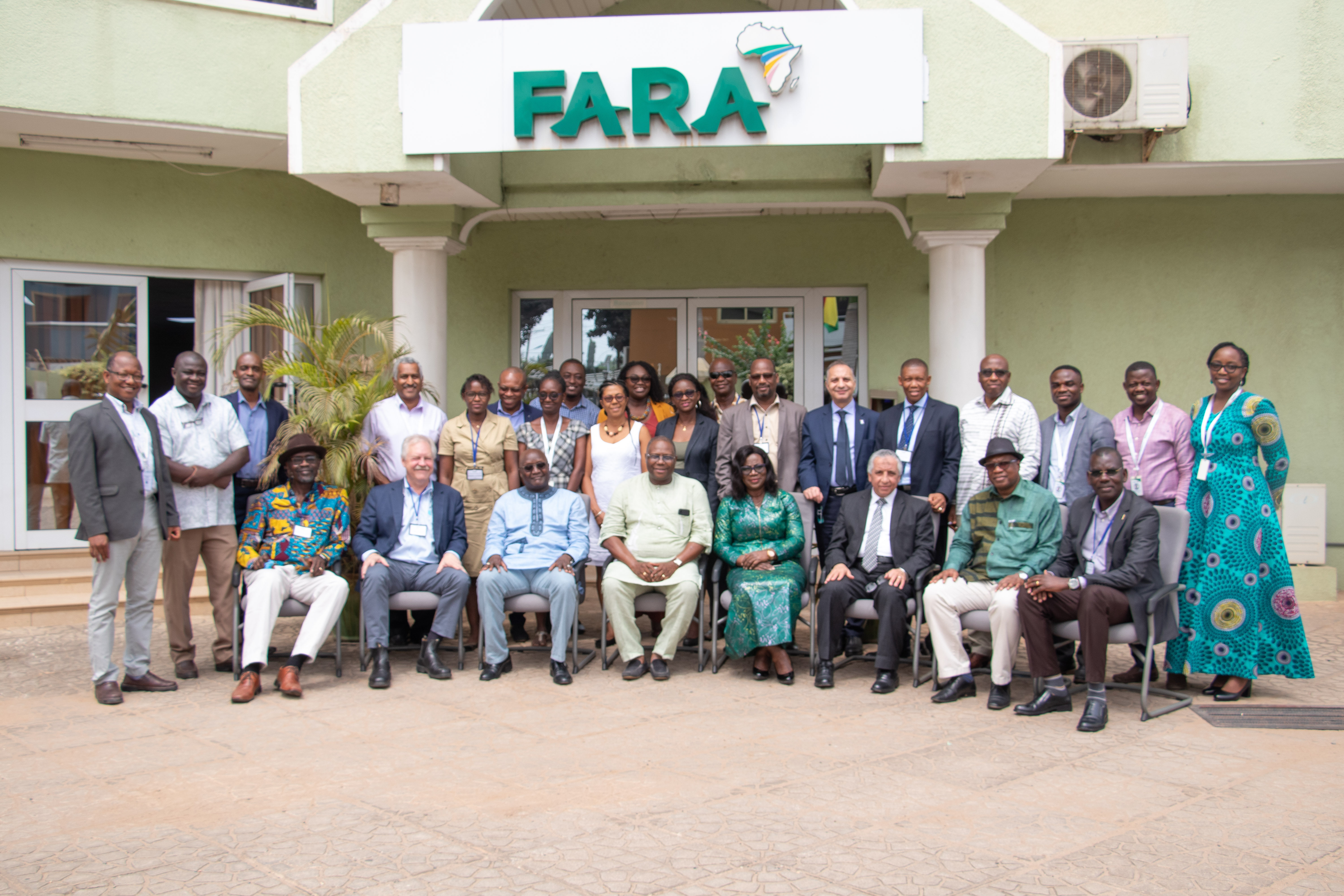
Le Forum pour la recherche agricole en Afrique (FARA) accueille à Accra la réunion du comité de coordination du programme des institutions anciennement en charge du pilier IV du PDDAA (AFAAS, ASARECA, CCARDESA, FARA et NASRO). Le FARA est l’organe technique de la Commission de l’Union africaine chargé de la promotion et de la coordination de la recherche agricole pour le développement en Afrique.
Pour jouer efficacement son rôle de coordination, le FARA a mis en place un comité de coordination du Programme (PC Panel en anglais) en vue de fournir des conseils techniques relatifs à l’assurance qualité et à la pertinence de son programme et de ses projets, conformément à son mandat de renforcer et de coordonner la recherche agricole intégrée pour le développement en Afrique.
Le PC Panel vise à renforcer la capacité du FARA à coordonner, à tirer parti des possibilités, à renforcer les synergies et le principe de responsabilisation et à réduire les doubles emplois lors de la mise en œuvre du CAADP XP4. Le PC Panel est actuellement le principal instrument utilisé par le FARA pour l’examen par les pairs et la planification conjointe en vue de fournir des services consultatifs à la Direction de la recherche et de l’innovation du Secrétariat dans le but d’assurer la qualité du programme du FARA et son harmonisation avec les autres interventions dans le domaine de l’IAR4D en Afrique.
La réunion de deux jours vise entre autres à :
présenter les faits saillants de la stratégie du FARA (2019- 2028) et à faire le point sur les progrès réalisés dans sa mise en œuvre en vue de mener à bien une réflexion sur l’orientation stratégique à donner aux interventions dans le domaine de l’AR4D sur le continent ;
identifier les domaines d’harmonisation de la stratégie du FARA avec celles des OSR et de l’AFAAS en vue d’appuyer conjointement les institutions de l’AR4D en Afrique ;
préciser les domaines de la planification en vue de renforcer le partenariat et la collaboration entre les institutions anciennement en charge du pilier IV du PDDAA ;
mettre à jour la planification commune et les mécanismes d’examen des activités du programme CAADP-XP4.
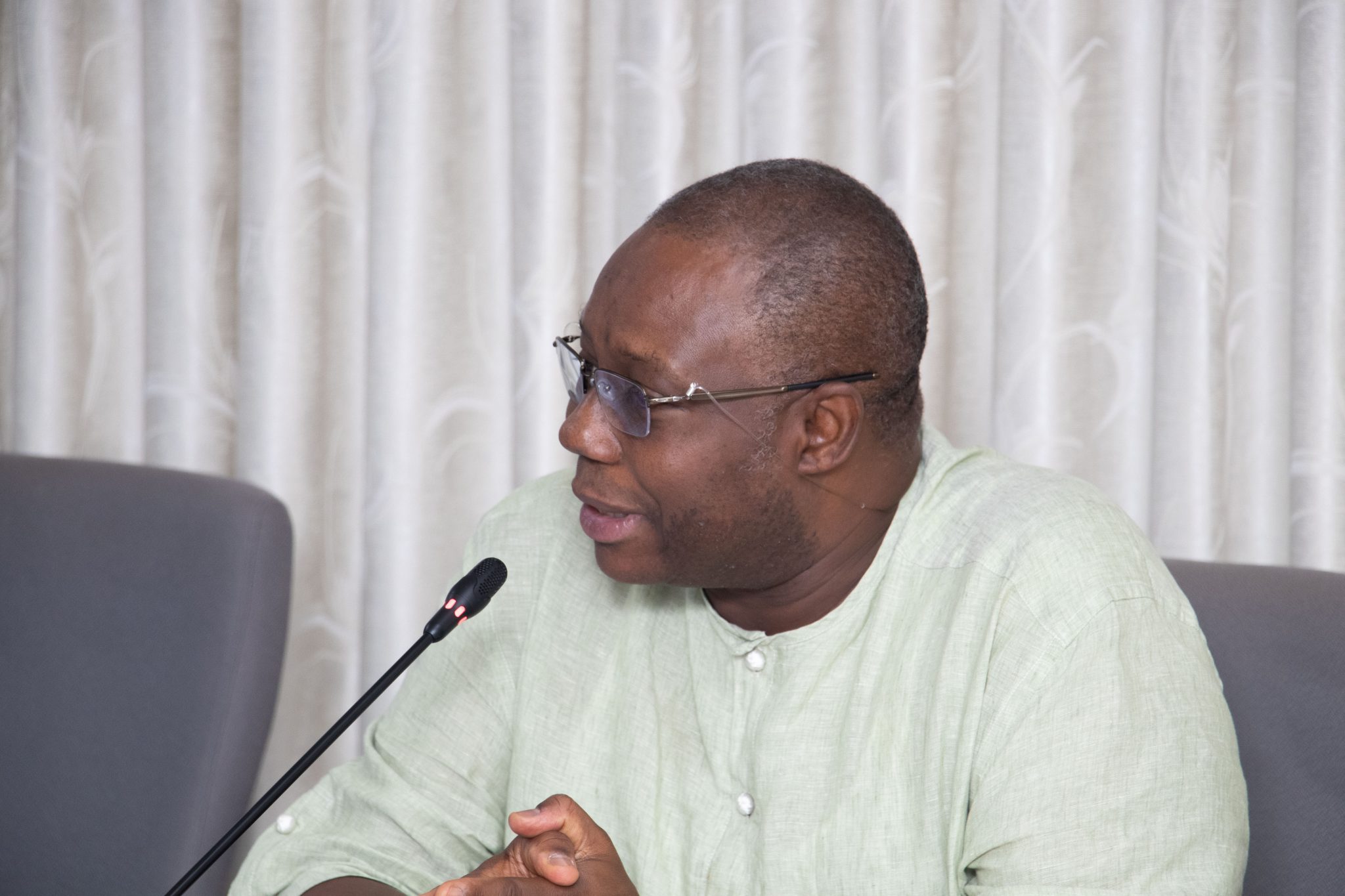
Le Directeur exécutif du FARA, Dr Yemi Akinbamijo, s’adressant aux participants, a souligné la nécessité de délibérations ouvertes et franches étant donné qu’il s’agit de la meilleure manière de créer la synergie nécessaire et l’alignement requis dans la mise en œuvre du CAADP XP4.
Dr Akinbamijo a également indiqué que « pour nous permettre de rester concentrés sur notre objectif et de faire le point sur les progrès réalisés dans la mise en œuvre de notre stratégie, le présent forum a pour objectif de nous aider à réfléchir aux orientations stratégiques devant guider la mise en œuvre de nos interventions en matière d’AR4D sur le continent. »
Dr Malu Ndavi, responsable du programme CAADP XP4 au Fonds international de développement agricole (FIDA), a saisi l’occasion pour réitérer les attentes de la Commission européenne qui finance le Programme CAADP XP4. Il a également suggéré d’élargir le PC Panel pour prendre en compte les vues d’autres acteurs de la chaîne de valeur agricole tels que les agriculteurs.
Dr Kwesi Attah-Krah, Directeur, Plaidoyer et alignement des pays, Bureau du Directeur général, à l’Institut international d’agriculture tropicale, a pour sa part rappelé aux participants la nécessité d’une collaboration et d’une harmonisation étant donné que la réussite du FARA est indispensable au succès global de la recherche agricole pour le développement en Afrique.
Le PC Panel est composé des Directeurs de la recherche et de l’innovation des institutions de l’AR4D en Afrique notamment le FARA, l’AFAAS, l’ASARECA, le CCARDESA, le CORAF et la NAASRO. Parmi les autres membres du comité figurent des directeurs, des conseillers et des spécialistes principaux au FARA ainsi que des experts (Dr Kwesi Attah-Krah, Dr Jojo Baidu-Forson, Dr David Nelson et Dr Irie Vroh-Bi).
The 2020 meeting of the programme coordination panel for the Ex-CAADP Pillar IV institutions is being hosted by the Forum for Agricultural Research in Africa (FARA), in Accra. As a technical arm of the African Union, FARA is responsible for the advancement and coordination of Agricultural Research for Development in Africa.
To effectively play its coordination role, FARA has instituted a Programme Coordination Panel (PC Panel) to provide technical advice, quality assurance and relevance of its Programmes and Projects in line with its mandate of deepening and coordinating Integrated Agricultural Research for Development in Africa.
The PC Panel aims to build the capacity and readiness of FARA to coordinate, take advantage of opportunities, enhance synergies and accountability and reduce duplications in the implementation of the CAADP XP4. The PC Panel is currently FARA’s main instrument for peer reviewing and joint planning, which is used to provide direct advisory support to the forum’s Directorate of Research and Innovation for ensuring programme quality, and alignment of FARA’s programmes to other AR4D interventions in Africa.
The two-day PC Panel engagement seeks among other things:
to take stock of the highlights of the implementation of FARA’s Strategy (2019- 2028), to guide reflection on strategic direction to the AR4D interventions on the continent;
identify areas of alignment of FARA’s Strategy to respective strategies of SROs and AFAAS to jointly support AR4D institutions in Africa;
refine areas of planning to strengthen partnership and cooperation among partner-member institutions of the PC panel;
the update specifically the joint planning and portfolio review mechanisms within the CAADP-XP4 Project
Addressing the participants, the Executive Director of FARA, Dr Yemi Akinbamijo, underscored the need for open and frank deliberations as that is the surest way of creating the needed synergy for alignment for implementing the CAADP XP4.
“The PC Panel is instituted to help build our preparedness to work together in the area of AR4D in Africa. It is a peer review mechanism, where we are encouraged to open our books to one another, having a frank conversation and drawing on the experiences of everyone in the room”
Dr Akinbamijo also indicated that
“as a part of keeping our eyes on the ball, and to take stock of the highlights of the implementation of our strategy, we hope that this forum will help us to reflect on our strategic directions for our AR4D interventions on the continent”.
Dr Malu Ndavi, Programme Manager for the CAADP XP4 at the International Fund for Agricultural Development, IFAD, used the occasion to reiterate the expectations of the European Commission who are the funders of the CAADP XP4 Programme and also suggested the expansion of the PC Panel to accommodate views from other actors in the agricultural science research value chain such as farmers.
“There are very specific achievements that the EC expects from the CAADXP4 implementing institutions. We want the partners to be more external-looking as opposed to internal-looking, to enhance collaboration. There should be the possibility to include representatives of farmer organizations on the PC Panel, to provide inputs to the strategic thrust of the CAADP XP4”
On his part, Dr. Kwesi Attah-Krah, Director, Advocacy and Country Alignment, Office of the Director-General, International Institute of Tropical Agriculture, reminded the participants of the need for collaboration and alignment as the success of FARA is vital to the overall success of Agricultural Research for Development in Africa.
The PC Panel is constituted by Directors of Research and Innovation of AR4D institutions in Africa, notably, FARA, AFAAS, ASARECA, CCARDESA, CORAF and NAASRO. Other members include Directors, Advisors and Lead Specialists in FARA.
The Board of Directors and Management of the Forum for Agricultural Research in Africa (FARA), wish to announce to the general public and all stakeholders, the 8th Africa Agriculture Science Week (AASW8), and FARA General Assembly, scheduled for June 15 to 18, 2020 in Accra, Ghana. This year’s event is under the theme, Foresighting Africa’s agri-food systems: innovations, institutions, impact.
The Africa Agriculture Science Week is a triennial platform that brings together stakeholders in Africa’s agriculture and agribusiness research and innovation to exchange information, showcase new products, network and shape the research and innovation agenda for the next triennium.
The details of venue and other event logistics arrangements shall be communicated in the next couple of days.
Le Conseil d’administration et la direction du Forum pour la recherche agricole en Afrique (FARA), souhaitent informer le public et toutes les parties prenantes que la 8e édition de la Semaine africaine des sciences agricoles (SASA8) et Assemblée générale du FARA se tiendra du 15 au 18 juin 2020 à Accra (Ghana). Le thème choisi cette année est « Prospective des systèmes agroalimentaires en Afrique : innovations, institutions, impact ».
La Semaine africaine des sciences agricoles est une tribune qui, tous les trois ans, réunit les parties prenantes de la recherche et de l’innovation dans le secteur agricole et agroalimentaire en Afrique pour échanger des informations, faire connaître de nouveaux produits, établir un réseau de contacts et façonner le programme de recherche et d’innovation pour les trois années à venir.
Le lieu et les dispositions logistiques prévus pour cette rencontre seront communiqués dans les prochains jours.
Pour plus de renseignements, veuillez prendre contact avec :
Aggrey Agumya (Président du comité d’organisation du SASA8 au FARA) : [email protected]
Christoph Essikpe (Spécialiste en communication au FARA) : [email protected]
The Forum for Agricultural Research in Africa (FARA) advances the systematic adoption of science-led solutions towards addressing Africa’s food insecurity challenges by promoting fundamental societal change. A necessary element in this respect is addressing youth unemployment, which constitutes a significant security risk in Africa. Unfortunately, the African youth are the key actors in conflicts while Africa imports nearly $50 billion net of food annually despite holding 60% of the world’s arable land. (Michael, 2019)[1] However, the increasing number of youth in Africa presents both challenges and opportunities for the growth of the agricultural sector, obviating the need to redirect the continent’s youthful energy and the [2], to drive economic transformation predicated on Agriculture Research and Development (ARD).
In Sub-Saharan Africa, 80% of all farms are small-scale with varied production of subsistence crops and a few cash crops on small plots of land. They rely majorly on family labor, with women playing a vital role. Investment priorities should, therefore, focus on supporting smallholder farmers and especially in the rural areas to become profitable considering 60% of Africa’s youth live in rural settings. (BBC, 2019)[3] Tangible actions are needed by the development community, national governments, and private sector partners to create the right conditions and policies to fast track this.
Beyond changing policies, their enforcement at all levels within the society is critical. This would include a concerted effort to deepen the understanding of barriers such as skills, access to resources, decision-making power, discriminatory norms, care obligations, security concerns, etc., which often hamper their implementation. In particular, the roles and priorities of women and youth, who often constitute the marginalized groups of the society, are important. These groups, therefore, need to be included in research in a meaningful way. For example, offering child-care support options, flexible schedules and proximity to the home when targeting (young) women; and affirmative actions, to ensure inclusion of women and youth. Investing in capacity development and agri-preneurship for gender and youth inclusions are very critical as research has shown that if women had the same access to agricultural resources as men, about 150 million fewer people would go hungry.
Social protection is also important for addressing economic and social risks, yet women and youth often face restricted access to, or exclusion from, social protection and social security. Some key suggestions for AR4D practitioners include; 1) encouraging national governments to commit to and invest in enhancing the collection, dissemination and analysis of data on youth and women, disaggregated by age and sex, education, qualifications, competencies, capacities, occupation, employment situation, and skill level, as well as country of origin; 2) building capacity for national governments to apply this data to meet age-sensitive, and equity-focused approaches to youth in agriculture and development; 3) promoting investment in Science, Technology and Innovations (STI) to provide conditions that make investment viable and sustainable in rural contexts and 4) expanding access to education, apprenticeships, finance, business and employment opportunities for young women and men in Agricultural Research for Development across the continent, and empowering them to expand access to their peers.
Operationally, the African Continental Free Trade Area (AfCFTA), provides an opportunity to increase youth and women’s participation in agricultural food enterprises. Women constitute 70% of the workforce in the agricultural sector in Africa and 10% in basic food processing. They also carry out 60 to 90% of the total rural marketing, which is mostly through informal channels. According to GrowAfrica’s analysis while celebrating the success of women in Agribusiness in 2018, women’s capacity to organize and mobilize while taking charge of their own issues provides great chances of them accessing the support they need in order to grow their businesses. As Africa prepares to silence the guns and end conflicts across the continent, there is a need for bold actions both in policy and investments to increase food security by strengthening critical mass and large numbers of youth and women to successfully and sustainably participate in AR4D.