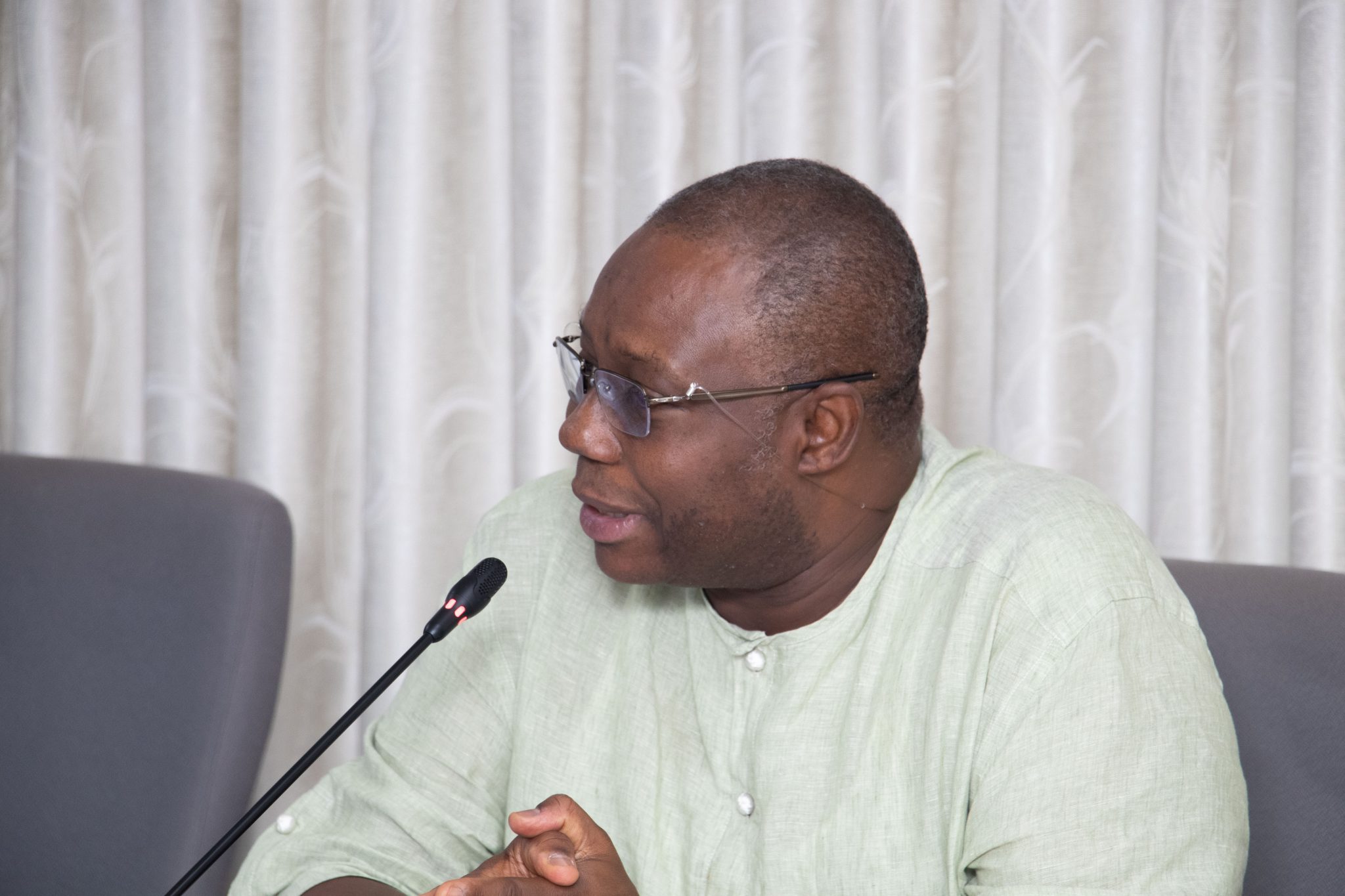
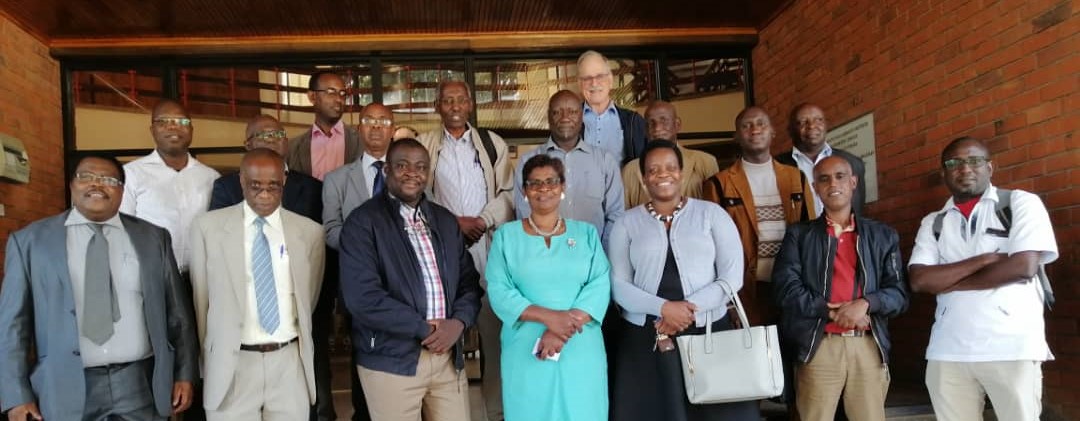
The 2020 meeting of the programme coordination panel for the Ex-CAADP Pillar IV institutions is being hosted by the Forum for Agricultural Research in Africa (FARA), in Accra. As a technical arm of the African Union, FARA is responsible for the advancement and coordination of Agricultural Research for Development in Africa.
To effectively play its coordination role, FARA has instituted a Programme Coordination Panel (PC Panel) to provide technical advice, quality assurance and relevance of its Programmes and Projects in line with its mandate of deepening and coordinating Integrated Agricultural Research for Development in Africa.
The PC Panel aims to build the capacity and readiness of FARA to coordinate, take advantage of opportunities, enhance synergies and accountability and reduce duplications in the implementation of the CAADP XP4. The PC Panel is currently FARA’s main instrument for peer reviewing and joint planning, which is used to provide direct advisory support to the forum’s Directorate of Research and Innovation for ensuring programme quality, and alignment of FARA’s programmes to other AR4D interventions in Africa.
The two-day PC Panel engagement seeks among other things:
to take stock of the highlights of the implementation of FARA’s Strategy (2019- 2028), to guide reflection on strategic direction to the AR4D interventions on the continent;
identify areas of alignment of FARA’s Strategy to respective strategies of SROs and AFAAS to jointly support AR4D institutions in Africa;
refine areas of planning to strengthen partnership and cooperation among partner-member institutions of the PC panel;
the update specifically the joint planning and portfolio review mechanisms within the CAADP-XP4 Project
Addressing the participants, the Executive Director of FARA, Dr Yemi Akinbamijo, underscored the need for open and frank deliberations as that is the surest way of creating the needed synergy for alignment for implementing the CAADP XP4.
“The PC Panel is instituted to help build our preparedness to work together in the area of AR4D in Africa. It is a peer review mechanism, where we are encouraged to open our books to one another, having a frank conversation and drawing on the experiences of everyone in the room”
Dr Akinbamijo also indicated that
“as a part of keeping our eyes on the ball, and to take stock of the highlights of the implementation of our strategy, we hope that this forum will help us to reflect on our strategic directions for our AR4D interventions on the continent”.
Dr Malu Ndavi, Programme Manager for the CAADP XP4 at the International Fund for Agricultural Development, IFAD, used the occasion to reiterate the expectations of the European Commission who are the funders of the CAADP XP4 Programme and also suggested the expansion of the PC Panel to accommodate views from other actors in the agricultural science research value chain such as farmers.
“There are very specific achievements that the EC expects from the CAADXP4 implementing institutions. We want the partners to be more external-looking as opposed to internal-looking, to enhance collaboration. There should be the possibility to include representatives of farmer organizations on the PC Panel, to provide inputs to the strategic thrust of the CAADP XP4”
On his part, Dr. Kwesi Attah-Krah, Director, Advocacy and Country Alignment, Office of the Director-General, International Institute of Tropical Agriculture, reminded the participants of the need for collaboration and alignment as the success of FARA is vital to the overall success of Agricultural Research for Development in Africa.
The PC Panel is constituted by Directors of Research and Innovation of AR4D institutions in Africa, notably, FARA, AFAAS, ASARECA, CCARDESA, CORAF and NAASRO. Other members include Directors, Advisors and Lead Specialists in FARA.
Hon. Sekou SANGARE, the Commissioner for Agriculture, Rural Economy and Environment of the Economic Community of West African States, has pledged his commitment to FARA’s Agricultural Research and Innovation Fellowship for Africa (ARIFA), ahead of its announcement later this year.
On the margins of the governing council meeting of CORAF, the Executive Director of FARA, Dr Yemi Akinbamijo discussed with Commissioner Sangare, the essence of the deployment of science to propel Africa’s agriculture, which is at the heart of the ARIFA initiative, indicating that it would be difficult for Africa to be food and nutrition secure without the deployment of science in Africa’s agriculture. He also explained the genesis of ARIFA which comes under another FARA flagship initiative, the Holistic Empowerment for Livelihoods Program (HELP).
Commissioner Sangare has been extremely receptive of the initiative and has indicated that FARA could count on him and his support for the capacity development of ECOWAS citizens in the area of agricultural research and innovation.
Dr Yemi Akinbamijo explained that under HELP, FARA is implementing the Agricultural Research and Innovation Fellowship for Africa, which aims to produce a new generation of fit-for-purpose workforce to re-engineer the African agri-food sector to provide the change factor for rapid agricultural transformation in the next 10 years. ARIFA will facilitate regular entry of cohorts of graduates and agri-preneurs into the innovation systems apparel of FARA through Innovation Platforms (IP) and rural learning routes located in and around African institutions, universities, technical colleges and rural communities.
The meeting was preceded by a field trip that allowed the participants to have a first-hand appreciation of the physical environmental challenges confronting the agricultural sector of the Republic of Cape Verde. The field trip was at the instance of the Director for Agricultural Research Institute of Cape Verde (INIDA) with a first visit to the Sao Felippe Research station. The work at the research station is principally focused on hydroponics as a major production system for horticulture since the country experiences long spans of drought. The mission was also able to appreciate firsthand the diverse coping mechanisms with drought, FAW and rocky terrain that hamper the use of farm machines.
The Forum for Agricultural Research in Africa (FARA), has launched the Brazilian version of the Agricultural Research and Innovation Fellowship for Africa (ARIFA), which will see young Africans equipped with 21st century skills and capacity to innovate. The launch of ARIFA on the margins of the Brazil Africa Forum 2019, currently underway in Sao Paulo, was chaired by Nigeria’s Minister of State for Education, Barrister Chukwuemeka Nwajiuba, and was also attended by other dignitaries including Ghana’s Ambassador to Brazil, Professor Abena Busia.
Speaking during the launch, Dr. Yemi Akinbamijo, the Executive Director of FARA, underscored the essence of the deployment of science to propel Africa’s agriculture, which is at the heart of the ARIFA initiative, indicating that it would be difficult for Africa to be food and nutrition secure without the deployment of science in Africa’s agriculture. He also explained the genesis of ARIFA which comes under another FARA flagship initiative, the Holistic Empowerment for Livelihoods Program (HELP).
Dr. Yemi explained that under HELP, FARA is implementing the Agricultural Research and Innovation Fellowship for Africa, which aims to produce a new generation of fit-for purpose workforce to re-engineer the African agri-food sector to provide the change factor for rapid agricultural transformation in the next 10 years. ARIFA will facilitate regular entry of cohorts of graduates and agri-preneurs into the innovation systems apparel of FARA through Innovation Platforms (IP) and rural learning routes located in and around African institutions, universities, technical colleges and rural communities.
Professor Vladimir Oliveira Di Iorio, Director of International Affairs at Universidade Federal de Viçosa (UFV), speaking to the South-South collaboration between FARA and the UVF, indicated the preparedness of the UVF to partner FARA on this journey.
“We have good reasons for high expectations for this partnership…we are glad to see that UFV has become one of the most important institutions to contribute to ARIFA”
In the first cohort in 2020, the UVF will host up to one hundred and twenty (120) ARIFA Fellows in short courses related to Brazilian agri-business and in Masters programmes in agriculture and food. The UFV/FARA Masters partnership will offer places for ARIFA Fellows in all agriculture related UFV graduate programmes.
Commenting on the objectives of the ARIFA, Director of Research and Innovation at FARA, Dr. Irene Annor-Frempong explained that ARIFA fits into the wider “Africa we want” agenda. She states that the Agenda 2063 encompasses a number of strategies including the strategy for Science, Technology and Innovation for Africa (STISA) and ARIFA will contribute to the Priority One of the STISA Framework.
“ARIFA is at the heart of training those practitioners that will formulate the DNA of advancing the Science Agenda on the continent”
Dr. Abdulrazak Ibrahim, Capacity Development Expert at FARA, who moderated the launch, indicated that ARIFA was designed with the innovation systems thinking to empower young Africans with 21st century skills needed for the continent to navigate through the current global challenges including climate change and the opportunities offered by the implementation of the Africa Continental Free Trade Agreement.
As part of the Development Smart Innovation through Research in Agriculture (DeSIRA), the European Commission (EC) and International Fund for Agricultural Development (IFAD) are jointly supporting the Comprehensive Africa Agriculture Development Programme (CAADP) ex-pillar IV Organisations in implementing a science-led and climate relevant agricultural programme; Supporting Implementation of a Science-Led and Climate-Relevant Agricultural Transformation in Africa (SISTA).
The Forum for Agricultural Research in Africa (FARA) and partner sub-regional agricultural research organizations are benefiting from the programme, which seeks among other things to contribute to progressive achievement of zero hunger (Sustainable Development Goal (SDG) 2), the action to combat climate change and its impacts (SDG 13), to promote progress towards ending poverty (SDG 1), gender equality (SDG 5), decent work and economic growth (SDG 8), and responsible consumption and production (SDG 12). The Programme will additionally contribute to Agenda 2063 and the Malabo Declaration of the African Union (AU).
With financing from the European Union, the five organizations – FARA, AFAAS, CORAF, ASARECA, CCARDESA – will implement individual projects as part of the overall programme with overall objective to enable agricultural research and innovation, including extension services, to contribute effectively to food and nutrition security, to economic development and climate mitigation in Africa. This will be achieved by improving the capacity, effectiveness and positioning of the regional and sub-regional agriculture research and extension organizations as well as National Agriculture Research Systems, and by promoting collaboration and knowledge sharing among the organizations.
The SISTA Inception Workshop was held in Johannesburg from 21st to 25th October and was attended by representatives of the implementing organisations and other partners and collaborators.
12/10/2017–NAIROBI – The Programme for Accompanying Research for Agricultural Innovation (PARI) and the Forum for Agricultural Research in Africa (FARA) have commenced a research action intended to scale innovations in the livestock value chain. (more…)
On 20th September 2019, the Executive Director of FARA Dr. Yemi Akinbamijo led a team of Secretariat staff that met with the leadership of the African Union Development Agency (AUDA)-NEPAD to deliberate on the future partnership between the two organizations. In this meeting, FARA sought to establish its role in the context of the redefined mandate of AUDA, namely to coordinate and execute priority regional and continental development projects towards the accelerated realization of Agenda 2063 – Africa’s vision and action plan. AUDA-NEPAD affirmed that FARA will continue to serve as its technical arm on continental agriculture research and innovation issues and workstreams.
AUDA-NEPAD and FARA identified several concrete actions they will execute jointly towards implementation of commitments by AU Heads of State and Government at their sitting in Malabo in 2014 (Malabo Commitments). These include: (i) mainstreaming the Science Agenda for Agriculture in Africa into National Agriculture Investment Plans and Programmes; (ii) development of African capacity in foresight, and (iii) undertaking foresight studies to improve the planning for Africa’s future agriculture and food system. The foresight studies are particularly targeted at strengthening the planning for harnessing the science, technology and innovation required to enable the continent’s agriculture and food system meet the exacting demands of the future.