Key African institutions and CGIAR have drafted a new agriculture-for-development knowledge management (KM) framework for Africa to enhance research (and extension) collaboration that transforms and sustains food, land and water systems.
This framework was part of from the Forum for Agricultural Research in Africa (FARA) Knowledge Management for Agricultural Development (KM4AgD) challenge, which brings together communication and knowledge management staff from across Africa to reflect and co-design KM strategies and good practices. The aim is to enable agricultural research and innovation, including extension services, to contribute effectively to food and nutrition security, economic development and climate mitigation in Africa. The program’s three-month course, in collaboration with the Knowledge for Development Partnership (K4DP), builds the individual and collective capacities of the critical supra-national agricultural research and innovation institutions.
The new framework was shared and endorsed at the FARA-led Science and Partnerships for Agriculture Conference held in Accra, Ghana, on 14–16 September, 2022. In his opening remarks, Simplice Noula Fonkou, head of the Agriculture and Food Security Division at the African Union Commission, commented: “We realize that our lack of appreciation of knowledge management over time has kept us back. FARA’s knowledge management initiative, under the CAADP-XP4 action, is helping to up the game of African institutions to ensure that knowledge is packaged, archived, disseminated, and utilized properly.”
Given the recent consultations between FARA, the Africa Union, African Development Bank (AfDB) and CGIAR regarding how best to work together to strengthen African agricultural development, the challenge for the group was to co-design a joint framework for collective action around knowledge management.
As Aggrey Agumya, FARA’s director of research and innovation mentioned, “FARA and CAADP-XP4 institutions have had a strong collaboration with individual CGIAR Research Centers. This group has made an important step forward to establish a framework on how we work together in a more seamless way.”
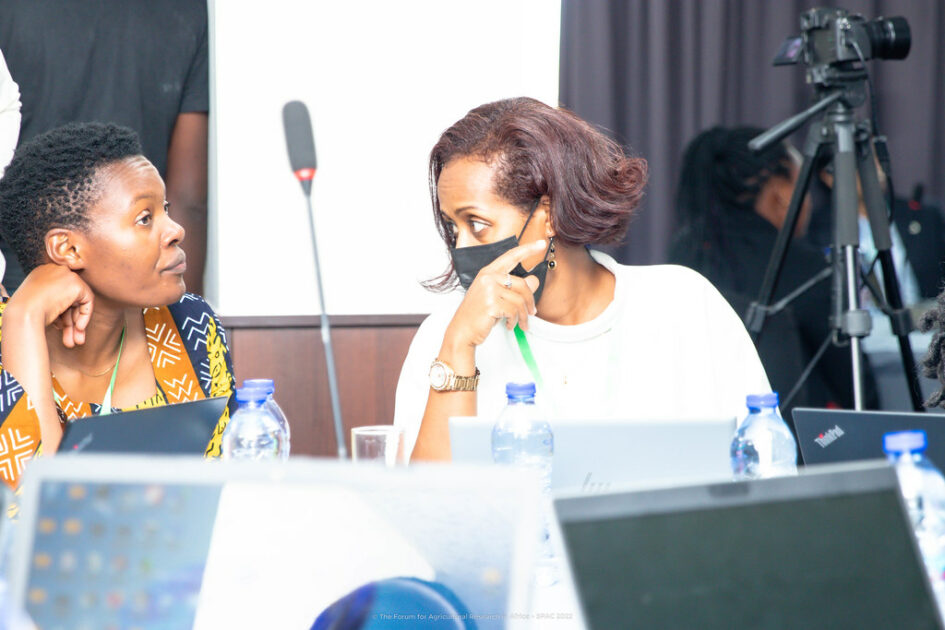
Tsehay Gashaw, ILRI and Patricia Oynango (Alliance) discussing. Source: FARA Flickr
After a SWOT analysis of the situation and an initial knowledge café within the context of the KM4AgD Challenge, the group used a KM framework within the Akosombo Integration Agenda to develop priority work areas. These priorities are around knowledge partnership, leadership, and governance; knowledge processes; knowledge products and services; and monitoring and evaluation.
The framework is underpinned by the guiding principles of the joint Communique on “The High-Level Consultative Forum on Strengthening Africa’s Agricultural Research and Innovation in the Context of the One CGIAR Reforms.” Some of the key challenges it expects to tackle include:
Establishing more systematic linkages between CGIAR and CAADP-XP4 partners: The partnership will look to establish formal and informal working ties between CGIAR centers and CAADP-XP4 partners. It will also emphasize learning as well as mechanisms such as use of the FARA Africa Dgroups Community in advancing knowledge sharing and learning.
Getting technologies to the field: The joint communique explicitly mentions the need to improve delivery of technologies to farmers “at the scale of millions of farmers and in particular, working through AfDB’s Technologies for African Agricultural Transformation (TAAT) to get to farmers at scale”. The joint framework builds upon this by including actions to support countries’ design strategies and policies. It also advocates for investment in digital extension and decentralizing information at extension level, thus bringing it closer to the farmers. Much of this work will be done through the African Forum for Agricultural Advisory Services (AFAAS) and its partners in the context of the Research to Extension Agenda (R2E Agenda).
Developing open and interoperable systems: Ensuring that data is shared and used openly between CGIAR centers and national and supra-national organizations is critical. The framework lays out critical actions to ensure greater openness between institutions, and development of standardized data and information-sharing protocols. One immediate action will be the development of a network of DSpace users for sharing research outputs. In the short to medium term, the development of a continental knowledge graph for AR4D has been proposed.
Making research processes more inclusive: A key priority for CGIAR and CAADP-XP4 partners is to improve priority setting in addition to instituting and ensuring a mechanism for effectively representing Africa’s priorities and research delivery. Knowledge sharing and management can support this effort through improved sharing and exchange, and a joint culture of working together on specific activities. This collaboration will particularly focus around KM products, events and resource mobilization as well as joint awards to recognize contributions on specific topics. The partners will also work to acknowledge the need to “decolonize” the research effort to make sure a diversity of knowledge systems and perspectives are recognized.
What remains to be done before full implementation is to have the key institutions sign off on the framework.
The team that developed this framework included:
Peace Lydia Mutuwa, Africa Union Commission
Andrianjafy Rasoanindrainy (Andri Raso), AFAAS
Ben M. Ilakut, ASARECA
Bridget Kakuwa, CCARDESA
Benjamin Abugri , FARA
Murielle Anougbre, AfricaRice/CGIAR
Edith Mutui and Patricia Onyango, CIAT/CGIAR
Tsehay Gashaw, ILRI/CGIAR
Soji Oloyede and Olumide Adeniran, IITA/CGIAR
Michael Victor (ILRI) and Katherine Lopez (IITA) provided support throughout the process. This work has also contributed to ongoing efforts to develop a CGIAR knowledge management strategy.
If you are interested in learning more about the framework, please contact Tsehay Gashaw ([email protected]) and Bridget Kakuwa ([email protected]).
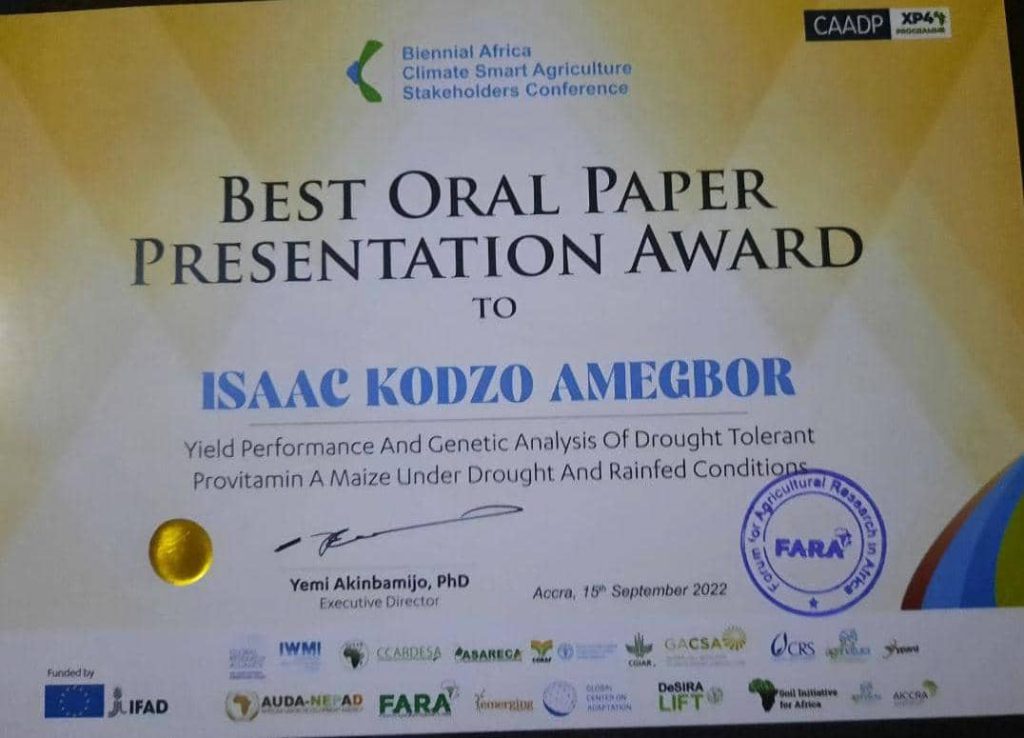
Dr. Isaac Kodzo Amegbor, a Research Scientist and Maize Breeder at the Savanna Agricultural Research Institute of the Council for Scientific and Industrial Research (CSIR-SARI) was presented with the “Best Oral Paper Presentation Award” at the Science and Partnership Agricultural Conference held at the Alisa Hotel from the 14th to the 16th of September, 2022.
The conference was organized by Forum for Agricultural Research in Africa (FARA) under the theme “Advances in Climate Smart Agriculture technology generation and use in the crop, livestock, fisheries, and aquaculture”. Dr. Amegbor gave a presentation on his research paper titled “Yield performance and estimates of genetic analysis of drought tolerant provitamin A maize under drought and rain fed conditions” which led to winning the award out of 113 presentations.
Dr. Amegbor said, “The award-winning presentation was an extract from a manuscript I submitted with my colleagues. Hence, it was a collective win. I would like to take this opportunity to thank all the co-authors: Drs. Darkwa, Nelimor, Adu, Mr. Kulai, Ms. Aboyadana, and our Director, Dr. Francis Kusi for their contributions to the manuscript.”
The Science and Partnerships for Agriculture Conference is crafted to encapsulate broad-based partnerships at different levels to address key issues in Africa’s agricultural research and innovation space. The conference hosts four continental and bi-continental initiatives supported by different European Union funding portfolios, International Fund Agricultural Development, Catholic Relief Services, GCA, GRA, etc. The four key conferences will run simultaneously but independently, that is “the 2022 Biennial Africa CSA stakeholders conference; the LEAP4FNSSA final writeshop to develop the EU/AU International Research Consortium on Food and Nutrition Security and Sustainable Agriculture and closing General Assembly; the 2022 scientific meeting of the Pan-African Network for Economic Analysis of Policies (PANAP) and the Knowledge Management for Agriculture Conference (KM4AGD).
The joint conference will provide the opportunity to leverage the participation of high-level individuals in Africa and European agriculture to jointly address pertinent emerging issues affecting the continent. The four conferences and their constituents will provide important technical and policy information from different engagements.
The Award came with a certificate and a cash prize.
The Forum for Agricultural Research in Africa (FARA) is hosting a Science and Partnership for Agriculture Conference (SPAC) from the 14th – 16th of September 2022. This conference seeks to address pertinent issues that are affecting agricultural productivity on the continent. The conference is held at the Alisa Hotel in Accra, Ghana. The Conference will also strengthen research and develop action on topical issues in African agriculture to ensure productivity and competitiveness in the sector that engages a larger proportion of the working population on the continent.
SPAC serves as the platform for key actors to update the continent’s preparedness to cope with and mitigate the impacts of climate change in African agriculture as well as contribute to the delivery of continental instruments like Agenda 2063. It will assemble actors in the value chain including policymakers, farmers, technocrats, researchers, and the private sector to facilitate the introduction of the much-needed coordination effort for climate change actions at the continental level to prevent duplication and foster value delivery for intervention funds.
Four top-line conferences that are aligned in SPAC include the 2022 Biennial Africa Climate Smart Agriculture Stakeholders Conference; the LEAP4FNSSA closing General Assembly and the Writeshop to develop the EU/AU International Research Consortium on Food and Nutrition Security and Sustainable Agriculture. Tthe 2022 Scientific Meeting of the Pan-African Network for Economic Analysis of Policies (PANAP) and the Knowledge Management for Agricultural Development (KM4AgD) Conference.
The four conferences will run concurrently, with joint opening and closing plenaries. Afterwards, the conferences will run its programs and a series of side events.
The Biennial Africa CSA conference will give the opportunity to take stewardship of the CSA actions especially the spate of technology generation and a foresight analysis of the plausible futures. The conference will host the continental dialogue on the Africa Climate Smart Framework (ACSAF); ACSAF is developed to respond to and plan the implementation of the AU-developed Africa Climate Change Strategy. The ACSAF dialogue also provides the opportunity to prepare adequately for CoP27 in Egypt. The conference will also host a side event for stakeholders’ consultation towards the development of the Soil Initiative for Africa (SIA). There will also be a side event that will host the meeting of the High-Level Technical Think-Tank set out to respond to emerging technological issues in African agriculture. The various side event will generate outputs that will flow into the conference outputs.
The Long-term Europe-Africa Research and Innovation Partnership for Food and Nutrition Security and Sustainable Agriculture (LEAP4FNSSA) is a project supported by the EU to provide a sustainable platform for European and African institutions to partner on research and innovation around food and nutrition. Decades of bi-continental collaboration have culminated in the LEAP4FNSSA project. The actors, coming from 23 countries across Africa and Europe, have taken on the task to help to establish a sustainable structure for the efficient and coherent implementation of the EU-AU Research and Innovation Partnership and the AU-EU Roadmap for Food and Nutrition Security and Sustainable Agriculture (FNSSA). The writeshop is aimed at creating consensus among founding partners on the design, strategy, and implementation plan of an AU-EU International Research Consortium (IRC) Platform. This IRC is as a framework for improved coordination and adds value to the diversity of European and African-supported research projects and initiatives on agriculture and food security.
The Pan-African Network for economic Analysis of Policies (PANAP) aims to foster the development of centers of excellence in Africa and to promote both the Europe-Africa and intra-Africa scientific collaboration as an element to vitalize synergies in Africa and between the two continents. PANAP was officially launched at the AU in November 2019 with the participation of 19 African partners. It is also supported by the EU.
The Knowledge Management for Agricultural Development (KM4AgD) is a joint initiative of CAADP-XP4 organizations. It is a lighthouse project for knowledge-based development in agriculture in Africa. It takes place annually in a growing number of countries. The climax for each annual three months Challenge is a KM Conference (hybrid) where participants present their countries/organizational Knowledge management strategies, receive certificates as Knowledge Management Agents for Sustainable Development, inducted into the Africa KM4AgD Community of Practice and as Fellows of the Knowledge Center, and network with the wider KM global Community. The European Union (EU) under the Development Smart Innovation through Research in Agriculture (DeSIRA) initiative provided funding and the International Fund for Agricultural Development (IFAD) administers the funds.
SPAC is an intermediary conference to the 8th edition of the main Africa Agribusiness and Science Week (AASW8) and the 9th FARA General Assembly scheduled to take place from June 3 – 8, 2023 in Durban South Africa.
Partners
The conference is co-organized by the Member organizations of the CAADP-XP4 in collaboration with several partners, donor agencies, authorizing agencies and Government of Ghana.
About FARA
The Forum for Agricultural Research in Africa (FARA) is the apex continental organization responsible for coordinating and advocating for agricultural research for development (AR4D). FARA is the designated technical arm of the African Union Commission and the African Union Development Agency on matters concerning agriculture science, technology and innovation.
Accra, Ghana – Stakeholders in the area of Climate Smart Agriculture (CSA) are converging in Accra, Ghana during 14-16 September 2022 to discuss innovative and sustainable solutions to challenges of climate change in African agriculture. The theme for the conference is: Introspection on climate smart agriculture actions to strengthen accountability, resource use, and impact in Africa.
The conference will bring together academia, researchers, policymakers and other stakeholders from the African continent and European Union. Over 250 participants will attend, while others will join remotely via dedicated Zoom platform.
There will be various sessions, including Keynote addresses, plenaries, technical paper presentations, and side-events. The sub-themes for the conference are: (1) The Role of Digitalization in Advancing CSA in the Smallholders’ Systems; (2) The nexus of CSA and the mechanization of smallholder system in Africa; (3) Bottom-up and system-wide capacity development approaches to enhance CSA practices; (4) Strengthening the support of extension and advisory services to ensure CSA compliance among smallholder famers in Africa; and (5) Advances in CSA technology generation and use in crop, livestock, fisheries, and aquaculture.
The outputs of the Africa Stakeholders Conference on Climate Smart Agriculture will contribute to the Africa Position at the next Conference of Parties on Climate Change (CoP27) which will hold in Egypt in November 2022.
The Africa Stakeholders Conference on Climate Smart Agriculture is facilitated by the Forum for Agricultural Research in Africa (FARA), European Union, and other partners.
At the 15 August 2022 signing of the protocol of agreement between the bank and the executing agency for TAAT, the International Institute of Tropical Agriculture (IITA), the bank lauded the giant strides recorded under TAAT-I, which has galvanised the investment of more than $800 million in agricultural value chain projects in 21 African countries.
“The Bank is well positioned to harness the power of the science, knowledge and innovation needed to catalyse Africa’s agricultural transformation through this investment. The Bank already has extensive experience in agricultural development assistance in Africa, and this additional funding will help us to consolidate the achievements of TAAT-I,” said Beth Dunford, African Development Bank Group Vice President for Agriculture and Human and Social Development.
Speaking on behalf of the IITA Director General, Dr Kenton Dashiell, the institute’s Deputy Director General, partnerships for delivery, commended the bank’s commitment to transforming African agriculture through its Feed Africa strategy as well as the trust reposed in the consortium of agricultural research institutions led by the IITA to implement the laudable objective of transforming African agriculture.
Dr Dashiell assured the bank that TAAT-II would work closely with African countries to support the implementation of the $1.5-billion African Emergency Food Production Facility. This facility was set up by the Bank in May 2022 to help African countries obtain additional resources for agricultural production to guard against an impending food crisis due to the war in Ukraine.
The facility is expected to provide certified seeds, fertilizers, extension services and post-harvest management technologies to 20 million farmers. It is expected to produce an additional 38 million tonnes of food (11 million tonnes of wheat, 18 million tonnes of maize, 6 million tonnes of rice and 3 million tonnes of soybeans) worth $12 billion over the next two years.
It would be recalled that countries that benefited from TAAT-I have substantially increased production and commercialization, raised farmers’ incomes and created job opportunities for women and youth. TAAT-I provided over 61,000 metric tons of heat-tolerant wheat seed varieties to Ethiopia. The seeds have enabled Ethiopia to boost its cultivated areas of wheat production from 50,000 hectares in 2018 to 167,000 hectares in 2021 and to 400,000 hectares in 2022.
In addition, Ethiopia has not imported wheat this year and is now producing wheat on 650,000 hectares and is on track to cultivating 2 million hectares next year. The country harvested 2.6 million tons and plans to begin exporting to Kenya and Djibouti next year.
Drawing largely on the results of TAAT-I, TAAT-II will strengthen national and regional seed-production systems to provide farmers with sufficient climate-resilient seeds, using a market-based model and helping local private sectors spread technologies and services (seeds, fertilisers, extension) on a larger scale in villages.
TAAT-II incorporates a nutrition compact (soybeans, vegetables, orange-flesh sweet potatoes and high iron beans) to develop nutrient-rich commodities, raise awareness and improve the adoption of foods with high nutritional values.
Established in 2018 as a key flagship programme of the Bank’s Feed Africa strategy (2016 – 2050), TAAT is a continent-wide initiative designed to boost agricultural productivity by rapidly delivering proven technologies to millions of farmers.
TAAT seeks to double crop, livestock, and fish productivity by expanding access to productivity-increasing technologies to more than 40 million smallholder farmers across Africa by 2025 and generating an additional 120 million metric tons.
A FARA Delegation to the Ministry of Science, Technology and Innovation (MESTI) of the Government of Ghana was led by the Executive Director of FARA, Dr Yemi Akinbamijo on a courtesy visit to the Minister of MESTI Hon. Dr Kwaku Afriyie in his Accra office, on Tuesday 30th August 2022.
The purpose of the visit was to brief the Honourable Minister on the upcoming Science and Partnerships Conference slated for 14-16 September in Accra, Ghana. It is anticipated that the Honourable Minister will officiate the launch of the International Research Consortium (IRC). The Africa-Europe International Research Consortium (IRC) is a long-term platform for connecting Research and Innovation Institutions, private sector, funders, policy makers and other actors for Food nutrition security and sustainability. The IRC is being set up under the aegis of the AU-EU High Level Policy Dialogue (HLPD) and Ghana is a member of the HLPD Bureau. In response to the request, the Minister affirmed his full support and enthusiasm to participate in the event; he was handed the first set of document for the launch. To read more details of the IRC, visit https://us02web.zoom.us/meeting/register/tZwtce6sqjgvGNYvl12Un2p4MXTnNcXMYqK7;