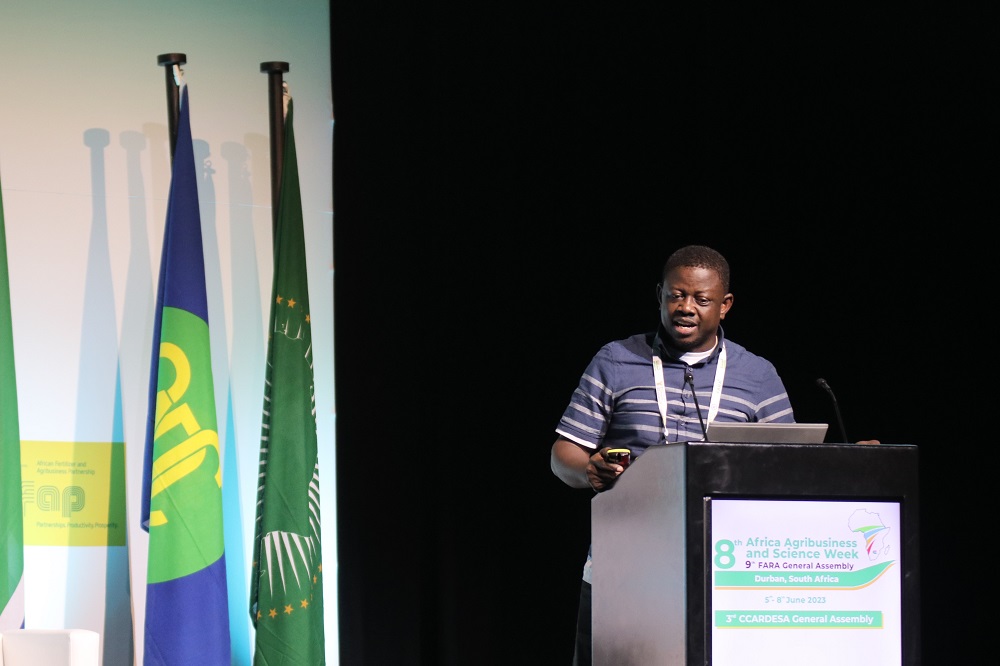
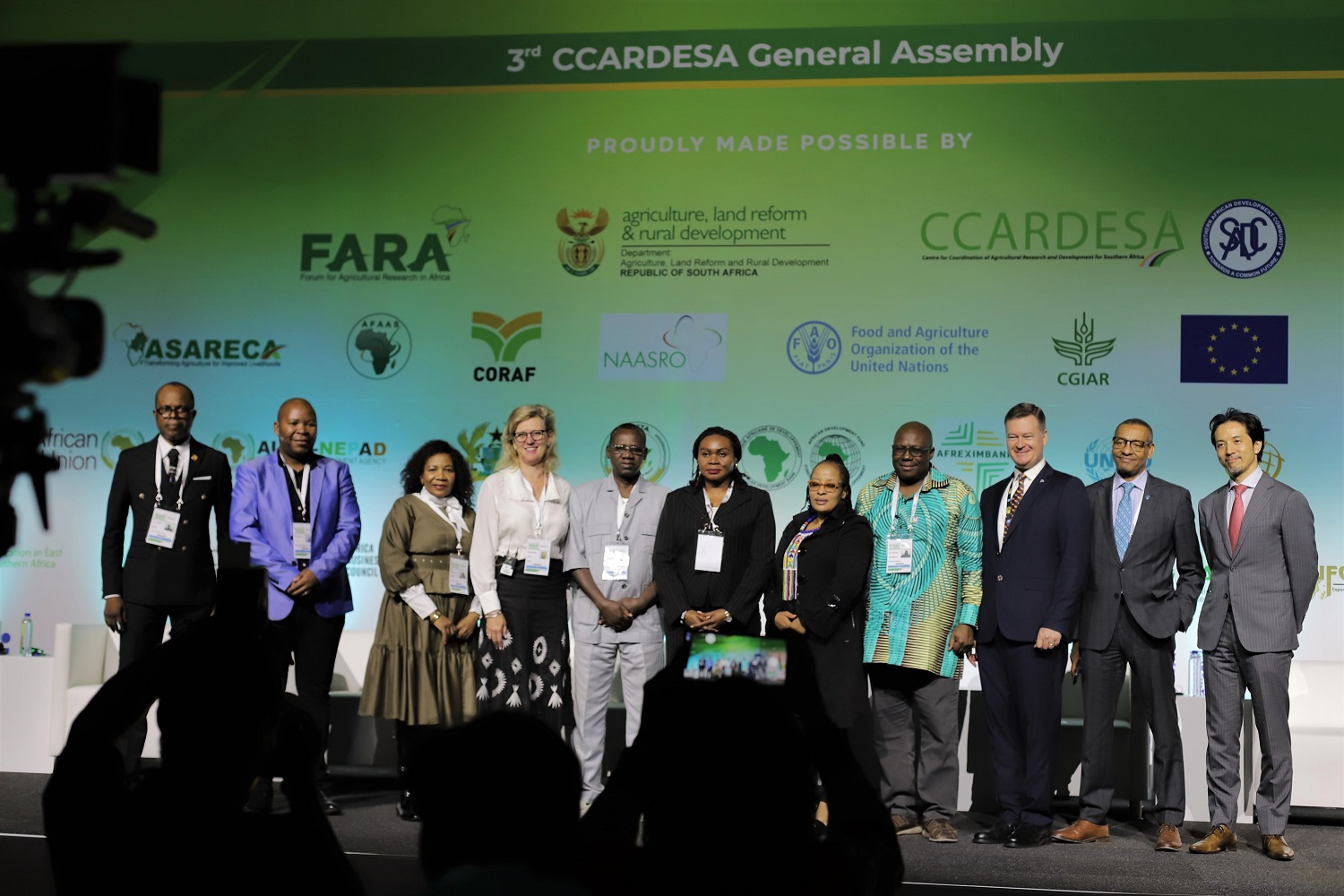
The Africa Union Commission (AUC), the CGIAR and the CAADP-XP4 Consortium have signed a Memorandum of Understanding (MoU) on the Knowledge Management Partnership Framework for Africa AR4D.
The MoU was signed during the 8th Agriculture and Science Week held in Durban, South Africa.
The framework will align CGIAR’s strategy with Africa’s priorities and frameworks for the development of agriculture, notably the Comprehensive Africa Agriculture Development Programme (CAADP) and the Science, Technology and Innovation Strategy for Africa (S3A).
Addressing participants on the theme “CAADP-X4P Knowledge management session: Acting on a Collaborative Agenda”, the Knowledge Management Officer at the AU, Peace Mutuwa stated that “partnership is very important because knowledge that is not be shared is not valuable; you only add value to knowledge and once it is shared and it is important that we collaborate, co-create, and inform the policies that will be implemented by the member states.”
Hence the partnership will contribute to an institutional framework that supports and strengthens national and supra-national agricultural research organizations
The Knowledge Management and Outreach Officer at FARA, Benjamin Abugri added that “knowledge is a foundation for innovation because it is a very critical factor for any healthy agro-food innovation system; we also think that making science accessible to stakeholders can easily be driven by their knowledge management agenda”.
The framework will support the focus on getting technologies out to farmers, at the scale of millions of farmers through the African Development Bank’s Technologies for African Agricultural Transformation (TAAT).
Also, a jointly organized technologies fair which will help achieve two (2) harvests per season to improve food security.
The CAADP-XP4 Consortium is made up of FARA, AFAAS at the continental level and CCARDESA, ASARECA and CORAF at the sub-regional levels representing SADC, COMESA and ECOWAS respectively.
Dr Amany Asfour is an Egyptian economist and businesswoman.
Appointed in 2021 as the President of the African Business Council {AfBC), Dr Asfour leads the council which is an independent private-sector institution of the African Union.
The council established in 2007, promotes and advocates for the interests of the African private sector. It also has a primary role to fast-track intra-trade in African countries and boost the integration of AfCFTA.
Education
Dr Asfour graduated from the Faculty of Medicine in the Cairo University, proceeded to earn her master’s degree and M.D. in Pediatrics.
She is a lecturer of pediatrics at the National Research Center of Egypt.
She joined the private sector while a student and has within a few years being able to establish a company for medical equipment. It sells more than 30 different brands.
Leadership
Dr. Amany Asfour is a trailblazing Egyptian businesswoman and entrepreneur who has dedicated her career to empowering women and youth in Africa.
She is the President of the African Business Council (AfBC), the Chair of Trade Promotion Committee of the COMESA Business Council, and the Vice President of PAFTRAC, the Pan African Committee for Trade and Investment.
She is also the President of the African Alliance for Women Empowerment (AFRAWE), the Egyptian Business Women Association (EBWA), and the Founder and Honorary President of Business and Professional Women-Egypt (BPW-Egypt).
Asfour is active in the African, Arab, and Mediterranean. She is credited with the formation of the Mediterranean Congress for Business and Professional Women which serves as a platform for sharing experiences and good practices among women entrepreneurs in the Mediterranean region.
Impact
Asfour is a recipient of several awards across the world notably in Egypt, Africa, and the Arab world.
She has established many partnerships with international and regional organizations, including UN Women, UNDP, ILO, UNIDO, the African Union, the European Union, the Common Market for Eastern and Southern Africa (COMESA), and different Mediterranean chambers of commerce.
She was also successful in implementing 2 large projects for establishing the Hatshepsut Business Women Development Center and a regional program for the support of female entrepreneurs in Egypt, Sudan, and Ethiopia.
The African Union Business Council (AfBC) and the Forum for Agricultural Research in Africa (FARA) have signed a memorandum of understanding to boost agribusiness in Africa.
The partnership was announced at the 8th Agricultural and Science Week held in Durban, South Africa.
The President of the African Union Business Council Dr Amany Asfour in her address explained that the partnership seeks to build the capacity of stakeholders in the agricultural sector with technology and an improved access to finance.
“While the private sector is investing in SMEs, women and youth, small-scale farmers, cooperatives, and young entrepreneurs, etc we need to see how we can build their capacity”, she said.
To achieve this feat, FARA plays a role in harnessing science and technology to accelerate the growth of agriculture and agribusiness by providing “knowledge, education, scientific innovation, etc to our farmers”, she added.
The Monitoring and Evaluation Lead Specialist at FARA, Mr. Anselme Vodounhessi, explained that FARA will focus on “technical assistance [providing farmers with inputs, education, etc” and the AfBC will look at “investment facilitation by linking the private sector to the stakeholders in the agribusiness.”
Mr Anselme who doubles as the CAAPs Coordinator quizzed that when the private sector wants to construct “a processing plant to produce mango juice and you’re not getting the raw mango how will you grow?”
“So what we will be doing is to create an enabling environment [for SMEs, farmers, etc] where they will be able to produce quality foods. Enabling environment refers to the technology and access to finance,” he added.
Dr Asfour further called on African governments to uphold their commitment “to have at least 1 per cent of their finances geared towards scientific and research technologies”, she further rallied them “to be self-sufficient in foods and nutrition”.
The AfBC serves as an independent private-sector institution of the African Union with a focus on boosting intra-African trade and the integration of the Africa Continental Free Trade Agreement (AfCFTA).
The partnership between the AfBC and FARA is a significant step forward in the fight against hunger and poverty in Africa as the two organizations can help to develop a more sustainable and resilient agricultural sector in Africa.
The President of the African Development Bank (AfDB), Dr. Akinwumi A. Adesina, has expressed his optimism about Africa’s potential to feed a projected population of 9 billion people by 2050.
He says this is “not a foregone conclusion” but rather a “call to action” which requires proactive measures, innovation, and dedicated research to ensure food security not only in Africa but worldwide.
During his keynote speech at the 8th Africa Agribusiness and Science Week (AASW8) in Durban, Dr. Adesina stressed the need for collaborative action among stakeholders in the agribusiness and science sectors.
“As the stewards of Africa’s agribusiness and science sectors, we bear a huge responsibility—to transform this continent into a food-secure, economically prosperous, sustainable, and resilient beacon for the world”, he said.
He also highlighted the AfDB’s initiatives including the “Agricultural Risk Insurance initiative, the Africa Disaster Risk Financing Programme (ADRiFi), which has provided $55 million to pay for sovereign risk insurance for countries and smallholder farmers through the Africa Risk Capacity”.
The 2013 recipient of the FARA Leadership Award initiative assured stakeholders that the “African Development Bank is mobilizing $25 billion for our African Adaptation Acceleration Program, jointly with the Global Center on Adaptation, to support countries.”
In 2022, the AfDB exceeded its climate finance commitment by allocating 45% of its financing to climate-related projects, surpassing the pledged 40%.
“We pledged to commit 40% of our total finance to climate finance; we have exceeded that as we devoted 45% of our financing for climate last year. Similarly, the Bank devoted 67% of its total climate finance to climate adaptation, far exceeding the 50:50 parity between climate adaptation and mitigation called for by the UN Secretary-General,” he added.
The Director-General of the World Trade Organization, Dr Ngozi Okonjo-Iweala, has received the FARA leadership award for her contributions to agricultural science, technology, and innovation in Africa.
Okonjo-Iweala who currently serves as the seventh Director-General of the World Trade Organization (WTO) is the first woman and first African to lead the organization.
She is noted for being a strong advocate of agricultural research and development, agricultural productivity, and increasing access to food for African farmers and consumers.
In an address presented on her behalf, she quizzed that “Why do we [Africans] import so much food? Africa can and should produce enough food for itself and also for exports”.
Reiterating her commitment to using trade to help African farmers, she urged stakeholders to ensure that everyone has access to nutritious food.
“Trade has a critical role to play in connecting producers and consumers across the continent and beyond. African exports have more than quadrupled over the last two decades while imports have grown five-fold. By strengthening agricultural productivity sustainably, Africa can make better use of its untapped potential including its arable land and freshwater resources.”
Okonjo-Iweala concluded her address by calling for a renewed commitment to fighting hunger and malnutrition in the world, stating that negotiators must place “people in Africa and elsewhere at the centre of their efforts to ensure that trade contributes to a dynamic sustainable and equitable food and agricultural sector in the months and years to come”.
Being an economist and development expert, she is noted to have helped to reduce Nigeria’s debt by $30 billion and play an oversight role in the implementation of a number of economic reforms that helped to stabilize the Nigerian economy.
Also, Dr Okonjo-Iweala as an advocate of trade and open markets played a key role in the creation of the African Continental Free Trade Area (AfCFTA).
Okonjo-Iweala was one of four recipients of the FARA leadership award.
The other recipients were Dr. Papa Abdoulaye Seck, is a former Minister of Agriculture and Rural Development of Senegal; Dr. Benedict Okey Oramah, the President of the African Export-Import Bank; and Josefa Leonel Correia Sacko, the Commissioner for Agriculture, Rural Development, Blue Economy and Fisheries of the African Union Commission.
The FARA leadership award is presented annually to individuals who have made outstanding contributions to agricultural science, technology, and innovation in Africa.