Regional body and UN agency join forces to minimize lockdown’s impact on the continent where one in five goes hungry
16 April 2020, Rome – The Food and Agriculture Organization of the United Nations (FAO), the African Union (AU) and international partners today described the food and agriculture system as “an essential service that must continue to operate during periods of lockdown, emergency, curfew and other containment measures”.
In a joint declaration, they committed to supporting access to food and nutrition for Africa’s most vulnerable; providing Africans with social safety nets; minimizing disruptions to the safe movement and transport of essential people, and to the transport and marketing of goods and services; and keeping borders open on the continent for the food and agriculture trade.
The document was adopted at a gathering co-organized by the AU and FAO and convened virtually. All 55 AU member states were represented, 45 at minister level. The debate was moderated by the AU Commissioner for Rural Economy and Agriculture, Josefa Sacko.
In his opening remarks, Director-General QU Dongyu said quick, strategic action was needed to lessen the impact of the COVID-19 pandemic on food security in Africa. “Border closures restrict trade and limit food availability in many countries, particularly those dependent on food imports,” he said. He expressed support for measures that do not lead to disruptions in food supply chains: these must be “kept alive,” he stressed.
Angela Thoko Didiza, Minister for Agriculture, Land Reform and Rural Development of South Africa, joined Qu in opening the debate. The Minister, whose country currently chairs the AU, cautioned against any moves to weaken inter-regional trade. Both officials highlighted the toll taken by lockdowns in a continent where informal markets, rather than supermarkets, provide a lifeline for most consumers.
FAO’s Chief Economist, Maximo Torero, pointed to growing evidence of logistical strains in food markets – strains which Qu suggested should be mitigated by “shortening the chain”: producing more, better, and locally if possible.
Minister after minister intervened to outline the challenges posed by the pandemic, in a region of the world where a fifth of the population is undernourished. The CEO of the New Partnership for Africa’s Development (NEPAD), Ibrahim Mayaki, warned of risks to social stability if food and cash were to run low among Africa’s urban residents. Many government representatives described strenuous efforts to bolster welfare benefits, often at great cost to national budgets.
Echoing these concerns, the European Commissioner for Agriculture, Janusz Wojciechowski, outlined an EU support package for Africa that should eventually exceed $20 billion. The World Bank’s Simeon Ehui also detailed support initiatives, including the possibility of re-purposing $3.2 billion in uncommitted funding. Speaking for the African Development Bank, Martin Fregene concluded with details of a COVID-19 response programme that includes targeted technical and financial support.
Ben Moses Ilakut: As the novel Corona Virus (COVID-19) continues to spread rapidly across the globe, countries across the world have shut down major socio-economic functions, putting livelihoods in a precarious situation.
A genuine fear that the worst is yet to come in regards to food and nutrition security is looming. The months of April, May and even the proceeding ones could pose some of the worst disruptions in food supply chains ever since the Global Food Crisis of 2007-2008 sparked off by rising food prices. The crisis reached an unprecedented peak in 2011 prompting ASARECA in partnership with the CGIAR to undertake evidence-based advocacy to curb food prices. The approach then was to keep policy-makers well informed of the food trends and their implications to avoid ad-hoc policy actions, which could have worsened the situation.
Policy options
Some of the recommendations given to the leaders at the time included: Working collaboratively as a region to allow food to move from production zones and areas of surplus to areas of deficiency; and making efforts to turn the crisis into a stimulus for domestic production, regional trade and integration. The arithmetic of doing this in the face of the Coronavirus is complicated since a balance has to be made between stopping the spread of the disease through restricted person-to-person contact on one hand, and ensuring emergency movements to provide families with food on the other hand. But the balancing act can be done.
A good example is the approach taken by Uganda. In his regular briefings, on measures to contain the spread of the disease, Uganda’s President Yoweri Museveni has literally shut down all functions that could compromise social distancing. He, however, has consistently been careful not to extend restrictions to cross-border and internal cargo movement, especially the movement of food supplies. Inbound and outbound cargo has been spared the travel ban, just as internal deliveries have been. This is a move that Governments across the world could exercise since, according to FAO, “there is still enough food to feed all people.”
Open markets like this in most African suburbs get supplies from rural farms
Where things are going wrong
The CGIAR, the largest global AR4D grouping, has highlighted key areas where things could go haywire if not addressed. They include The food systems which have been significantly affected, and whose impacts will grow if processing enterprises cannot restart production in a near future; production of staple food crops if the outbreak continues into critical planting periods; domestic and international trade disruptions, which may trigger food price panics; restrictions on mobility which may lead to labour shortages, among others.
Resourcing the rural food baskets
Luckily, the African rural areas are not as vulnerable to the spread of COVID-19 as are the cities. Many Governments have already taken measures to stop the urban populations from transferring the virus to the rural areas, which are naturally the food baskets. However, there is a danger that restrictions of movement could affect farm productivity due to shortage of fertilizers, veterinary services and other inputs, while the closure of food cooking businesses could curtail fresh produce and fisheries products, affecting producers and suppliers. The Governments should, therefore, move to ensure that the rural areas are resourced with agricultural inputs and resident extension services to encourage them to produce more to feed the urban populations. Given the currently favourable rain patterns, this could turn out to be an opportunity for farmers to reap big from their urban folk who have been grounded and are requiring more food supplies.
Logistics for movement of food
There is also a need to put in place logistical systems including storage, transport and protective gear, to move food from places of production and surplus to places of deficiency. Noting that the Corona pandemic could escalate before it calms down, governments could besides securing lives from the virus, invest in postharvest facilities to store, and move food where it is most needed.
Areas for emergency action
According to the CGIAR, action now needs to focus on: Increasing support for production entities; ensuring the smooth flow of trade and making full use of international markets to secure food supply and demand; ensuring smooth logistical operations of regional agricultural and food supply chains; monitoring food prices and strengthening market supervision; explaining issues related to wet-markets and livestock-wildlife interface and how to mitigate future zoonotic disease and supporting one-health approaches; increasing resilience and mitigation of social disruptions by increasing local food productivity and water access. It is clear from this list that coordinated regional action towards production and keeping food circulation has an important place in pushing back the impacts of COVID-19.
It is arguable that if policy leaders desist from interrupting food exports and imports, the impact of Corona Virus on food and nutrition security will be minimal
Finally, as the world grapples with the impact of the COVID-19 pandemic, the FAO has attempted to answer critical questions in the face of the pandemic globally. Some of the key questions posed and answered by FAO are:
Will COVID-19 have negative impacts on global food security?
Whose food security and livelihoods are most at risk due to the pandemic?
What are the implications of the COVID-19 situation – now and in the future – for food production, agricultural and fishery/aquaculture supply chains and markets?
How will the pandemic affect food demand?
What is the connection between COVID-19 and animals?
ACCRA, 23rd May 2018:
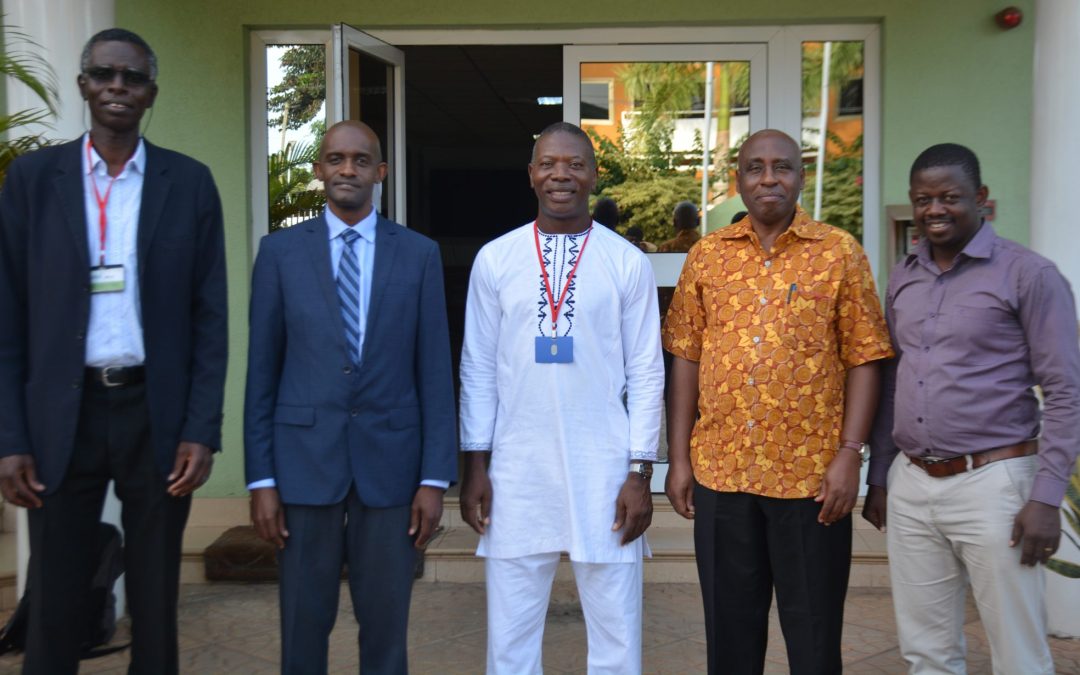
THE Forum for Agricultural Research in Africa (FARA) will collaborate with the African Observatory of Science, Technology and Innovation (AOSTI) of the African Union Commission (AUC) to advance the implementation of the Science, Technology and Innovation Strategy for Africa (STISA-2024). During a courtesy visit to the FARA Secretariat on the sidelines of the Ghana chapter workshop on Indicators of Agricultural Expenditures and Agricultural Technologies for Africa, Dr. Vroh Bi Irie, Senor Expert, Science and Technology Policy of AOSTI, in the company of Dr. Almany Konte, Senior Expert Innovation, met with Dr Aggrey Agumya, the Director of Corporate Partnerships and Communication at FARA to discuss the modalities for collaboration between the two institutions.
Both parties reiterated their commitment to collaborate with clearer and actionable outputs beyond the existing memorandum of Understanding with the AU Commission (DREA & HRST). The main areas of collaboration discussed include: (i) the harmonization of indicators under the FARA Data and Information Systems (FARADataInformS)—an observatory for Africa Agriculture research and innovation, with agriculture indicators of AOSTI’s observatory on Science, Technology and Innovation; (ii) advocacy for Science, Technology and innovation; (iii) Facilitating the implementation of research and innovation policies by African Union Member States; and (iv) Capacity Development focusing on (i) to (iii) above.
The AOSTI team announced that its observatory on Science, Technology and Innovation will be launched as part of the side events during the Africa Innovation Summit scheduled for June 6 – 8, 2018 in Kigali, Rwanda.
Other FARA staff present at the meeting were Dr Jonas Mugabe, the Manager for The Platform for African – European Partnership in Agricultural Research for Development (PAEPARD) and Mr Benjamin Abugri, the Knowledge Management Officer.
Dr Aggrey Agumya, Director of Corporate Partnerships & Communications and Acting Executive Director, FARA (2nd from Left), Dr. Almany Konte (1st Left), Senior Expert Innovation, AOSTI; Dr Vroh Bi Irie (Middle), Senior Expert Science and Technology Policy, AOSTI; Dr Jonas Mugabe (2nd from right), Senior Manager, PAEPARD, FARA and Mr. Benjamin Abugri (1st Right), Knowledge Management Officer, FARA during the visit of the AOSTI Delegation.