*Monty Jones: The ‘Rice Pope’
*
(First published December 31, 2015 in several local newspapers in Sierra Leone. Republished as Monty Jones makes his transition)
Monty Jones is indisputably the greatest Sierra Leonean scientist!! Before I interviewed Prof. Monty Jones at his Special Adviser to the President & Ambassador-at-Large office at State House last week, before I did cyber-research on this most famous son of Sierra Leone , I would have stopped at that accolade; but, after listening keenly to the normally subdued Prof. Jones oozing with excitement as he gave me detailed technicalities on rice research (…on “endosperm…backcrossing…chromosomes…celsus”…and the genius of using “coconut milk” to place him, after over ten years of dogged research, into the global hall of fame as one “the greatest” ranks) , I upgraded him: Monty Jones is the greatest scientist in Africa. Hyperbole? No!!
Given the utilitarian value of Monty Jones’ science achievement for billions of Africans, Asians, and Latin Americans, I put Prof. Monty Jones on the highest of scientific pedestal on which you would find the likes of Isaac Newton, Albert Einsten, Marie Curie, Lois Pasteur, etc. The 63 year old Monty Jones, in leading the team that ‘made’ the New Rice for Africa (‘NERICA’), is pregnant with symbolisms for Africans on all continents. Do we give Monty Jones ‘godhead’? Oh no!!
The modest, humble, easily approachable Monty Jones would be horrified at those encomiums.
Veering from Catholic priesthood to ‘agricultural priesthood’
Monty Jones has always been a fervent Catholic, an uncompromising believer in the ‘Trinity’ of Jesus Christ. He was a ‘mass server’ at the St. Anthony’s Catholic church at Brookfields, in Freetown, Sierra Leone, from the age of seven – till the time he entered university at about age 19. Every day, from Monday to Friday, Monty Jones and his junior brother, and three sisters, would leave their home at Kingtom in Freetown and walk the two miles to St. Anthony’s church in Brookfield at about 6a.m. At the end of the early morning Catholic mass, they would rush back home to get dressed for school not to be late for their 8a.m. call in time. They were never late. So devoted and diligent was Monty Jones in his Catholicism that the white Irish priests then were certain that with his piety the priesthood was the inexorable road for Monty Jones.
Unbeknown to the Catholic priests, a different light had sparked in Monty Jones. That was after the news vendors in Freetown, with clanging bells, screamed out the newspaper headline of the rice riot in Liberia on April 14, 1979; a year later, almost as a concomitant to that rice riot, Monty Jones was jarred to the bones by the Master-Sergeant Samuel Kanyan Doe-led bloody coup in which Liberia’s President W.R. Tolbert was bludgeoned to death in his pyjamas in the Executive Mansion. Monty Jones silently
“… resolved to study agriculture and help produce rice for my country so that what happened in Liberia would never happened in Sierra Leone”.
Monty Jones’ choice: “To destroy the world”; or “To save the world” (??!!)
After Monty Jones had completed his school-leaving GCE ‘O Level’ exams, one of the white Catholic priests closest to him at the Catholic St. Edward’s Secondary School, Father Martin, said to him: “Monty…it is almost time for you to go to Ireland to begin your training as a priest”. With his head bowed, his eyes lowered in trepidation at disappointing the ‘Reverend Father’, but, his voice steady with determination, Monty Jones told the priest he would want to become an agriculturist, not a priest. Father Martin was shocked !! ; and said to Monty Jones, “You want to destroy the world?”; and Monty Jones responded: “I want to produce enough food to save the world”. The Catholic priests felt they could change his mind – they descended on his father, asking he helped them. They failed. Finally, the Catholic priests acquiesced to Monty Jones’ decision, and prayed for him in his chosen path – as Monty Jones went to the rural-based Njala University College in Sierra Leone. The Catholic priests were ahead of their time, apparently – for that was about forty years before the current head of the Catholic Church, Pope Francis, had made a public pronouncement that ‘God is in science; science is of God….’.
Monty Jones, the Pride of Africa!!!
The New Rice for Africa (NERICA) breakthrough ‘made’ by Monty Jones at the main M’be research center of WARDA in Bouake, Cote d’Ivoire – in what he called a “TEAM partnership” with national and international scientists…. should be educative for all of Africa’s elite – led to Africa being catapulted almost overnight from relative obscurity among the international rice research and development institutes into the international limelight.
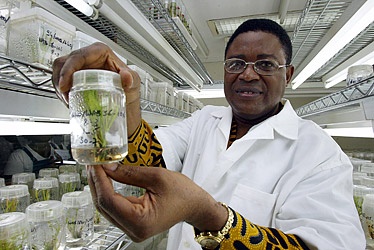
Like the signature line in the famous US TV serial, ‘Star Trek’, Monty Jones went “boldly where no man (scientist) had ever gone before….”: Dr. Jones and his team succeeded for the first time in producing fertile progenies – later dubbed NERICA – from the crossing of African rice (Oryza glaberrima), which is highly resistant to drought and local pests, but has a very low yield….AND the Asian rice (Oryza sativa), which has a very high yield per plant, but is much more sensitive to environmental conditions (which leads to increased use of pesticides).
(About 40 percent of West Africa’s 4.1 million hectares of rice is grown under upland/rain-fed conditions, and about 80 percent of this is slash-and-burn agriculture. Each crop grown after a slash-and-burn cycle produces less than the previous harvest, stressing an already fragile ecosystem, and driving up demand for rice imports.
which in turn leads to widespread “slash and burn” style farming; destroying invaluable species-rich tropical rainforests. The high-yield NERICA would not only help to reverse hunger and poverty, but, helped in conservation and preservation of rare species in West Africa’s tropical rainforests).
Crossing Africa’s Oryza glaberrima and Asia’s Oryza sativa was a formidable scientific challenge – because the two species have evolved separately over millennia and are so different that many previous attempts to cross them have failed. Using conventional breeding, as well as advanced scientific tools (‘anther culture’), the Monty Jones-led West Africa Rice Development Authority (WARDA) scientists succeeded in overcoming hybrid sterility – the main problem in crossing the species.
NERICA is a rice crop with high protein content (25% more than other rice), capable of increasing farmers’ harvests by 25 to 250 percent. NERICA’s advantage over other varieties lies in its combined characteristics of higher yields (by 50% without fertilizer and by more than 200% with fertilizer); earlier maturity (by 30–50 days earlier than farmers’ varieties); resistance to local stresses (blasts, stem borers, termites). In addition, its three-month harvest time – as opposed to the six months required by its parent species – allows African farmers to harvest NERICA rice during the annual rainy season “hunger period”. For this phenomenal achievement, Monty Jones was the first African to win the US-originated World Food Prize, the agriculture world’s own Nobel Prize . (For comparative value, of the eight Africans who have won the Nobel Prize since 1911 – Anwar Sadat; Desmond Tutu; Nelson Mandela; Ellen Johnson-Sirleaf, etc, – all have been for “peace”, except Wole Soyinka in 1986 who won it for Literature. No African has won the Nobel Prize in the sciences).
Monty Jones: “First” among unequals
Dr. Jones has had many “firsts” to his credit. He was among the first agricultural scientist to understand that Africa needed to do its own research and develop technologies adapted to its specific conditions, rather than importing wholesale solutions from outside. He was also among the first to realize the value of Africa’s indigenous rice species as a rich reservoir of genes for resistance to several local stresses and to develop and apply new tools to increase the efficiency of the rice breeding program in Africa.
At a time when participatory approaches were relatively unknown in Africa, Dr. Jones introduced and promoted participatory varietal selection and community-based seed systems to accelerate NERICA varieties’ dissemination. Dr. Jones recalls that when he proposed a program to the WARDA board to cross the African and Asian rice varieties in 1991, some members thought it was “too ambitious.” Ambition for self-aggrandizement is antithetical to the strict Catholic upbringing of Monty Jones, but, he is an ambitious man for the collective good, doing Jesus-like combat to confront and attack problems which are daunting to others.
Urgent Need for Monty Jones’ “creative genius” – NERICA
Africa consumes 11.5 million tonnes of rice per year – 33.6 percent of which is imported. The Gambia imports up to 175,000 tonnes of rice annually, or approximately 70 percent of its rice needs – spending $50million on that. Sierra Leone spends about a $140million on rice imports. Africa’s population is expected to double to about 2 billion people by 2050, and the continent would need to double its food output by that time – with some countries having to triple food production. NERICA presents the best hope to help especially WEST Africa cut down its rice imports, and, even, checkmate rice political instability.
For its NERICA achievement, WARDA received several awards, including the Consultative Group on International Agricultural Research (CGIAR) King Baudouin Award in 2000; and the United Nations Award for South-South Triangular Partnership in 2006. In his supporting letter to the World Food Prize Committee, Sir Gordon Conway, chief scientific adviser for the United Kingdom’s Department for International Development, wrote, “Dr. Jones’ ability to combine cutting-edge science with on-farm work ” …was unique.
To honor Dr. Jones, WARDA recently launched an annual “Dr. Monty Jones Lecture” . WARDA Director General Papa Abdoulaye Seck observes, “Dr. Monty Jones has demonstrated …that it is possible to reshape the agricultural map ….through the African creative genius.”
Dr. Jones may not look like a stereotypical scientist, but perhaps he possesses some of the eccentricity that seems to go hand in hand with scientific greatness. At a WARDA ceremony to honor him, he confessed that he used to speak to his NERICA plants, praising them for their performance.
Monty Jones professional and personal life are pregnant with symbolisms. Given his global stature, he would get well-paying jobs from China, Thailand to Europe and U.S. He has chosen to come home – to serve in President Koroma’s government. . He spoke passionately about a $2billion pre-Ebola ‘Master Agricultural Plan’, which he hopes will be re-activate for the Post-Ebola Recovery Plan, albeit, scaled down to $500,000 million by ‘donors’. For pan-Africanist, and patriotic reasons, I have resolved to popularize, even, glamourize, Monty Jones. Blessed by Catholic priests about forty years ago, the ‘rice pope’ is certain to be acknowledged shortly by Pope Francis. Monty Jones, implicitly, presents an opportunity and a challenge to President Ernest Bai Koroma, the governing APC, and all the elite in Sierra Leone – shame or glory?
~ End 🛑🛑
Prof. Monty Jones died yesterday. May his soul Rest-In-Peace.
When I wrote that article on Monty Jones in 2015, I was media adviser to former President Ernest Bai Koroma at State House. Monty Jones was appalled by my closing lines: ” Monty Jones, implicitly, presents an opportunity and a challenge to *_President Ernest Bai Koroma, the governing APC, and all the elite in Sierra Leone – shame or*_ *glory?”.
He told me that he was not at State House to “challenge” anyone.
Within a month or two after that article had been published, I left my own office on the ground floor and went to his office on the second floor of State House to congratulate Monty Jones after his name was announced as the new Minister of Agriculture, Forestry and Food Security (MAFFS). He thanked me for writing the article published on him, which he said could have influenced the President (former President Ernest Bai Koroma) in appointing him Minister.
In several audio messages, and social media postings recently, I would chide current President Maada Bio for not taking advantage of the unparalleled brilliance of Monty Jones.
In early 2019, I interviewed Monty Jones at his two storey seaview house in the gated Regimanuel Gray estate at Goderich, Freetown. I was developing a Paper for the first agriculture minister in the Bio presidency, Joseph Ndanemah. In that Paper, I recorded some of the experiences and advices of Monty Jones – his giving direct cash to female farmers to encourage their productivity when he was agriculture minister; his circumventing the cumbersome bureaucracy in the agriculture ministry; and the contacts he had made to raise billions of dollars for agriculture in Sierra Leone during the years he was agriculture minister between 2016 and 2018
I shared that Paper with Joe Ndanemah as Minister; Sam-King Koinhima Brima, as deputy agriculture minister; and several of the directors of the agriculture ministry. I advocated that the agriculture ministry should be transformed from a ministry into a private-public-
partnership agency, after research. None of them got back to me.
Sadly, the Bio presidency claims to have Human Capital Development as its major platform, but my experience so far with some of the ministers, and senior aides of the President at State House gives me the impression that they can hardly fathom what Human Capital Development is all about….
I doubt whether 80% of the governing elite in this SLPP government would have bothered to read to this point. Is the new agriculture minister going to call me?
Has he called Melvin Foday Kamara, the indigenous Sierra Leone-based technology genius, with his innovations that would catalyze rapid success for the FEED SALONE programme of the President?
Unbelievable. One of the nicest and most humble souls God has ever created, PROFESSOR MONTY JONES, passed away on Sunday. I shivered in shock and disbelief when I was called and told.
I worked with him in the last government where he was Minister of Agriculture and Forestry. He was an angel .
He was one of the most internationally famous Africans ever born. He discovered the genetic process to create new rice for Africa ( NERICA ) . He became the first African ever to be awarded the World Food Prize for this discovery.
He loved me and my late buddy Ambassador Foday Mansaray so much that whenever he came for the UN General Assembly in New York, it was a pleasant moment for us. He was like the uncle you always wanted for Thanksgiving or Christmas. Professor Monty Jones was good at listening more than talking. He was always affirming and upbuilding others.
Professor Monty Jones towered like a mighty colossus over all through the hallways of the UN. Presidents, ministers , ambassadors and other diplomats wanted to shake the hands of the man who created new rice for Africa , but he remained an impeccable model of modesty and humility.
The world has lost a true gem and machine of international progress and advancement. He brought tremendous pride to Africa and Sierra Leone and his name will forever resonate throughout the halls of reknown of world history.
It is now street knowledge that the availability of technology is not the central bane to improvement of Africa agriculture and management of the prime production asset, our soil. While technologies is modestly available, bringing the technologies from pilots to scale is still a key problem to overcome.
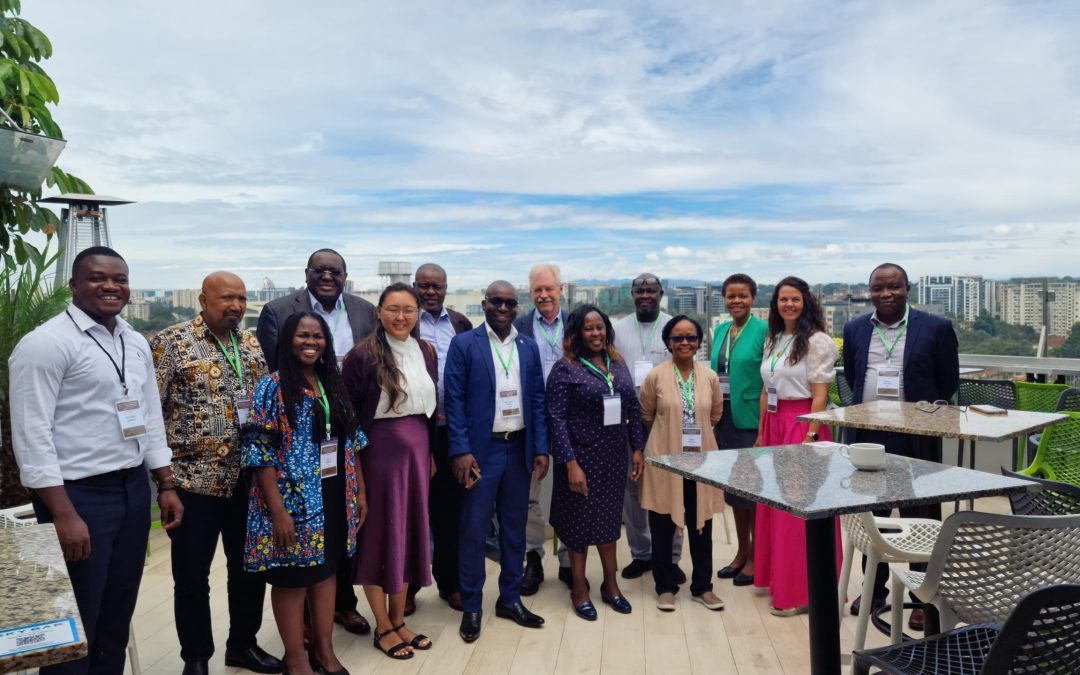
Notable experts in the theory and practice of scaling across Africa gathered in a workshop between 9th -11th of April 2024 at the Ibis Hotel in Nairobi. The workshop, scaling the pillar of the Soil Initiative for Africa (SIA) framework and the Africa fertilizer and Soil health Action Plan to write the scaling chapter of the companion document to the SIA. The companion document will aid the domestication of the framework and the development of the right action at the country and sub regional levels.
The central question is; What exactly should we bring to scale to ensure an effective management of the Africa soil? What easily comes to mind is to scale “technologies” and or Innovation. This is done using the processes of scaling out, possibly with all kinds of extension models and provision of enabling factors that pull the use of technologies. Even at this, the acceptance of technologies by the users takes time, sometimes five to ten years before the skepticism and phobia of the technology users is overcome. Apparently, the scaling up notion and its associated policy and institutional change will help to move things forward.
As it relates to the ensuring the management of Africa soil; critical analysis of project experience in the last decade showed that most Soil health interventions are not scalable because they are context specific. As such, efforts should not solely concentrate on specific technologies, rather on farmers learning, know-how and the capacity to innovate. The notion of “Capacity to Innovate” suggests the inculcation of the knowledge package and experiences that will foster a mind-set change for the farmers to continually improving their capabilities and resources to address challenges from a position of knowledge.
Most soil management interventions especially those that target soil health and organic matter increase does give immediate returns to investment, rather it yield after some years of continuous investment and the continuous benefits also needs to be managed carefully. Thus, the scaling model is scaling deep and the item to scale is farmers appreciation of the nature of the soil and pathway to benefit. Indeed the “Capacity to Innovate” is the right target of our scaling intervention.
Consultancy Services: Commission Regional Case Studies on Effective Partnerships for Innovation
Name of Project:
CAADP-XP4
Activity Ref No:
CAADP-XP4 Activity: 2.3.5
Procurement Ref:
FARA/CAADP-XP4/CS/IC/2024/01
Issue Date:
Thursday, February 01, 2024
Submission Deadline:
Thursday, February 15, 2024
The CAADP-XP4 program, involving organizations like AFAAS, ASARECA, CCARDESA, CORAF, and FARA, aims to enhance the development of African agriculture for shared prosperity and improved livelihoods. FARA, as part of this program, seeks to strengthen its capacity and collaborate with stakeholders to support African countries in achieving CAADP and SDGs results. The program focuses on promoting food security, economic development, and climate resilience through effective partnerships and innovation. Over the past two decades, FARA has championed the Agricultural Innovation System (AIS) approach, including the Integrated Agricultural Research for Development (IAR4D) concept and Innovation Platforms (IP). The IAR4D/IP model has demonstrated positive impacts on livelihoods, research demand, and meeting end-user needs. As the agricultural sector undergoes changes, the CAADP-XP4 program introduces an activity to commission regional case studies on effective partnerships for innovation. FARA, in implementing this, plans to collate knowledge on AIS, update continental synthesis studies, support SROs in institutionalizing IAR4D/IP, and document stakeholder experiences on Multi-Stakeholder Partnerships (MSPs). Recognizing the evolving landscape, the TOR proposes a desk study to assess the continued relevance of the IAR4D-IP approach. This study includes synthesizing existing knowledge on AIS, reviewing the IAR4D-IP model with experts, collecting stakeholder experiences on AIS, and producing a third white paper on the IAR4D/IP model. The goal is to ensure the model’s adaptability to emerging issues in African agriculture, considering factors like food security, climate change, and evolving agricultural trends. The primary objective of this assignment is to engage a consultant to assess and document the effectiveness of the IAR4D/IP partnerships model for innovation to generate insights on the best model to ensure a collaborative effort for innovation in Africa.
This request for expression of interest aims to engage a consultant to carry out the following functions:
Desk study: a comprehensive desk review of existing literature, reports, studies, and documents on partnerships, innovation, multistakeholder arrangements for R&D, and other issues on agricultural innovation systems.
Surveys, Interviews, Key informant interviews, case studies, etc.
Online questionnaire to sampled stakeholders
Run a webinar with front-line experts, stakeholders and partners for validation exercise.
The Executive Director of FARA invites interested consultants to express interest in carrying out this assignment.
Consultants interested in this call must provide an Expression of Interest no longer than 10 pages, outlining proposed methodologies, references related to the execution of similar assignments, experience in similar areas, or evidence of knowledge and a proposed timeline. Brochures, CVs, and other supplementary materials submitted shall not be accounted for as part of the 10-page limit.
The anticipated period of performance for this consultancy is 30 man-days spread over three months (March 2024 to May 2024).
The individual consultant shall be selected based on procedures defined in the Procurement Guidelines of FARA.
Interested consultants may obtain further information from the Ag Director of Research and Innovation,Fatunbi Oluwole[[email protected]], and copy the Procurement Expert, Mr. Callistus Achaab [[email protected]], during the following hours: 9h00 to 16h00 GMT.
Please download the Terms of Reference below, for further information on this opportunity.
Expressions of Interest should be submitted electronically to [[email protected]] and addressed to Dr. Aggrey Agumya, Executive Director of FARA, No 7 Flower Avenue, New Achimota, Mile 7, Accra, Ghana, no later than [highlight dark=”no”]Thursday, February 15, 2024[/highlight], at 16h00 GMT. Tel: +233 302 772823/744888.
FARA Affirmative Action Statement on Recruitment: there is no discrimination based on gender, race, religion, ethnic orientation, disability, or health status.
The Vision for Adapted Crops and Soil (VACS) is the latest wave in the development thought for Africa’s agriculture, food, and nutrition security. The brain behind VACS is Dr. Carry Fowler, the US special envoy for global food security. Since the beginning of his thoughts, he has aligned it with the thoughts and actions of the Africa Union Commission (AU) and the Food and Agricultural Organization of the United Nations (FAO). The VACS has also drawn inputs from several other organizations such as the Forum for Agricultural Research in Africa (FARA), the CGIAR, AGRA, the Rockefeller Foundation, universities in the US and Africa, and ancillary organizations.
The objectives of VACS are to foster sustainable and resilient food systems in Africa and other parts of the world. VACS seeks to boost agricultural productivity and nutrition by developing diverse, climate-resilient crop varieties and building healthy soils.
Fulfilling this vision will certainly require identifying indigenous or adapted food crop commodities with highly competitive nutrient content and the capacity to adapt to the known and projected vagaries of climate change as well as having the potential to contribute to the desired food systems transformation in Africa. In the Phase 1 Technical Workshop to operationalize VACS held in Rome in May 2023, the need for data and evidence for the selection of crops was highlighted as well as having robust evidence for consumption patterns for food made from the commodities. The first workshop commissioned a series of studies including smart modeling to inform the choice of commodities with the required potential.
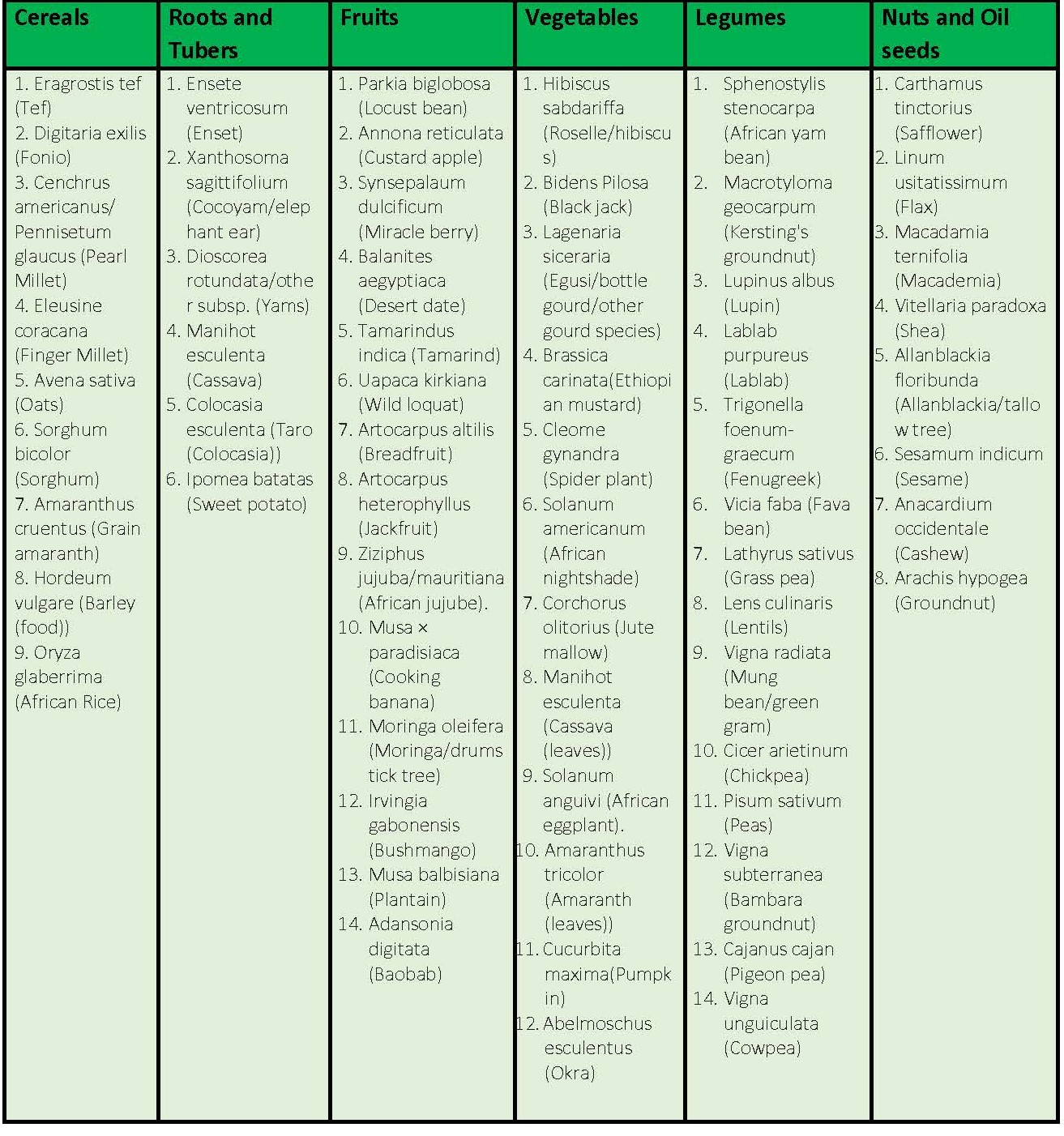
FARA participated in the second convening of the VACS organized by the Rockefeller Foundation in its exquisite Global Headquarters at 420 Fifth Avenue on 38th Street New York. The Phase 2 workshop was held on the 28th and 29th of November 2023 and had more than 71 high-level researchers and thought leaders in agricultural subjects especially, plant breeding, modeling, climate change, agronomy, and policies. The presentation of outcomes of the studies and interaction pointed to the following commodities as potential crops for intervention Table 1. Apparently, these commodities are selected based on available data, but the modelers still complain about insufficiency of data.
The FARA one cent idea is not to equate humans to figures in data, apparently most great opportunity crops lack research and data in key global repository, as such they will not feature prominently. The selected commodities need to be subjected to more qualitative methods like the “Participatory Prospective analysis” often used in Foresight studies. The bottom line is to provide the Africa stakeholders, especially the non-research actors viz., farmers, youths, women, and private sector actors the opportunity to have a say in this vital selection of commodities that will affect their food and nutritional security. Doing this will be the truest way to give all the needed sense of ownership, co-creation, and co-delivery of the VACS vision. On another note, some of the commodities that comes prominent in the list have had a significant research investment and promoted widely; the likes of Sweet Potato etc, have shown their potentials and are already widely used. The investment on such commodities could target the development of new food products and publicity on their nutritional values. All the commodities also needs to be screened for ease of crop improvement through breeding and the possibility of having a good seed systems. The commodities that are propagated using vegetative methods are often tricky in this sense, for instance genetic improvement of the Banana and Plantain are limited due to the ploidy issues that makes cross pollination difficult and having a hybrid almost impossible except with the new technologies in plant breeding.
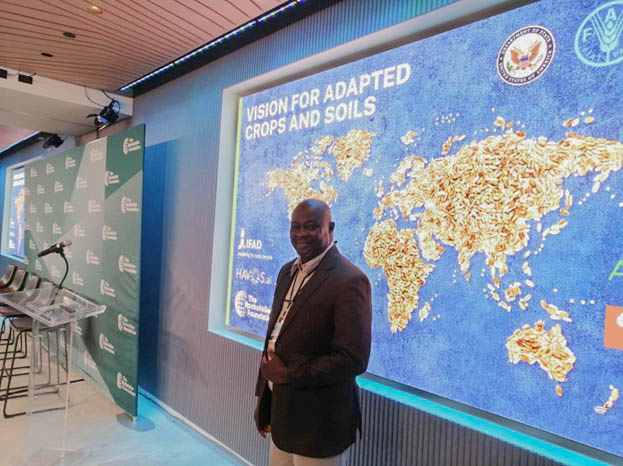
VACS Event Session at the Rockefeller Foundation Headquarters, USA
Prof. Lindiwe Majele Sibanda (CGIAR System Board Chair) addressing the VACS session at the Rockefeller Foundation Headquarters, USA
The VACS is a vision accompanied by action and should be domesticated on the continent and at the country level. The research efforts should engage actively with the African regional agricultural research coordination architecture and the National Agricultural Research System (NARS) for implementation. VACS needs to avoid the old error of solely delegating African agricultural research to the International agricultural research centers in the name of the erroneous lack of capacity of the NARS. The international center should complement the NARS and not the other way around. Mainstreaming the VACS implementation into the recently developed framework for cooperation between the Africa Agricultural Research and Innovation Institutions (ARII) and the one-CGIAR will be a great way to go.
It is believed that the starting point of VACS is the mainstreaming of the opportunity crops; this will embrace the development of breeding programs and seed systems. It will also include research and development efforts to create new food products to drive a commercial demand for the commodities and research outputs. The next in line should be a set of systematic actions on soil management; this should be built on the existing continental framework in Africa. The Soil Initiative for Africa (SIA) is the long-term framework, its 10-year implementation is structured into the Africa Fertilizer and Soil Health Action Plan (AFSH-AP). The core element should include halting land and soil degradation, promoting soil health, developing an Africa soil information system to drive the sustainable use of Africa soils as a vital production asset. These efforts will align together to ensure concurrent adaptation and mitigation of climate change.
In conclusion, VACS is the new wave and keeping it strong to deliver its intended outcome will relies on effective engagement, right investment and giving attention to the right and practical issues.
Prof. Wole Fatunbi (Ag. Director of Research, FARA) at the VACS Event organized by the Rockefeller Foundation
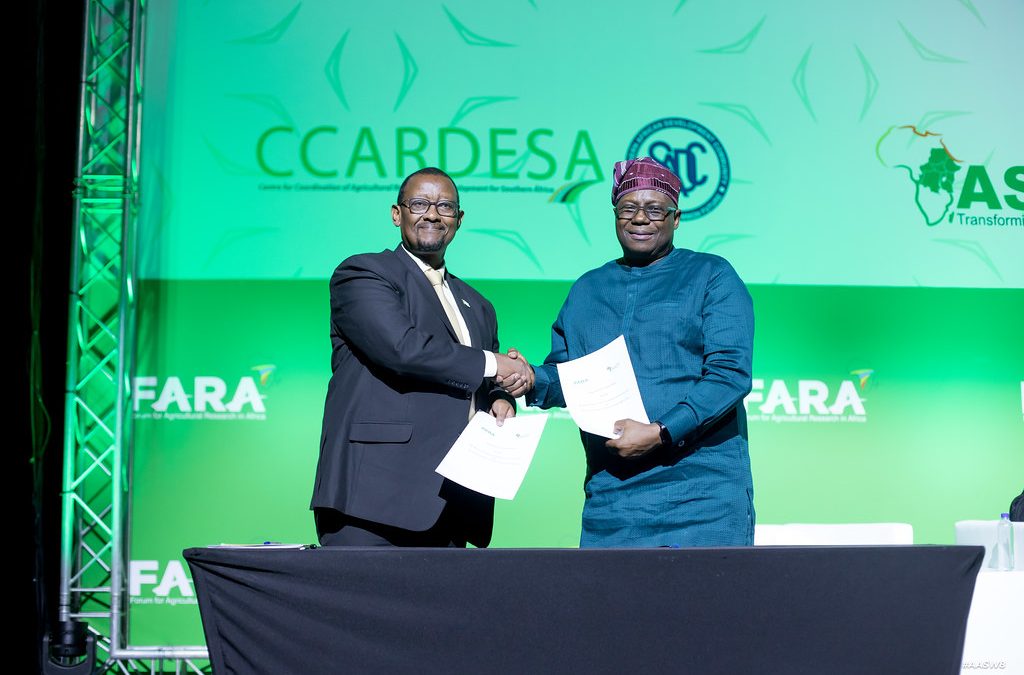
[Durban, South Africa, June 8, 2023]:AATF and the Forum for Agricultural Research in Africa (FARA) have signed a five-year Memorandum of Understanding (MoU) to raise productivity, competitiveness, and resilience of agriculture in Africa through research, policy advocacy, technological development, delivery, and uptake.
The partnerships agreement will promote generation and uptake of Science, Technology, and Innovation (STI) to accelerate agricultural development in Africa, including diversification of agricultural technologies.
Dr. Yemi Akinbamijo, the outgoing Executive Director, FARA, noted that the pact will support in enhancing the capacity of Africa to advance climate smart agriculture, especially improving climate change resilience among farmers in Africa.
Dr. Canisius Kanangire, the Executive Director of AATF and Dr. Yemi Akinbamijo, outgoing Executive Director, FARA, during the signing of the MoU at the Durban International Conventional Centre in Durban, South Africa, in June 2023.
He observed that through the agreement, the two organisations commit to promote a conducive policy environment for the access, development and delivery of agricultural technologies and products with focus on acceleration of their commercialization for a food secure Africa.
“Our joint activities would include, among others, to design and leveraging of mechanisms for exchange of technology-based innovations, information and knowledge that will empower Africa’s researchers, decision makers, influencers and technology users,” said Dr. Akinbamijo.
According to Dr. Canisius Kanangire, the Executive Director of AATF, the partnership agreement with FARA will help raise agricultural productivity to improve livelihoods of smallholder farmers on the continent, noting that AATF is keen on transforming farmers livelihoods in Africa through scaling of agricultural technologies.
“Our strategy 2023-2027 reinforces the need for partnerships with like-minded organisations and leveraging each other’s strength to deliver our mandate to farmers in Africa. We are therefore committed to building partnerships with continental bodies such as governments, national and international research institutions, FARA and its constituent bodies, Regional Economic Communities, farmer organisations, the private sector, and all players along the agriculture value chain, to deliver agricultural value to our farmers,” he noted.
He added that smallholder farmers in Africa continue to face various constraints that hinder their ability to increase their yields, improve their incomes, and contribute to food security.
According to Dr. Kanangire, the situation can change by investing in new farming technology for Africa—from better seeds to digital tools to machinery—which hold promise for transforming African agriculture into an engine of economic growth that will have benefits far beyond the farm sector.
Founded in 2003 to address Africa’s food security prospects through agricultural technology, AATF believes that the agricultural sector is a key foundational pillar as Africa consolidates its economic growth and carves out its new position as a major global economic powerhouse and the next growth market in the world. It was formed in response to the need for an effective mechanism that would facilitate and support negotiation for technology access and delivery and formation of appropriate partnerships to manage the development & deployment of innovative technologies for use by smallholder farmers in SSA:
FARA is the continental apex organization for agricultural research and innovation in Africa. With its Secretariat based in Accra, Ghana, FARA serves as a platform for stakeholders in the continent’s agriculture research and innovation space to mobilize collective actions including the articulation of common positions. FARA is mandated by the African Union Commission and the African Union Development Agency (AUDA)-NEPAD to coordinate the formulation and operationalization of continental research and innovation policies, initiatives and programmes designed to achieve the continent’s food and agriculture development targets. These targets include doubling agricultural productivity, improving nutritional status, halving post-harvest losses, tripling intra-Africa trade in agricultural commodities and increasing resilience to climatic, pest and disease shocks. FARA performs these functions in collaboration with sub-regional agricultural research and innovation organizations in East and Central Africa (ASARECA), Southern Africa (CCARDESA), West and Central Africa (CORAF) and North Africa (NAASRO), as well as the Africa Forum for Agricultural Advisory Services (AFAAS). FARA counts on the CGIAR, AATF, amongst others, as a key strategic partner.
For more information contact:
George Achia, Communications Officer, East and Southern Africa, AATF; [email protected] ; +254 785 334163