The Director-General of the World Trade Organization, Dr Ngozi Okonjo-Iweala, has received the FARA leadership award for her contributions to agricultural science, technology, and innovation in Africa.
Okonjo-Iweala who currently serves as the seventh Director-General of the World Trade Organization (WTO) is the first woman and first African to lead the organization.
She is noted for being a strong advocate of agricultural research and development, agricultural productivity, and increasing access to food for African farmers and consumers.
In an address presented on her behalf, she quizzed that “Why do we [Africans] import so much food? Africa can and should produce enough food for itself and also for exports”.
Reiterating her commitment to using trade to help African farmers, she urged stakeholders to ensure that everyone has access to nutritious food.
“Trade has a critical role to play in connecting producers and consumers across the continent and beyond. African exports have more than quadrupled over the last two decades while imports have grown five-fold. By strengthening agricultural productivity sustainably, Africa can make better use of its untapped potential including its arable land and freshwater resources.”
Okonjo-Iweala concluded her address by calling for a renewed commitment to fighting hunger and malnutrition in the world, stating that negotiators must place “people in Africa and elsewhere at the centre of their efforts to ensure that trade contributes to a dynamic sustainable and equitable food and agricultural sector in the months and years to come”.
Being an economist and development expert, she is noted to have helped to reduce Nigeria’s debt by $30 billion and play an oversight role in the implementation of a number of economic reforms that helped to stabilize the Nigerian economy.
Also, Dr Okonjo-Iweala as an advocate of trade and open markets played a key role in the creation of the African Continental Free Trade Area (AfCFTA).
Okonjo-Iweala was one of four recipients of the FARA leadership award.
The other recipients were Dr. Papa Abdoulaye Seck, is a former Minister of Agriculture and Rural Development of Senegal; Dr. Benedict Okey Oramah, the President of the African Export-Import Bank; and Josefa Leonel Correia Sacko, the Commissioner for Agriculture, Rural Development, Blue Economy and Fisheries of the African Union Commission.
The FARA leadership award is presented annually to individuals who have made outstanding contributions to agricultural science, technology, and innovation in Africa.
The Commissioner for Agriculture, Rural Development, Blue Economy, and Sustainable Environment of AU, Josefa Leonel Correia Sacko has called for an increased investment in science and innovation to address the worsening food insecurity in Africa.
Miss Josefa assured that Africa could become a net food exporter since it has “the best lands and the youngest population” which when coupled with science and technology will boost the agricultural sector.
“Africa has rivers, 38 coastal countries … So let us unlock the potential we have and start going out of these reports that come from FAO, etc [which states that] Africa is always left behind in the issue of malnutrition and food insecurity”, she stated.
Speaking at the opening ceremony of the 8th Africa Agribusiness and Science Week in Durban, Miss Josefa bemoaned that the COVID-19 pandemic, conflict, and climate change have worsened food insecurity in Africa.
Therefore to address this challenge, she asked African leaders to revive their scientific institutions and fulfil their obligation to “allocate 10% of public resources to agriculture” as stated in the Malabo Declaration on Accelerated Agricultural Growth and Transformation for Shared Prosperity and Improved Livelihoods.
“African leaders need to leverage our science potential and invest in African scientific institutions. We know that the Ministers of Agriculture in our continent have their national research institutions and these national research institutions are collapsing. We should not allow it because we have scientists and our own knowledge so let us build on science; let’s support science”, she said.
She added that “the African Union has already taken some steps to address the challenges facing Africa’s agriculture sector. In 2014, the AU adopted the Malabo Declaration, which commits member states to invest at least 10% of their national budgets in agriculture.”
The 8th Africa Agribusiness and Science Week (AASW8) is underway in Durban, South Africa, from June 5-8.
The week-long event is held under the theme “Linking Agribusiness with Science and Innovation for Sustainable Agriculture and Food Systems”.
This will feature workshops, agritech expo, an investment forum, match-making sessions, and AfCFTA CAAPs.
The conference seeks to improve the performance of African agriculture and agribusiness in productivity, profitability, job creation, nutrition, sustainability, and resilience.
In the context of FARA’s South-South and Triangular Cooperation Strategy (SSTC), FARA and the Brazilian Agency for Capacity Development CAPES (Coordenação de Aperfeiçoamento de Pessoal de Nível Superior) have begun discussing how the two institutions can work together to strengthen postgraduate capacity in Africa.
FARA’s Executive Director, Dr Yemi Akinbamijo, was received by Prof Rui Opperman, Director of International Cooperation of CAPES in Brasilia. Dr Akinbamijo briefed Dr Opperman on the collaboration between FARA and the Brazilian Association for International Education (FAUBAI), which seeks to strengthen institutional and human capacities in Agricultural Research and Innovation in Africa through ARIFA.
The FARA-FAUBAI partnership is built on scaling, co-sharing, demand-driven approaches, and capacity-building principles. This partnership takes advantage of the agroecological similarities between Africa and Brazil and Brazil’s competitive advantage to contribute to the goal of the AU Agenda 2063.
The discussions between FARA and CAPES explored new collaboration areas to strengthen postgraduate capacity in Africa, focusing on agriculture, agribusiness and related fields while tapping into Brazil’s Innovation and entrepreneurial capabilities. The partnership will leverage Brazil’s experience and expertise in postgraduate education and scientific research, including the Programa de Estudantes-Convenio de Pós-Graduação (PEC-PG), and commercialization of research outputs to support the development of a new generation of highly skilled researchers, innovators, and science-based entrepreneurs in Africa.
The initiative is expected to complement ongoing programs to further create opportunities for Africans pursue higher degrees in Brazilian universities and research institutions, where they can benefit from contemporary teaching methods and pedagogy, the latest technologies and research methods in agriculture and related fields, and exposure to innovation-driven agribusiness. This will enable Africa to build a critical mass of highly skilled professionals who can catalytically drive the continent’s agricultural transformation and contribute to its economic development.
The FARA-CAPES partnership is a concrete example of how South-South cooperation can be harnessed to promote sustainable development in the global South.
The partnership is expected to inspire other countries and regions to collaborate and work together to promote sustainable development and poverty alleviation in the global South.
The Forum for Agricultural Research in Africa (FARA) and the Brazilian Association for International Education (FAUBAI) collaboration is an innovative partnership to strengthen the capacity of Africa’s agricultural research and development through internationalizing Brazilian education.
The partnership is operationalized through the Agricultural Research and Innovation Fellowship for Africa (ARIFA), a flagship program of this collaboration that seeks to leverage on South-South and Triangular Cooperation (SSTC) to train and equip 5,000 agriculture research and innovation practitioners in Africa.
The 35th meeting of FAUBAI, held in Belo Horizonte, Brazil from the 15th to the 19th of April 2023, allowed the two institutions to renew their commitment to the ARIFA program. During the meeting, FARA’s Executive Director (ED), Dr Yemi Akinbamijo, expressed gratitude to the government and people of Brazil for their continuous support of the program through FAUBAI and the Federal University of Viçosa (UFV). He highlighted that the ARIFA program has already supported over 120 fellows from Nigeria who are currently studying at 15 universities in Brazil.
Tagged “building knowledge with all voices”, the FAUBAI 2023 meeting offered a space for ideas and knowledge sharing on the ARIFA model among partners from the Global South.
The ARIFA program seeks to produce a new fit-for-purpose workforce to re-engineer the African agri-food sector and provide the change factor for rapid agricultural transformation in Africa. The program is designed to equip fellows with the skills, knowledge, and attitudes necessary to drive agricultural Innovation and entrepreneurship in Africa, one person at a time, one nation at a time.
Launched in 2019, the ARIFA program has trained close to 100 Nigerians in several universities in Brazil. In March this year, FARA inducted the first set of ARIFA fellows who have returned to Nigeria. Reporting on the progress of the program’s second phase, Dr Vladimir Iorio, the Director of International Relations at the UFV, confirmed that FAUBAI has selected 398 applicants from Nigeria in the second cycle of the program. The newly elected candidates are expected to commence academic activities in August 2023. This is a significant milestone in implementing the ARIFA program, demonstrating the increasing interest and demand among African youths.
It is hoped that other countries and regions will emulate this partnership to address the global food security challenges and poverty alleviation.
The last five decades of the Brazilian socioeconomic landscape are replete with commendable accolades that have led to the transformation of a net importing, food insecure economy to the third largest agricultural producer in the world that is not only self-sufficient.
This story echoes through the length and breadth of Brazil as EMBRAPA —the country’s agricultural research corporation—commemorated its golden jubilee anniversary last week in Brasilia. Consistent hard work on all fronts was the hallmark of the occasion that celebrated visionary leadership and committed followership that tamed the hunger and food insecurity rampant in the Brazilian federation up to the 1970s.
This is good history being made as Celso Moretti, the President of EMBRAPA, read his emotion-laden valedictory statement in Brasilia last Wednesday (27th April 2023).
That Brazil is food self-sufficient is no longer news. The news is about the emerging frontiers hitherto untouched by science and Innovation. The star-studded crowd in the agriculture world rendered unending encomiums as the President relayed the journey of a state parastatal that has become a much-vaunted success story and the pride of Brazil.
This spirit of excellence was one of FARA’s rationales for choosing Brazil as a partner. The objective is to learn from the defining interventions that birthed the highlights that were being celebrated around the globe. In addition, Brazil is a natural choice of partner for Africa because the two regions share ecological attributes and cultural-historical ties.
On the margins of the auspicious occasion, the principals of FARA and EMBRAPA expressed their willingness to enter into a new partnership phase in agricultural research and innovation with Africa. The partnership aims to mobilize other stakeholders on the continent, including the African Development Bank (AfDB) among others, to build on the gains of previous collaborations between the two institutions, notably the Africa-Brazil Agricultural Innovation Marketplace and M-BOS (Building on the Success of the Marketplace).
To underscore the value of the new partnership, FARA’s Executive Director, Dr Yemi Akinbamijo, acknowledged that there appears to be a Brazilian solution to every African problem. He noted that the recalibration of the FARA-EMBRAPA partnership is coming when Brazil is retaking its leadership position in the comity of nations with strong solidarity extended to African countries. During the meeting, Nigeria’s Ambassador to Brazil, Professor Ahmed Makarfi, expressed gratitude and continued support of the Nigerian government for the partnership.
Dr Celso Moretti reiterated EMBRAPA’s willingness to work with FARA to design a new Brazil-Africa initiative on food and fibre for economic transformation and food security in the two regions. This initiative will leverage the strengths of the two regions to develop and scale innovative solutions that will help address challenges of food security and economic growth. The proposed initiative will further create opportunities for African and Brazilian researchers and entrepreneurs to collaborate and exchange knowledge and expertise while developing demanded solutions. The partnership between FARA and EMBRAPA is an excellent example of how South-South cooperation can be harnessed to promote sustainable development in the global South. The partnership is expected to inspire other countries and regions to collaborate and work together towards promoting sustainable agricultural development for all benefits.
[Abuja, Nigeria – April 3, 2023] – The Agricultural Research and Innovation Fellowship for Africa (ARIFA), a flagship program of the Forum for Agricultural Research in Africa (FARA), has inducted its first set of fellows in Nigeria. The program aims to produce a new fit-for-purpose workforce to re-engineer the African agri-food sector and provide the change factor for rapid agricultural transformation in Africa.
ARIFA is implemented in partnership with Tertiary Education Trust Fund (TETFund). The inducted fellows were trained at Brazilian universities, notably Universidade Federal de Viçosa, Universidade Federal de Goiais, Universidade Federal de Lavras and Universidade Federal de Itajuba.
The induction ceremony was officiated by the Executive Secretary of the Tertiary Education Trust Fund (TETFund), Arch Sonny Echono, and the Executive Director of FARA, Dr Yemi Akinbamijo. Both institutions’ commitment towards this program’s success is highly commendable.
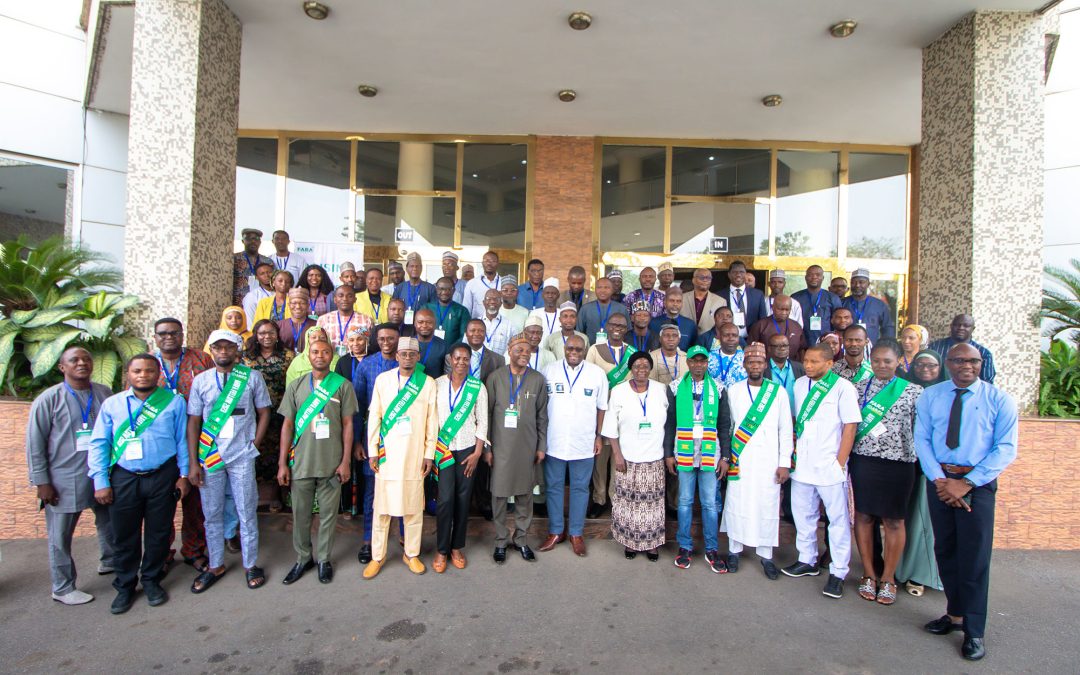
Held on the margins of ongoing training on Innovation System thinking as a post-training component of ARIFA, the induction ceremony was attended by Directors from TETFund Centers of Excellence, designated ARIFA institutions, the Agricultural Research Council of Nigeria (ARCN), ARIFA Faculty Focal Leads, and other stakeholders from Nigeria’s Agricultural Research for Development (AR4D) landscape. The fellows are expected to form part of a national pool of scholars supporting at least thirteen TETFund ARIFA Innovation Platforms across the county. Their expertise is expected to increase the productivity of over 24,000 farmers.
The event was a celebration of the program’s success, a recognition of the fellows’ achievements and the launch of the establishment of Innovation Platforms.
Dr Akinbamijo and Arc. Echono encouraged the fellows as they prepare to be part of the TETFund ARIFA Innovation Platforms across the country, where they will be supported to put their newly acquired skills and knowledge into practice. The ARIFA program is a vital step towards realizing the vision of transforming Africa’s agricultural sector and ensuring food security on the continent.