In a bid to reinforce the African Union’s comprehensive commitment to agricultural development in Africa, the first-ever meeting since the formation of the Comprehensive Africa Agriculture Development Programme (CAADP) Communication and Knowledge Management Thematic Working Group took place at the Movenpick Hotel, Nairobi, from 3-4 August.
Some Participants at the AU CAADP KM & Comms Workshop
The main objective of the meeting was to propel the CAADP agenda forward through meticulous communication, advocacy, and knowledge management. The meeting also aimed to assess the strides made, design a concrete work plan, and establish a coordinated mechanism to bolster CAADP and forge a coordination blueprint for the CAADP Communication group following recommendations from Yaounde’s engagement, from 1-5 August 2022.
The desired outcomes of this coordination meeting were manifold, from highlighting the progress made in communication, knowledge management and advocacy at all levels to defining coordination tools for the CAADP Communication group. This will help improve awareness of the CAADP Malabo declaration, and support the implementation of the CAADP Business Plan 2022-2025 and the Jointly developed CAADP work plan.
Ms Panduleni Elago – Senior CAADP Advisor – African Union Commission
The meeting was officially opened by Ms Panduleni Elago, the CAADP Advisor, who emphasized the African Union’s anticipation towards the thematic working group to expedite the AU agenda. “The AU looks forward to the Key Performance Indicators that will emerge from this group that will address the knowledge and information gap in the Biannual Review Process,”.
Ms Peace Mutuwa the Communication and Knowledge Management expert, echoing the sentiments of the African Union Commission (AUC), emphasized how pivotal this group would be in propelling the AU’s goals forward. “As we commence this mammoth task, we need to develop Terms of Reference (TORs) that will govern our modus operandi. We should also not forget the critical role of the media in disseminating information to the communities on the CAADP process.
A palpable sense of duty settled in the room as the discussions pivoted to the 4th Biannual Review (4BR) of the CAADP. Two decades after the inception of Malabo, a gap remains; farmers are still in the dark about its potential. The need of the hour is curating content specifically tailored for small-scale farmers, ensuring it’s digestible and beneficial.
The African Union envisions this esteemed assembly to be the foundation of a robust CAADP Communication strategy. Policy LINK, a global Feed the Future program to advance leadership and collaboration for better policy systems implemented by DAI and working with the AUC, voiced the importance of technical and financial backing. They stressed, “It’s time we lay down tangible recommendations, lighting our path forward.”
CCARDESA, through its Information, Communication, and Knowledge Management Officer, Mrs Bridget Kakuwa-Kasongamulilo, joined the chorus, recognizing the CAADP as Africa’s agricultural cornerstone, she urged the assembly to prioritize the seven commitments, though it demands perseverance.
Mr Benjamin Abugri, FARA’s Knowledge Management and Communication Cluster Lead, urged the Working Group to be forward-thinking in using existing knowledge services and tools such as the FARA Africa Community (Dgroups) to discuss BR processes as they also act as interactive tools that allow information exchange and knowledge co-creation.
The meeting’s purpose shone clear: addressing the gaping communication void, ensuring synchronization with technical processes, advocating for CAADP, and strategizing its communication. The dialogue flowed, touching upon the support communications provided to the Biannual Review reporting and the Malabo. The ensemble also considered the potential of leveraging annual events like the CAADP Meetings, the AASW, the KM4AgD Conference, the Fertiliser Summit, and others, ensuring these platforms spread the right message.
Delving deep into recommendations from the Critical BR Analysis Report, the group proposed developing a protocol for the Biannual Review mechanism and a review of the toolkit for communication and knowledge management.
In attendance were participants from AUC, AUDA-NEPAD, AU-IASPC, RECs, Policy Link, FAO, ILRI, TASAI, CCARDESA, FARA, AU-IBAR, and other esteemed organizations. With two days of productive discourse, this meeting in Nairobi, from 3-4 August 2023, was not just a gathering, but a revolution in the making.
The African Export-Import Bank (Afreximbank) has staked US$6 billion in development financing to strengthen Africa’s food security prospects which has faced severe challenges due to climatic changes heightened by geo-political conflicts, Oluranti Doherty, Director of Export Development at the Bank, said in Accra today.
Ms. Doherty, who was participating in a panel discussion on “Overcoming the challenges of food security for sustainable development in Africa” at the ongoing Afreximbank Annual meetings (AAM2023), said that the Bank had also released more than US$700 million to support the setting up of special economic zones (SEZs), industrial and agro parks in several of its member countries.
She said that with food insecurity constituting a major challenge to Africa’s economic independence and growth, Afreximbank was reinvigorating its approach to supporting the continent to achieve self-sufficiency in food production.
“At Afreximbank, we are firmly convinced that industrial parks and SEZs are critical tools the continent can deploy to fast-track its agricultural development, promote intra-African trade and facilitate export development,” she said. “This is a priority for the Bank as it remains pragmatic in providing workable solutions to challenges facing its member countries”.
Also speaking, Dr. Josefa Sacko, African Union Commissioner for Agriculture, Rural Development, Blue Economy and Sustainable Development, called for the implementation of the 2014 Malabo Declaration on Accelerated Agricultural Growth and Transformation for Shared Prosperity and Improved Livelihoods, which set a targeted approach to achieving the continent’s aim of food security and sustainability for economic growth and poverty reduction.
Noting that Africa boasted of abundant aquatic resources, over 60 per cent of uncultivated arable lands and a young population, Dr. Sacko said that what remained was the effective implementation of such policies as the Malabo Declaration.
She commended Afreximbank for the role it was playing to help make Africa a sustainable and food secure continent and expressed regret that, at the moment, 38 African countries were net importers of food. That situation called for urgent action from every player.
“We cannot be food secure in a conflict-filled environment,” said Dr. Sacko. “Let us silence guns all over Africa, implement already generated policies around sustainability for profitable agriculture and watch as the continent becomes the world’s food basket.”
Also participating in the panel were Hardy Pemhiwa, President and CEO of Cassava Technologies, and Dr. Yemi Akinbamijo, Executive Director, Forum for Agricultural Research in Africa.
AAM2023, which ends on 21 June, is being attended by political and business leaders, bankers and other trade and trade finance practitioners from across Africa and beyond, including leaders of several member countries of the Caribbean Community.
[Durban, South Africa, June 8, 2023]:AATF and the Forum for Agricultural Research in Africa (FARA) have signed a five-year Memorandum of Understanding (MoU) to raise productivity, competitiveness, and resilience of agriculture in Africa through research, policy advocacy, technological development, delivery, and uptake.
The partnerships agreement will promote generation and uptake of Science, Technology, and Innovation (STI) to accelerate agricultural development in Africa, including diversification of agricultural technologies.
Dr. Yemi Akinbamijo, the outgoing Executive Director, FARA, noted that the pact will support in enhancing the capacity of Africa to advance climate smart agriculture, especially improving climate change resilience among farmers in Africa.
Dr. Canisius Kanangire, the Executive Director of AATF and Dr. Yemi Akinbamijo, outgoing Executive Director, FARA, during the signing of the MoU at the Durban International Conventional Centre in Durban, South Africa, in June 2023.
He observed that through the agreement, the two organisations commit to promote a conducive policy environment for the access, development and delivery of agricultural technologies and products with focus on acceleration of their commercialization for a food secure Africa.
“Our joint activities would include, among others, to design and leveraging of mechanisms for exchange of technology-based innovations, information and knowledge that will empower Africa’s researchers, decision makers, influencers and technology users,” said Dr. Akinbamijo.
According to Dr. Canisius Kanangire, the Executive Director of AATF, the partnership agreement with FARA will help raise agricultural productivity to improve livelihoods of smallholder farmers on the continent, noting that AATF is keen on transforming farmers livelihoods in Africa through scaling of agricultural technologies.
“Our strategy 2023-2027 reinforces the need for partnerships with like-minded organisations and leveraging each other’s strength to deliver our mandate to farmers in Africa. We are therefore committed to building partnerships with continental bodies such as governments, national and international research institutions, FARA and its constituent bodies, Regional Economic Communities, farmer organisations, the private sector, and all players along the agriculture value chain, to deliver agricultural value to our farmers,” he noted.
He added that smallholder farmers in Africa continue to face various constraints that hinder their ability to increase their yields, improve their incomes, and contribute to food security.
According to Dr. Kanangire, the situation can change by investing in new farming technology for Africa—from better seeds to digital tools to machinery—which hold promise for transforming African agriculture into an engine of economic growth that will have benefits far beyond the farm sector.
Founded in 2003 to address Africa’s food security prospects through agricultural technology, AATF believes that the agricultural sector is a key foundational pillar as Africa consolidates its economic growth and carves out its new position as a major global economic powerhouse and the next growth market in the world. It was formed in response to the need for an effective mechanism that would facilitate and support negotiation for technology access and delivery and formation of appropriate partnerships to manage the development & deployment of innovative technologies for use by smallholder farmers in SSA:
FARA is the continental apex organization for agricultural research and innovation in Africa. With its Secretariat based in Accra, Ghana, FARA serves as a platform for stakeholders in the continent’s agriculture research and innovation space to mobilize collective actions including the articulation of common positions. FARA is mandated by the African Union Commission and the African Union Development Agency (AUDA)-NEPAD to coordinate the formulation and operationalization of continental research and innovation policies, initiatives and programmes designed to achieve the continent’s food and agriculture development targets. These targets include doubling agricultural productivity, improving nutritional status, halving post-harvest losses, tripling intra-Africa trade in agricultural commodities and increasing resilience to climatic, pest and disease shocks. FARA performs these functions in collaboration with sub-regional agricultural research and innovation organizations in East and Central Africa (ASARECA), Southern Africa (CCARDESA), West and Central Africa (CORAF) and North Africa (NAASRO), as well as the Africa Forum for Agricultural Advisory Services (AFAAS). FARA counts on the CGIAR, AATF, amongst others, as a key strategic partner.
For more information contact:
George Achia, Communications Officer, East and Southern Africa, AATF; [email protected] ; +254 785 334163
The Forum for Agricultural Research in Africa has inaugurated Bongiwe Njobe and Aggrey Agumya as its Board Chairperson and Executive Director respectively.
The ceremony took place at the 9th FARA General Assembly during the 8th African Agriculture and Science Week in Durban, South Africa.
The Board Chair of FARA, Bongiwe Njobe in her address applauded the Government of Ghana and her predecessors for their continuous support and assured that in the next three years she will “deliver on the strategic vision based on the achievements till date and work together to enhance the overall effectiveness of the organization.”
She further added that her leadership will focus on “tackling the critical and much-needed relationship from enhanced participation in the ecosystem by the private sector through drawing insights from our relationship with the African Development Bank, AFRIEXIM Bank, African Business Council, etc. that are aimed at boosting intra-Africa trade.”
The immediate-past Board Chair of FARA , Dr Alioune Fall applauded participating organizations and sponsors for a successful FARA general assembly and the 8th African Agriculture and Science Week.
Giving an account of the board’s work, Dr Fall recalled that during the heights of COVID, the solutions and recovery plans showed the power of collated efforts among the scientists.
He boasted of the board’s work in operationalizing FARA’s business plan, the formation of CAADP-XP4, relocation of FARA’s office, appointing of external auditor for 2021 to 2023 financial year, various partnerships to streamline operations, among others.
The Executive Director of FARA, Dr Aggrey Agumya presenting on FARA’s medium term strategy said that the institution is in a transition phase [in both business and leadership] therefore it “will draw an institutional assessment carried out in the context of CCGAR which will be in line with CAADP research and innovation strategy.”
Recounting FARA’s successes in the past years, he said that the entity still had “it’s mandate and convening power, aligned with the CAADP and AUC, among others”, however low funding affected its operations.
Also, “fragmentation in innovation system is a challenge but there has been progress”, he assured.
Dr Aggrey Agumya succeeds Dr Yemi Akinbammijo who served as the second Executive Director of FARA from 2013 – 2023.
The board chaired by Madam Bongiwe Njobe comprises Dr Abdou Tenkouano, Mr Philip Boahen, Dr Simeon Ehui, Dr Enock Warinda, Prof Cliff Dlamini , Prof Mohamed Soliman, Madam Elizabeth Nsimadala, Madam Janet Ngombalu, Mrs Beatrice Nakacwa-Egulu, Mr Christophe Larose, Mr Anthony Boateng, and Dr Aggrey Agumya who is FARA’s Executive Director and Secretary to the Board.
The ceremony was held at the 8th Africa Agriculture and Science Week.
About FARA
The Forum for Agricultural Research in Africa (FARA) is the apex continental organization responsible for coordinating and advocating for agricultural research for development (AR4D). FARA serves as the technical arm of the Africa Union Commission on matters concerning agriculture science, technology and innovation.
FARA was conceived in the late 1990s by a core group of committed champions, including both African scientists and enlightened donor aid officials, who believed in agriculture’s potential to lift the continent from poverty, yet realized that this would only be achieved if the continent’s weak and fragmented agricultural research systems could somehow be brought together and strengthened under a common banner.
FARA was then voted into existence in 1997 by the Sub-Regional Organizations, including CORAF/WECARD, ASARECA and SADC-FANR, at the 17th Plenary of the Special Programme for African Agricultural Research (SPAAR), a precursor organization to FARA, situated within the World Bank.
The WTO chief has called on African countries to create trading opportunities and increase investment in agriculture to address food security in Africa, as the head of the African Federation of Women Entrepreneurs (AFWE) stressed the need for improved infrastructure and the removal of tariffs to facilitate intra-African commerce.
In a speech read on her behalf at the 8th Africa Agribusiness and Science Week (AASW8) in Durban, the Director-General of the World Trade Organization (WTO), Ngozi Okonjo-Iweala, has noted that one-fifth of Africa’s population continues to face hunger despite being “a continent with the world’s largest reserved arable land” and called on African governments to take steps “to reinforce the provision of public goods”. This can be done by “improving the availability of extension and advisory services, investing in research, promoting access to technology, science and innovation, and improving infrastructure in rural areas,” she noted. Highlighting the need for trade integration through the African Continental Free Trade Area AfCFTA, she said that “trade can connect producers and consumers across the [African] continent and beyond. It can also help improve agricultural productivity and create jobs in rural areas.”
Echoing the WTO chief’s appeal to the continent, the Secretary-General of the AFWE, Lucia Quachey, called on African countries to boost intra-African trade by removing cumbersome border inspections, harassment, bribes, and poor infrastructure. “Only a few hundred kilometers separate Lagos, Nigeria, from Accra in Ghana but for the thousands of traders who ply this route, the journey through these routes can take a full day,” Quachey complained in the most recent issue of Pathway Africa. She also pushed for the construction of infrastructure to facilitate commerce and for the removal of several tariffs and non-tariff obstacles.
On the positive side, Quachey noted that Kenya and Ghana have boosted their commercial ties under the AfCFTA, while the Ugandan government sees the potential offered by the AfCTA as a long-term solution to unreliable non-trade barriers (NTBs) with Kenya.
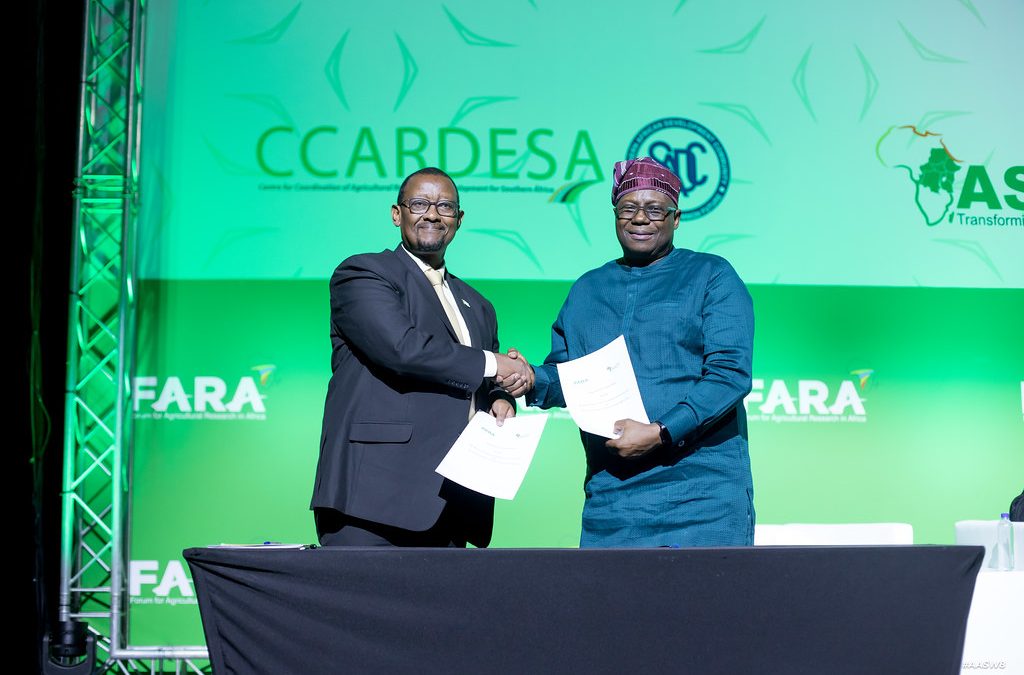
[Durban, South Africa, June 8, 2023]: AATF and the Centre for Coordination of Agricultural Research and Development for Southern Africa (CCARDESA) have today announced a partnership agreement that seeks to upscale agricultural technologies to address farming challenges affecting key staple crops in Africa including rice, cassava, and maize.
The two organizations will utilize their knowledge and resources to implement agricultural and food security initiatives in CCARDESA countries.
The CCARDESA Executive Director, Prof. Cliff Dlamini, stated that, the two organizations will leverage each other’s competitive advantage for the improvement of Africa’s agricultural vision and agenda.
“By bringing together the best minds in agriculture and food security, the collaboration will help create an enabling environment for adoption of agricultural technologies in Africa, including development of policies and programs on food security,’ said Prof. Dlamini
According to Dr. Canisius Kanangire, the Executive Director of AATF, the partnership agreement with CCARDESA will help realize impactful engagements that will assist farmers in Africa improve their food security and livelihoods through creation, dissemination and adoption of value adding technology that will contribute to improved crop yields, knowledge sharing and empowerment especially of youth and women.
He added that smallholder farmers in Africa continue to face various constraints that hinder their ability to increase their yields, improve their incomes, and contribute to food security.
According to Dr. Kanangire, the situation can change by investing in new farming technology for Africa—from better seeds to digital tools to machinery—which hold promise for transforming African agriculture into an engine of economic growth that will have benefits far beyond the farm sector.
He noted that AATF is committed to building partnerships with continental including governments, national and international research institutions, farmer organizations, the private sector and all players along the agriculture value chain, to deliver agricultural value to our farmers.
The partnership will focus on increasing food production, improving access to markets, and promoting economic growth in rural areas. In addition, the agreement will enhance knowledge sharing to improve understanding and uptake of innovative technologies by fostering and advocating for harmonization of policies, especially seed policies in the region.
About AATF (www.aatf-africa.org)
Founded in 2003 to address Africa’s food security prospects through agricultural technology, AATF believes that the agricultural sector is a key foundational pillar as Africa consolidates its economic growth and carves out its new position as a major global economic powerhouse and the next growth market in the world. It was formed in response to the need for an effective mechanism that would facilitate and support negotiation for technology access and delivery and formation of appropriate partnerships to manage the development & deployment of innovative technologies for use by smallholder farmers in SSA:
About CCARDESA
The Centre for Coordination of Agricultural Research and Development for Southern Africa (CCARDESA) was founded by SADC member states to harmonize the implementation of agricultural research and development (R&D) in the SADC region. CCARDESA intends to address agricultural research and design issues in the SADC region through the following interventions:
Coordinating implementation of regional agricultural R&D programmes
Facilitating collaboration among stakeholders of the national agricultural research systems (NARS)
Promoting public – private partnerships in regional agricultural R&D
Improving agricultural technology generation, dissemination and adoption in the region through collective efforts, training and capacity building
For more information contact:
George Achia, Communications Officer, East and Southern Africa, AATF; [email protected] ; +254 785 334163